
Canada’s Top 10 Quantum Computing Companies: The Companies Leading the Charge
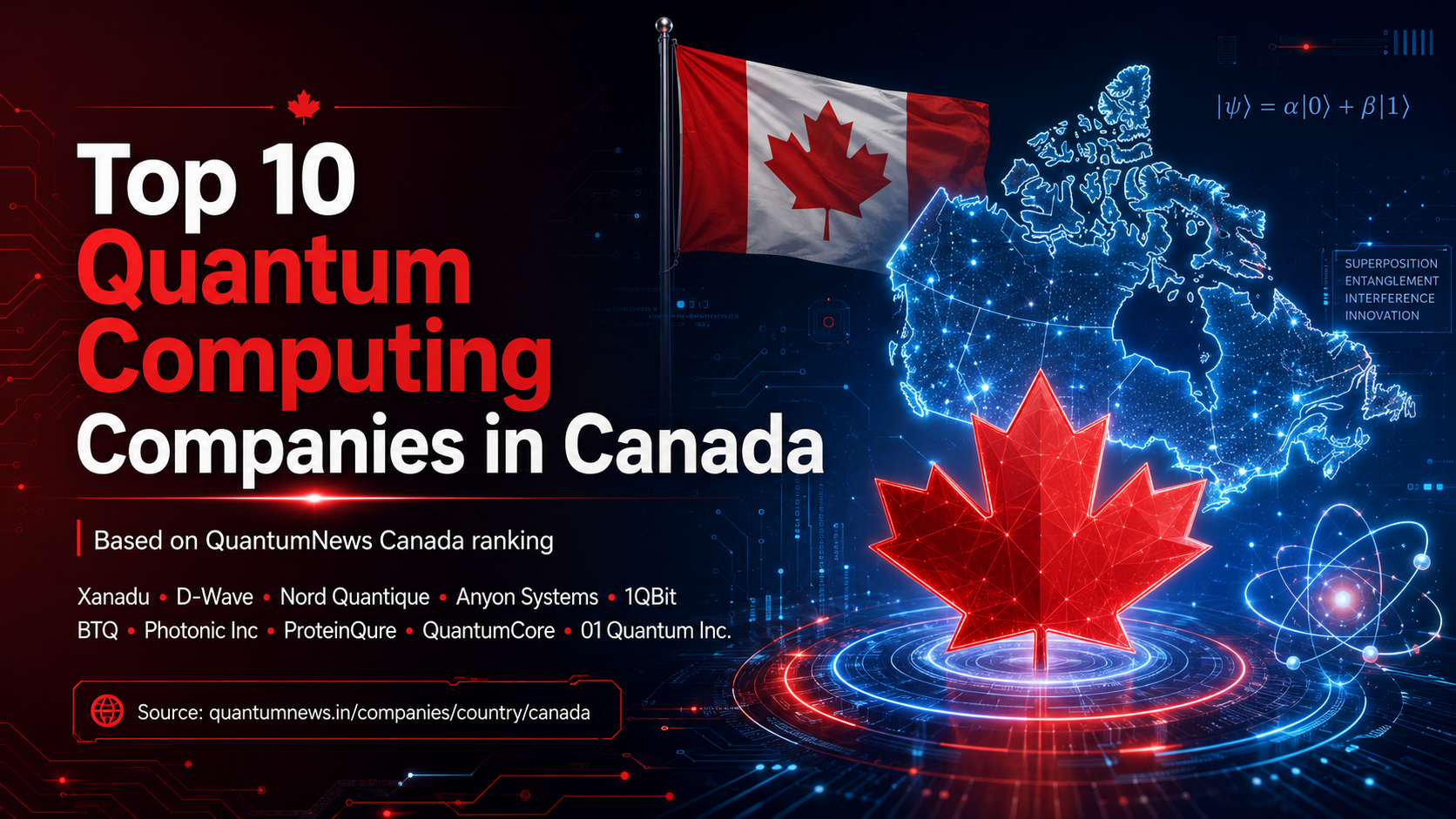
Canada’s quantum ecosystem demonstrates that the future of quantum technology will not be built around a single type of processor or one narrowly defined application. The companies included in this ranking cover nearly every major layer required for a functioning quantum economy.
Understand this faster with AI


According to QuantumNews, Canada ranks fourth among 52 countries covered by the platform. The country is home to 69 quantum companies and 13 research universities, with Toronto, Waterloo, Montreal and Vancouver emerging as its principal quantum innovation centres.
Of the 69 companies listed, 42 are focused on hardware, 26 on software and one on services. This breadth matters because Canada’s quantum industry is not dependent on a single technology or application.
Canadian companies are working across:
Photonic quantum computing
Quantum annealing
Superconducting processors
Quantum error correction
Quantum networking
Quantum software
Quantum drug discovery
Cryogenic components
Post-quantum cryptography
Based on the Quantum Scores and company profiles published by QuantumNews, here are the Top 10 Quantum Computing Companies in Canada.
Canada ecosystem page:
https://quantumnews.in/companies/country/canada
Complete Canada company directory:
https://quantumnews.in/companies?country=Canada
1. Xanadu — Quantum Score: 90/100
Company page:
https://quantumnews.in/company/xanadu
Headquarters: Toronto, Canada
Founded: 2016
Quantum focus: Hardware
Qubit technology: Photonic
Physical qubits: 216
Logical qubits: 12
Xanadu leads the QuantumNews Canada ranking with a Quantum Score of 90.
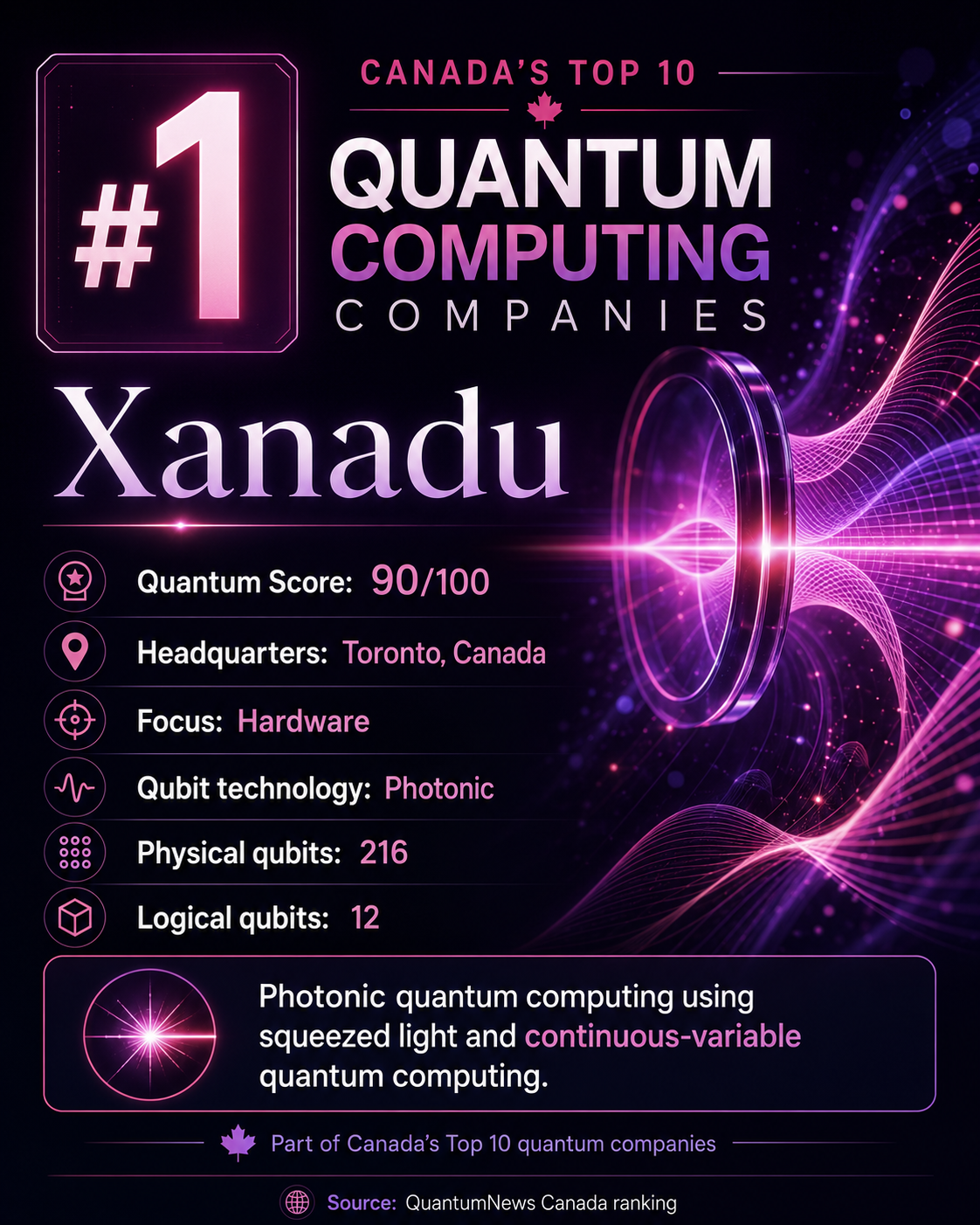
The Toronto-based company develops photonic quantum computers using squeezed light and continuous-variable quantum computing. It is also the creator of PennyLane, an open-source quantum machine-learning framework that connects quantum hardware with machine learning and hybrid quantum-classical development.
Xanadu became the first publicly listed pure-play photonic quantum computing company worldwide, trading under the symbol XNDU on Nasdaq and the Toronto Stock Exchange following its March 2026 public-market transaction.
The company’s technical progress includes the Borealis photonic processor, which demonstrated quantum computational advantage, and the Aurora photonic quantum system. Aurora was presented as a 35-chip processor connected through 13 kilometres of fibre and capable of generating 86 billion time-domain modes of entanglement.
The system also demonstrated real-time measurement-based error correction while operating at room temperature. This is important because photonic architectures may offer a path towards scalable quantum computing without requiring every part of the system to operate inside extremely cold cryogenic environments.
Xanadu has attracted backing from investors including Bessemer Venture Partners, Lakestar, Georgian, Real Ventures, Porsche Ventures and Lightspeed Venture Partners. Its research relationships include the Perimeter Institute, the University of Waterloo and McGill University.
With its combination of photonic hardware, logical-qubit development, open-source software and public-market access, Xanadu represents one of Canada’s most globally visible quantum technology companies.
2. D-Wave — Quantum Score: 75/100
Company page:
https://quantumnews.in/company/d-wave
Headquarters: Burnaby, British Columbia
Founded: 1999
Quantum focus: Hardware
Qubit technology: Quantum annealing
Physical qubits: 4,400
Stock: NYSE: QBTS
D-Wave ranks second with a Quantum Score of 75.
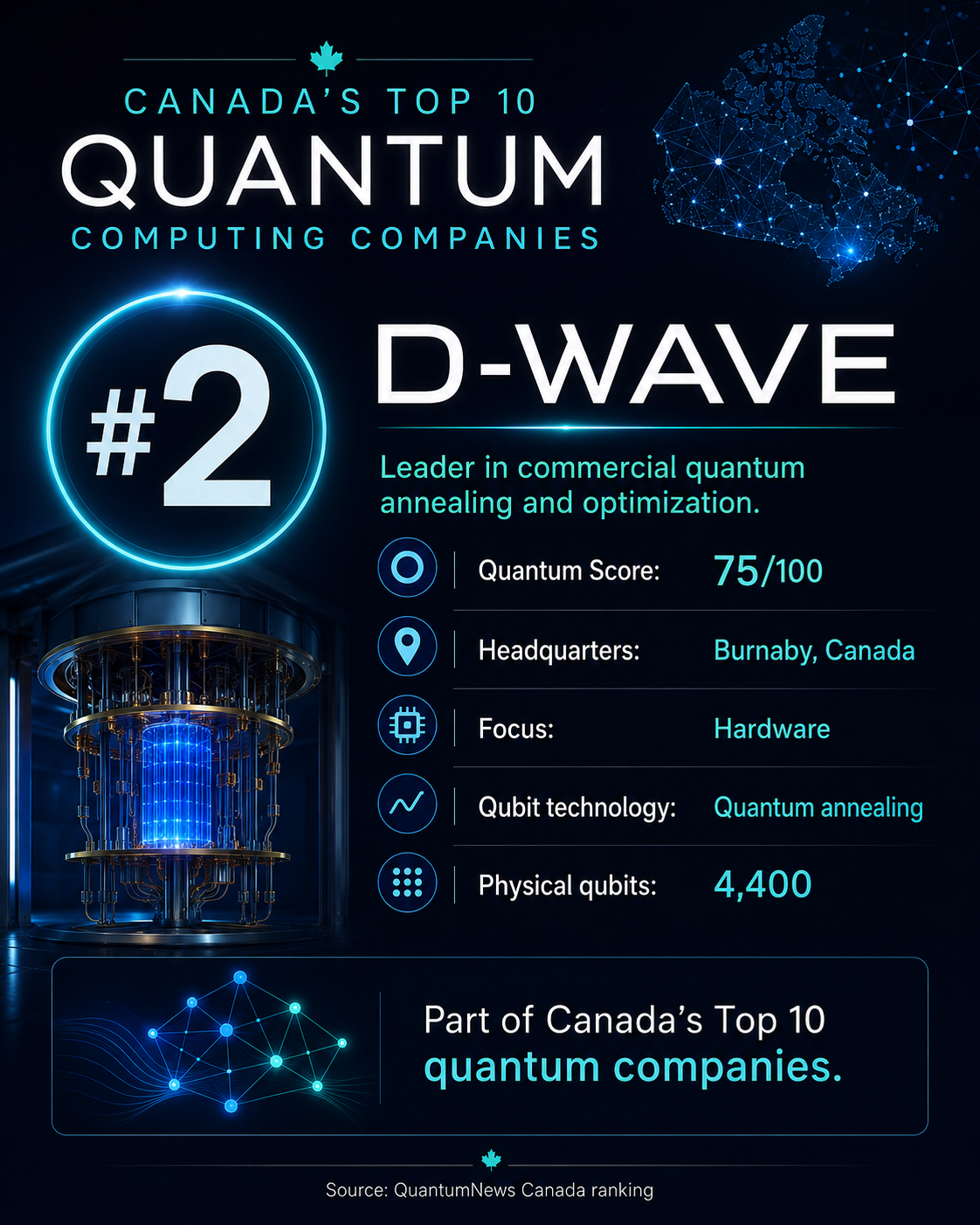
Founded in 1999, D-Wave is the longest-running commercial quantum computing company in the Canadian ranking and one of the world’s best-known developers of quantum annealing systems.
Quantum annealing is designed primarily for optimisation and sampling problems. Instead of operating in the same manner as a universal gate-based quantum computer, an annealing system searches for low-energy states that can represent solutions to complex optimisation challenges.
D-Wave’s Advantage2 system operates with 4,400 physical qubits. The company has built commercial activity around optimisation use cases in areas such as logistics, finance, manufacturing, drug discovery and defence.
The company’s named customers and collaborators include Volkswagen, Mastercard and BBVA. Its commercial agreements include quantum-computing-as-a-service arrangements and deployments of its Advantage2 system.
D-Wave has also expanded beyond its original annealing focus. Its acquisition of Quantum Circuits Inc. brought gate-model quantum technology into the company’s portfolio, creating a strategy that combines annealing and gate-based architectures.
In drug discovery, the PolarisQB QuADD platform has used D-Wave hardware to search extremely large molecular spaces. D-Wave has also reported work with defence companies on trajectory optimisation and other computationally difficult problems.
The company’s longevity, installed systems, customer relationships and dual hardware strategy make it one of the most commercially mature companies in Canada’s quantum ecosystem.
3. Nord Quantique — Quantum Score: 65/100
Company page:
https://quantumnews.in/company/nord-quantique
Headquarters: Sherbrooke, Quebec
Founded: 2020
Quantum focus: Hardware
Qubit technology: Superconducting bosonic/GKP
Physical qubits: 1
Logical qubits: 1
Nord Quantique ranks third with a Quantum Score of 65.
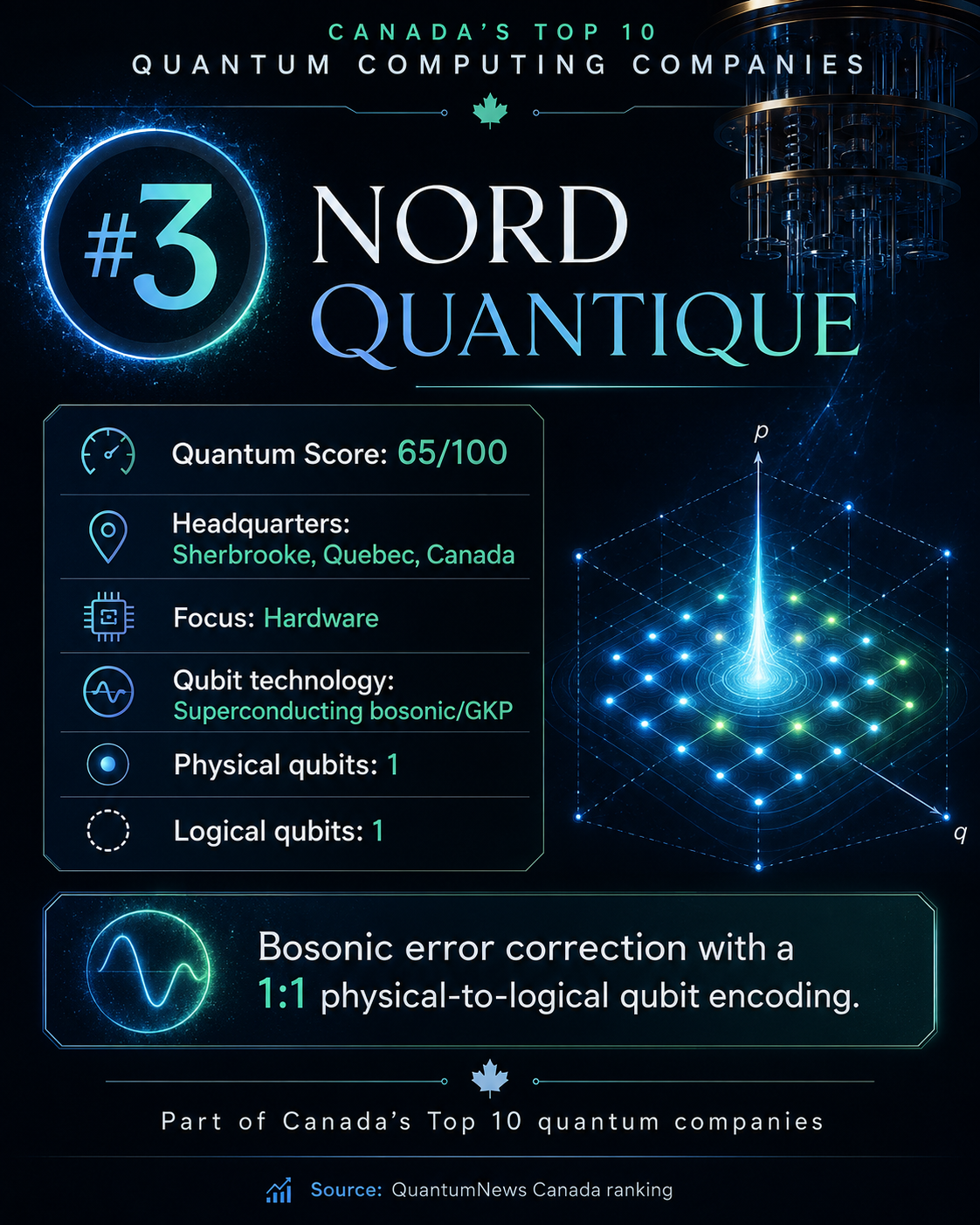
The company is developing fault-tolerant quantum computers based on superconducting hardware, bosonic codes and multimode encoding.
Quantum error correction is one of the most important challenges in the development of useful quantum computers. Qubits are extremely sensitive to environmental noise, imperfect control and measurement errors. Large-scale quantum systems will therefore require logical qubits capable of detecting and correcting faults.
Nord Quantique’s approach uses Gottesman–Kitaev–Preskill, or GKP, bosonic encoding. Its Tesseract code uses the natural redundancy available within quantum modes to improve error resilience.
The company demonstrated a one-to-one encoding ratio: one physical qubit supporting one logical qubit. This is significant because many conventional error-correction approaches require large numbers of physical qubits to construct a single logical qubit.
Nord Quantique aims to develop utility-scale machines with more than 100 logical qubits by 2029.
The company has received support through Canadian government programmes and was selected for the DARPA Quantum Benchmarking Initiative. Its progress through DARPA’s evaluation stages reflects the strategic importance of its approach to low-overhead quantum error correction.
Nord Quantique’s position near the top of the ranking shows that the quantum industry is increasingly evaluating companies not only by their physical-qubit counts, but also by the quality and efficiency of their logical-qubit architectures.
4. Anyon Systems — Quantum Score: 55/100
Company page:
https://quantumnews.in/company/anyon-systems
Headquarters: Montreal, Quebec
Founded: 2014
Quantum focus: Hardware
Qubit technology: Superconducting transmon
Physical qubits: 24
Anyon Systems ranks fourth with a Quantum Score of 55.
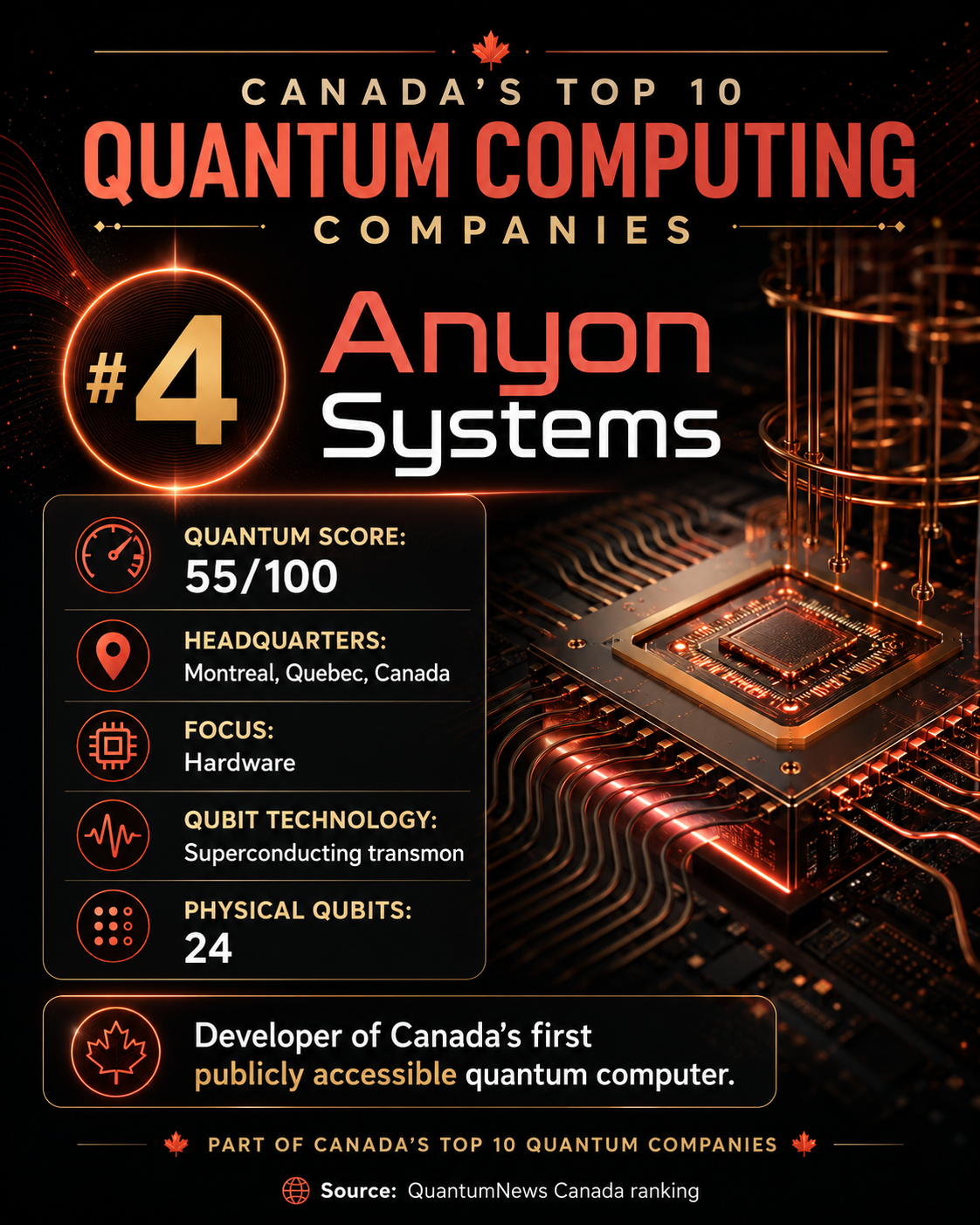
The company develops full-stack superconducting quantum computers, including processors, cryogenic systems, control electronics and supporting hardware.
Building a complete quantum computer requires substantially more than fabricating qubits. The system must include refrigeration, microwave control, calibration, packaging, measurement electronics and software capable of coordinating the complete hardware stack.
Anyon Systems addresses this broader systems-engineering challenge through in-house development and quantum nanofabrication capabilities associated with the C2MI facility.
In December 2025, the company launched MonarQ, a 24-qubit superconducting quantum computer installed at Calcul Québec. It became Canada’s first publicly accessible quantum computer.
MonarQ operates below 15 millikelvin and is listed with 99.8% single-qubit gate fidelity and 15-nanosecond gate times. It also integrates with NVIDIA CUDA-Q to support hybrid quantum-classical workflows.
Anyon Systems has received support through Canada’s Quantum Champions Program and maintains a research relationship with McGill University.
The company is important to Canada because it contributes domestic capability across quantum processor manufacturing, cryogenics, controls and complete system integration.
5. 1QBit — Quantum Score: 40/100
Company page:
https://quantumnews.in/company/1qbit
Headquarters: Vancouver, British Columbia
Founded: 2012
Quantum focus: Software
Technology: Hardware-agnostic quantum and quantum-inspired computing
1QBit ranks fifth with a Quantum Score of 40.
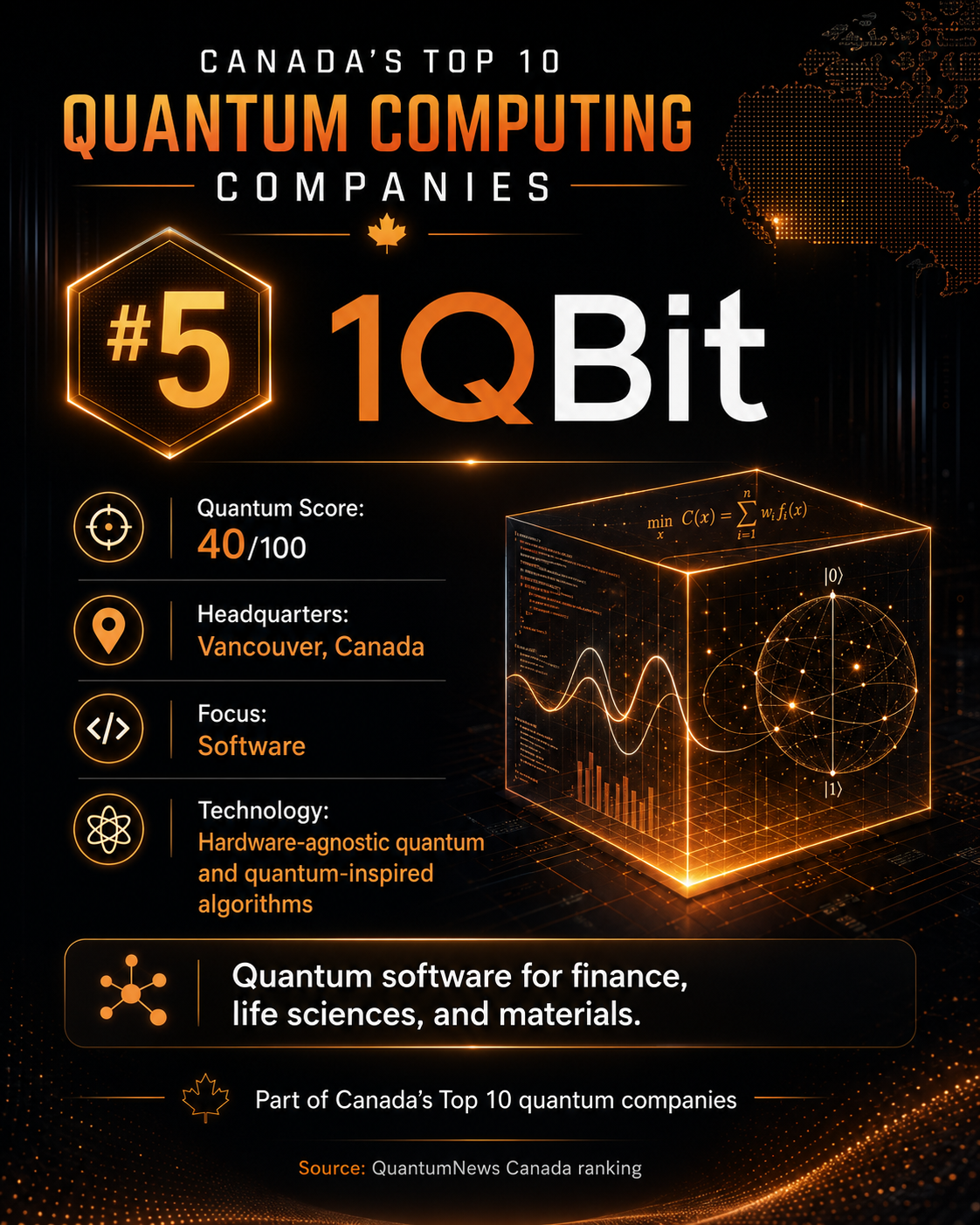
Founded in 2012, 1QBit was one of the world’s first companies dedicated specifically to quantum software.
The company develops hardware-agnostic quantum and quantum-inspired algorithms for applications in financial services, life sciences, materials and optimisation. Its platform has supported D-Wave systems, IBM quantum hardware and gate-model processors.
This hardware-independent approach is important because the quantum computing market remains technologically fragmented. Different processors use different qubit architectures, programming models, connectivity constraints and error characteristics.
Software companies such as 1QBit help organisations formulate business or scientific problems in ways that can be tested across multiple quantum and classical computing platforms.
The company’s HOPE, or Hyperparameter OPtimization Environment, supports optimisation benchmarking. 1QBit has also worked with companies and institutions including Dow Chemical, Biogen, Accenture and Microsoft Quantum.
The business later shifted towards an incubation model, producing companies including Synthesise and quantum chemistry company Good Chemistry.
In 2024, 1QBit was acquired by Terra Quantum and became part of the wider group.
Its place in the ranking highlights the importance of software, algorithms and application development within Canada’s broader hardware-heavy quantum ecosystem.
6. BTQ — Quantum Score: 40/100
Company page:
https://quantumnews.in/company/btq
Headquarters: Vancouver, British Columbia
Founded: 2021
Quantum focus: Post-quantum cryptography and security
Stock: Nasdaq: BTQ
BTQ Technologies ranks sixth with a Quantum Score of 40.
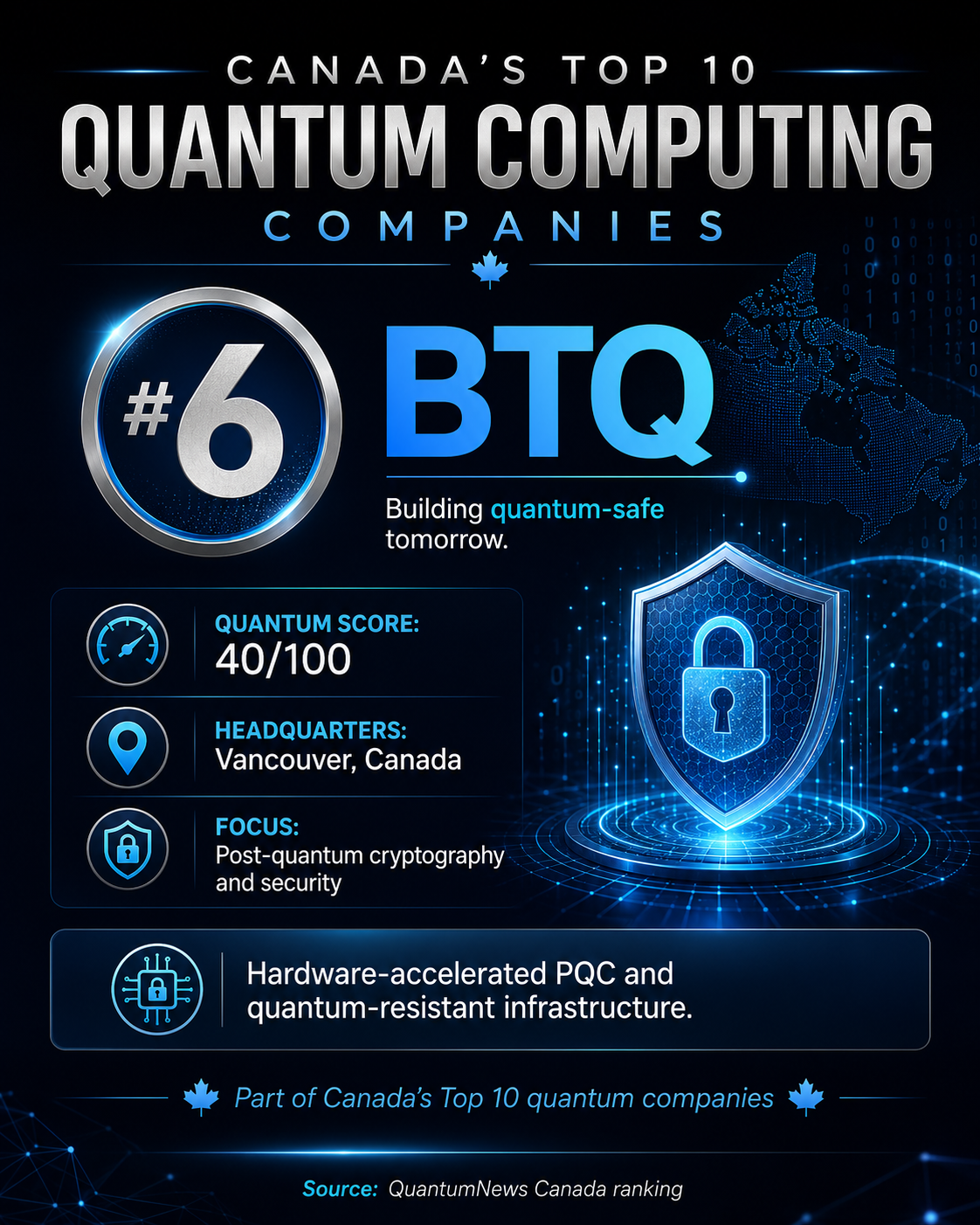
The company develops post-quantum cryptographic technologies and hardware-accelerated security systems for critical infrastructure, digital assets and large-scale networks.
Quantum computing creates a future risk for several public-key cryptographic systems currently used to protect communications, digital identities, financial transactions and blockchain networks.
BTQ’s work addresses this transition through quantum-resistant cryptography, semiconductor security and computing infrastructure.
The company acquired post-quantum cryptography assets from Radical Semiconductor, including the CASH cryptographic accelerator architecture. It also entered a strategic partnership with Korean semiconductor company ICTK to develop a Quantum Compute in Memory security chip.
BTQ launched Bitcoin Quantum Core, a quantum-resistant Bitcoin implementation that replaces conventional ECDSA signatures with the NIST-standardised ML-DSA algorithm.
The company also acquired QPerfect, bringing the MIMIQ quantum emulator into its QUREKA cloud platform. This expanded BTQ’s activities beyond cryptographic protection into quantum simulation and cloud-based development.
BTQ’s position in the ranking reflects the growing commercial urgency of post-quantum migration. Organisations need to identify vulnerable cryptography and begin implementing quantum-resistant alternatives before cryptographically relevant quantum computers become available.
7. Photonic Inc — Quantum Score: 40/100
Company page:
https://quantumnews.in/company/photonic-inc
Headquarters: Vancouver, British Columbia
Founded: 2016
Quantum focus: Hardware and quantum networking
Qubit technology: T-centre silicon spin-photon qubits
Photonic Inc ranks seventh with a Quantum Score of 40.
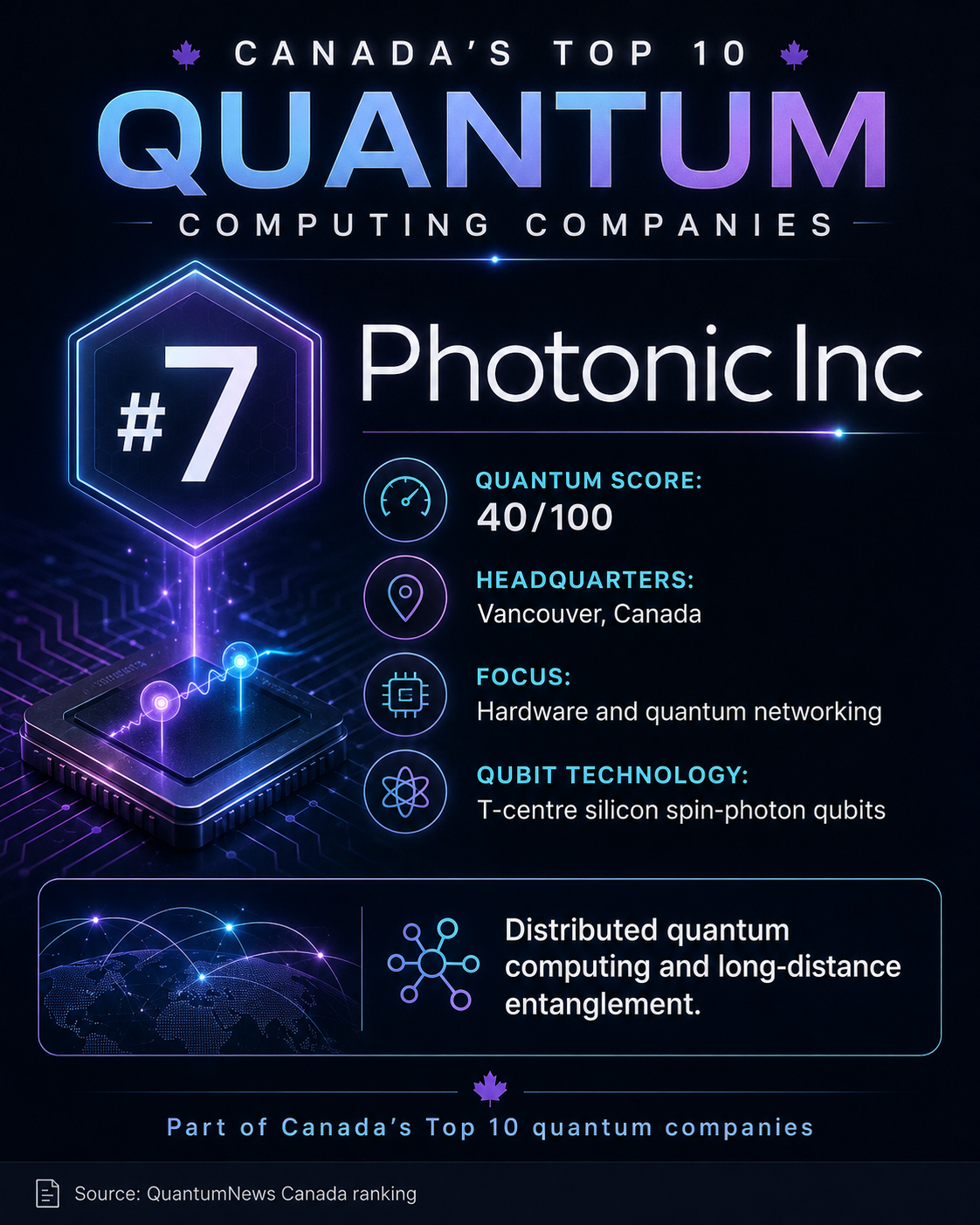
The company is developing silicon spin-photon quantum processors designed for distributed quantum computing and long-distance quantum networking.
Its T-centre architecture connects spin qubits with telecom-wavelength photons. The spin component can retain and process quantum information, while photons can transmit that information between processors over optical fibre.
This addresses one of the central questions in quantum computing: how to scale beyond the practical limits of a single processor.
Rather than attempting to place every qubit inside one machine, distributed quantum architectures could connect multiple processors through entanglement. In this model, quantum networking becomes part of the computing system itself.
Photonic reported quantum teleportation across 30 kilometres of commercial metropolitan fibre in partnership with TELUS. The company also integrates with Microsoft Azure Quantum and advanced to Stage B of DARPA’s Quantum Benchmarking Initiative.
It has attracted investment from organisations including Microsoft’s M12, Planet First Partners, BDC Capital, Inovia Capital, RBC, TELUS and Mubadala Capital.
Photonic represents an important intersection of quantum computing, semiconductor technology, optical communications and networking infrastructure.
8. ProteinQure — Quantum Score: 35/100
Company page:
https://quantumnews.in/company/proteinqure
Headquarters: Toronto, Canada
Founded: 2017
Quantum focus: Quantum software and drug discovery
Total funding: $15 million
ProteinQure ranks eighth with a Quantum Score of 35.
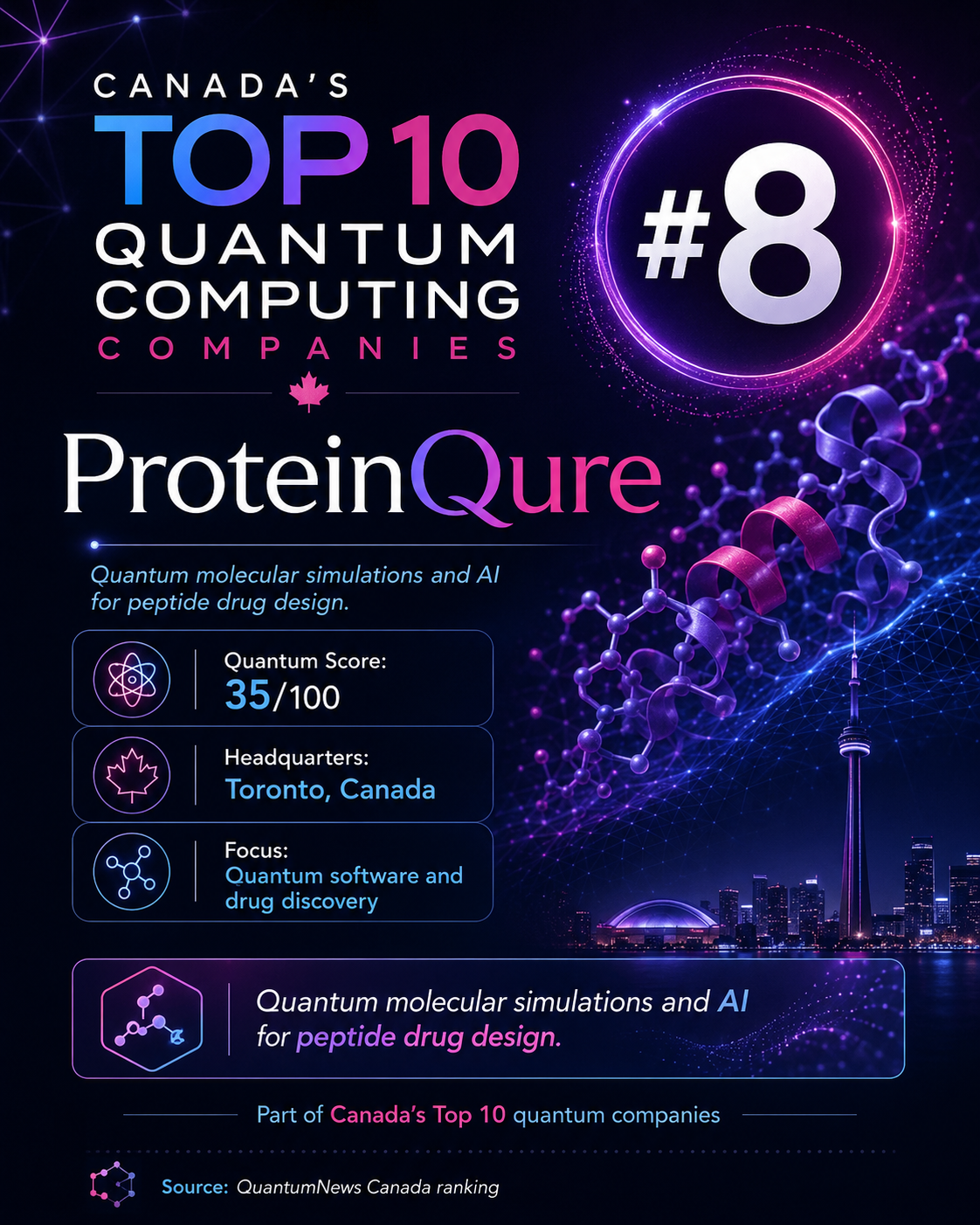
The company combines quantum-enhanced molecular simulation, artificial intelligence and classical machine learning to accelerate the discovery and development of peptide medicines.
Drug discovery requires researchers to understand how molecules, proteins and potential treatments interact. These interactions can become computationally difficult because biological systems contain large numbers of possible molecular configurations.
ProteinQure uses computational methods intended to model these interactions and identify promising drug candidates more efficiently.
The company has used D-Wave Advantage hardware as part of its quantum-enhanced workflow. Its approach combines quantum optimisation with classical machine-learning models rather than treating quantum computing as an isolated replacement for existing systems.
ProteinQure raised $11 million in Series A funding in 2025, bringing its total funding to $15 million.
The company also advanced PQ203, an AI-designed peptide-drug conjugate for triple-negative breast cancer, into a Phase 1 clinical trial at the Princess Margaret Cancer Centre in Toronto.
ProteinQure’s inclusion in the top 10 demonstrates that Canada’s quantum ecosystem extends beyond processor and infrastructure development. It also includes companies applying quantum methods to commercially and socially important areas such as healthcare and drug development.
9. QuantumCore — Quantum Score: 35/100
Company page:
https://quantumnews.in/company/quantumcore
Headquarters: Waterloo, Ontario
Founded: 2025
Quantum focus: Hardware components
Technology area: Cryogenic readout amplifiers
Total funding: $10.7 million
QuantumCore ranks ninth with a Quantum Score of 35.
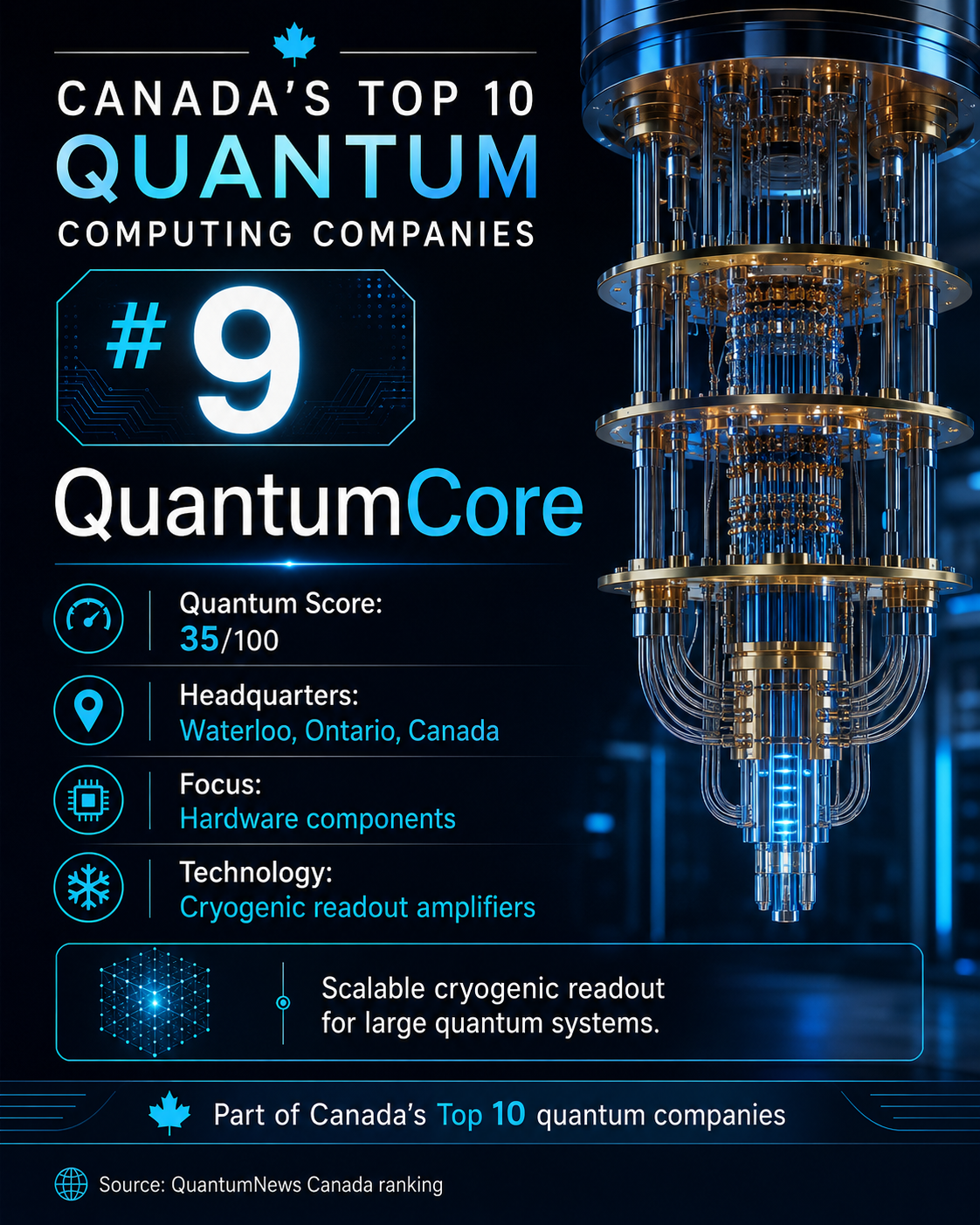
The company was spun out of the Institute for Quantum Computing at the University of Waterloo and develops scalable cryogenic readout amplifiers.
Readout is a critical part of quantum computing. After a quantum processor performs a computation, the system must measure the state of its qubits accurately and convert extremely weak quantum signals into information that conventional electronics can process.
As systems grow, the readout layer must handle increasingly large numbers of qubits without creating excessive wiring, heat, noise or power consumption inside the cryogenic environment.
QuantumCore is working on travelling-wave parametric amplifiers and related cryogenic components designed to address these scaling constraints.
The company raised $10.7 million through a combination of dilutive and non-dilutive funding and moved from university spinout to public listing within roughly six months.
It also partnered with the Institute for Quantum Computing on an NSERC-supported programme for travelling-wave parametric amplifier development.
QuantumCore’s inclusion illustrates the importance of specialised component suppliers. Useful quantum computers will depend not only on processor companies, but also on businesses developing amplifiers, control electronics, cryogenic systems, interconnects and measurement infrastructure.
10. 01 Quantum Inc. — Quantum Score: 30/100
Company page:
https://quantumnews.in/company/01-quantum-inc
Headquarters: Mississauga, Ontario
Founded: 1992
Quantum focus: Software and post-quantum cryptography
Stock: TSX-V: ONE.V
01 Quantum Inc. completes the Canadian top 10 with a Quantum Score of 30.
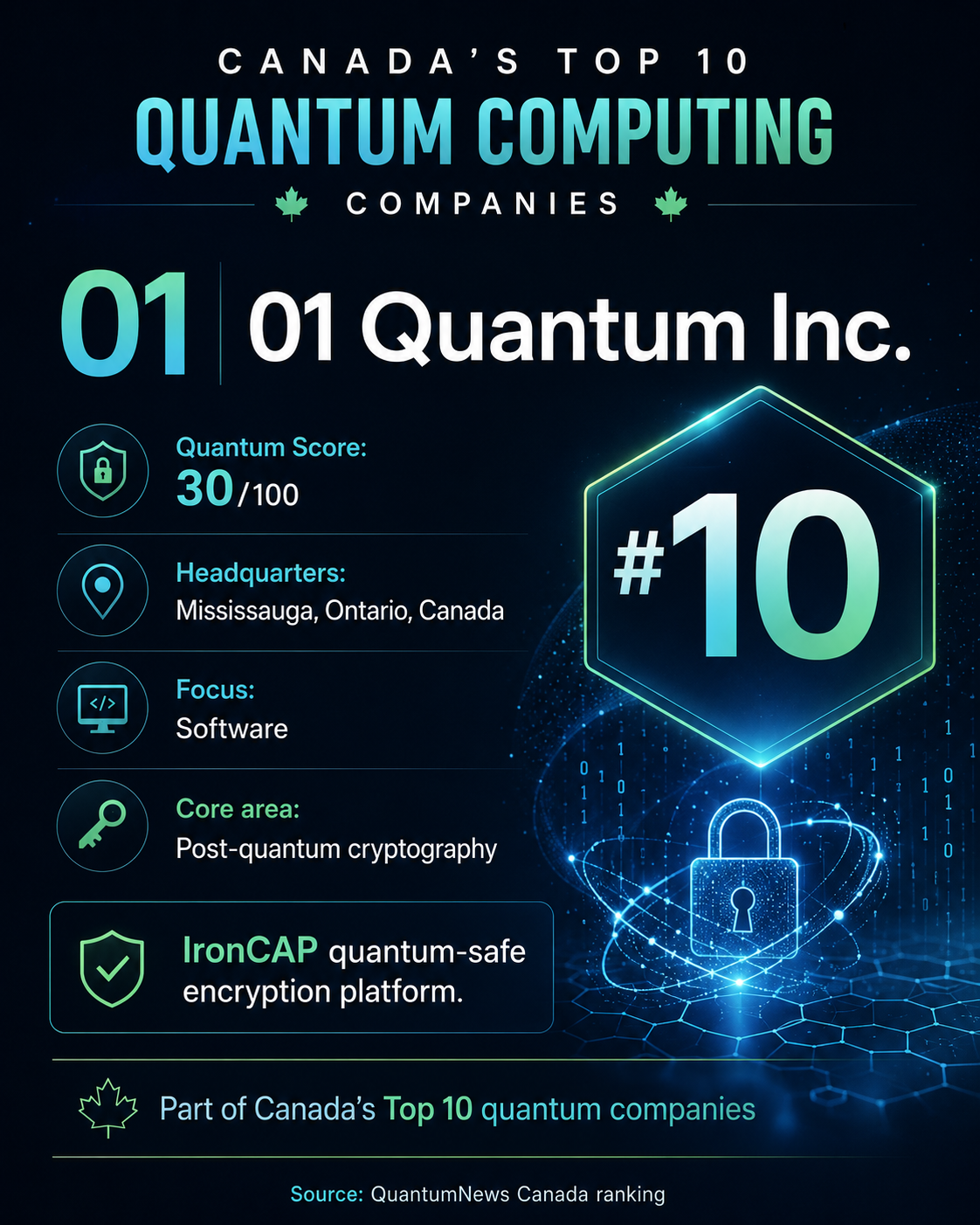
Formerly known as 01 Communique Laboratory Inc., the publicly traded cybersecurity company repositioned itself around quantum-safe security and adopted the 01 Quantum name in 2025.
Its main platform, IronCAP, is designed to protect data and communications against attacks from both classical and future quantum computers.
IronCAP incorporates NIST-standardised post-quantum algorithms, including ML-KEM, previously known as Kyber, and ML-DSA, previously known as Dilithium.
The company’s product portfolio includes IronCAP X for secure email, developer toolkits for integrating post-quantum cryptography and the IronCAP SCEP Gateway for enterprise certificate enrolment.
Its target customers include enterprises, government agencies, healthcare organisations and financial institutions that need to migrate sensitive systems towards quantum-resistant protection.
01 Quantum is also a founding member of the Post-Quantum Computing Alliance.
The company’s inclusion in the ranking demonstrates that post-quantum migration is becoming a practical product category rather than remaining only a theoretical cybersecurity concern.
What Canada’s Top 10 Reveals
Canada’s leading companies span almost every major layer of the emerging quantum economy:
Photonic quantum computing: Xanadu
Quantum annealing: D-Wave
Quantum error correction: Nord Quantique
Superconducting quantum systems: Anyon Systems
Quantum software: 1QBit
Post-quantum security: BTQ and 01 Quantum
Distributed quantum computing: Photonic Inc
Quantum drug discovery: ProteinQure
Cryogenic quantum components: QuantumCore
This breadth is one of Canada’s greatest strengths.
The country is not relying exclusively on one qubit architecture, one commercial application or one route to market. It has companies working on processors, logical qubits, networking, software, cybersecurity, healthcare applications and the specialised components required to operate quantum machines.
That diversity could prove particularly valuable as the industry matures.
A commercially useful quantum ecosystem will require more than high qubit counts. It will need:
Reliable logical qubits
Error-correction technologies
Quantum networking
Application software
Cryogenic control and readout components
Enterprise integration
Quantum-safe cybersecurity
Skilled researchers and engineers
Canada already has companies working across each of these areas.
Explore Canada’s complete quantum ecosystem:
https://quantumnews.in/companies/country/canada
View the full directory of Canadian companies:
https://quantumnews.in/companies?country=Canada
#QuantumComputing #QuantumTechnology #Canada #CanadianTech #QuantumNews #DeepTech #QuantumHardware #QuantumSoftware #QuantumSecurity #PostQuantumCryptography #QuantumNetworking #Photonics #QuantumAnnealing #QuantumErrorCorrection #DrugDiscovery
Tags
Source Information
Discussion
0 professional contributions
Sign in to join this professional discussion.
Be the first to add a constructive contribution.