India's National Quantum Mission

₹6,003 Crore Investment in Quantum Future (2024-2031)

Tracking India's ambitious quantum technology initiative across 4 thematic hubs and a growing startup ecosystem
₹6,003 Crore
Budget
($720 million)
2024-2031
Timeline
8 years
4
Thematic Hubs
Leading IITs & IISc
50-1000 Qubits
Target
Quantum computers
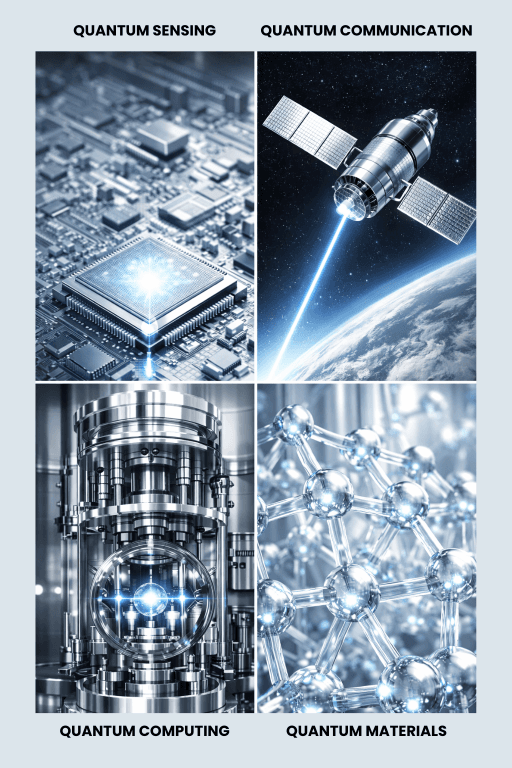
India NQM Pillars

Mission Objectives

Quantum Computing

Develop 50-1000 physical qubit quantum computers on superconducting and photonic platforms

Quantum Communication

Establish 2000 km satellite-based secure quantum communication network

Quantum Sensing

Develop atomic clocks with 10⁻¹⁵ precision for navigation and timing

Quantum Materials

Create topological materials and devices for quantum applications

Qubit Scale-Up Roadmap

India's phased approach to building quantum computers with increasing qubit counts

Phase 1

3 Years
2024-2027
20-50 Physical Qubits

Foundation building with initial quantum processors

  • Establish quantum computing infrastructure
  • Develop superconducting qubit fabrication
  • Build photonic quantum systems
  • Demonstrate basic quantum algorithms
⟳ In Progress

Phase 2

5 Years
2024-2029
50-100 Physical Qubits

Scaling up quantum systems and improving coherence

  • Scale qubit fabrication processes
  • Improve quantum error correction
  • Develop quantum software stack
  • Establish quantum cloud access
○ Planned

Phase 3

8 Years
2024-2031
50-1000 Physical Qubits

Full-scale quantum computers with practical applications

  • Achieve fault-tolerant quantum computing
  • Deploy commercial quantum systems
  • Integrate with HPC infrastructure
  • Enable quantum advantage applications
○ Planned

Thematic Hubs

Four leading research institutions driving India's quantum technology development

Startup Ecosystem

India's growing quantum technology startup landscape
Explore 5 Quantum Startups
Discover India's leading quantum technology companies
Faster-Than-Light Photons May Not Break the Rules of Cause and Effectquantum-computing

Faster-Than-Light Photons May Not Break the Rules of Cause and Effect

Scientists are increasingly investigating the implications of superluminal photon propagation arising from the Drummond-Hathrell effective action in quantum electrodynamics. Madhukar Deb, Jay Desai, and Diptimoy Ghosh, all from the Department of Physics at the Indian Institute of Science, Education and Research, Pune, have revisited the question of causality in curved spacetime using novel diagnostics. Their research establishes conditions under which this seemingly superluminal behaviour does not lead to the formation of closed causal curves, addressing a conceptually nontrivial problem in theoretical physics. By analysing both the global causal structure and applying flat-spacetime analyticity bounds to the photon commutator, the authors demonstrate causal consistency within the regime of validity of the Drummond-Hathrell effective theory for scenarios including circular photon orbits and two-black-hole geometries. The study centres on understanding whether the observed superluminality, where photons appear to travel faster than light, genuinely disrupts the established order of events. The investigation employs two independent methods to assess causal consistency. First, the team analysed the global causal structure of the effective optical metric governing photon propagation, establishing conditions under which it remains stably causal and prevents the formation of closed timelike curves. This analysis was performed for both a circular photon orbit within the Schwarzschild geometry and a linear trajectory in a two-black-hole spacetime. Secondly, researchers examined microcausality from a quantum field-theoretic perspective, treating gravity as a fixed, Lorentz-breaking field and applying flat-spacetime analyticity bounds to the photon commutator within the geometric-optics regime of the effective field theory. For the representative examples of a circular orbit in Schwarzschild spacetime and a linear trajectory in a two-black-hole geometry, the findings indicate

Quantum ZeitgeistLoading...0
Breaking ground on India’s quantum future - ibm.comquantum-computing

Breaking ground on India’s quantum future - ibm.com

Quantum ResearchBlogBreaking ground on India’s quantum futureConstruction begins on India’s Quantum Valley Tech Park as the nation grows its quantum education initiatives and prepares for its first IBM quantum computer.Date7 Feb 2026AuthorsAnupama RayRobert DavisTopicsCommunityNetworkShare this blogBlog summary: India has begun construction on the Quantum Valley Tech Park in Amaravati, the future home of the country’s first IBM quantum computer. The ground breaking arrives as a nationwide push to grow India’s quantum workforce is accelerating. For example, one free online quantum computing course co-created by IBM has already surpassed 168,000 enrollments for 2026. While construction is under way, tech park members will have access to IBM quantum computers over the cloud thanks to a collaboration between IBM and India’s Tata Consultancy Services (TCS). India takes a bold step toward scaling its quantum workforce this week as the Government of Andhra Pradesh, a State in southern India, begins construction on Quantum Valley Tech Park in the capital city of Amaravati. Quantum Valley Tech Park will soon host India’s first IBM quantum computer, and tech park members already enjoy access to IBM’s cloud-based quantum computers thanks to a partnership between IBM and India’s Tata Consultancy Services (TCS), first announced last spring. These initiatives are bringing renewed national focus to India’s ongoing efforts in quantum education and workforce development. According to a report published by the Government of India’s apex policy think tank NITI Aayog (National Institution for Transforming India) in December, India will need to train approximately 100,000 quantum developers to secure its place as a quantum computing leader in the 2030s, a decade that will be shaped by the emergence of large-scale, fault-tolerant quantum computing. The message is clear: India’s long-term competitiveness in quantum computing will hinge on the strength of its talent pipeline. “With Quantum

Google News – Quantum ComputingLoading...0

Mission Timeline (2024-2031)

2024
Mission Launch & Hub Establishment
✓ Completed
2025
Initial Infrastructure Setup
✓ Completed
2026
First Quantum Prototypes
⟳ In Progress
2027
50-Qubit Systems Demonstration
○ Planned
2028
Satellite QKD Testing
○ Planned
2029
100-Qubit Systems & Network Expansion
○ Planned
2030
Commercial Deployments Begin
○ Planned
2031
1000-Qubit Systems & Mission Completion
○ Planned