Quantum Communication Thematic Hub

Indian Institute of Technology Madras

Chennai, Tamil Nadu
Established 1959

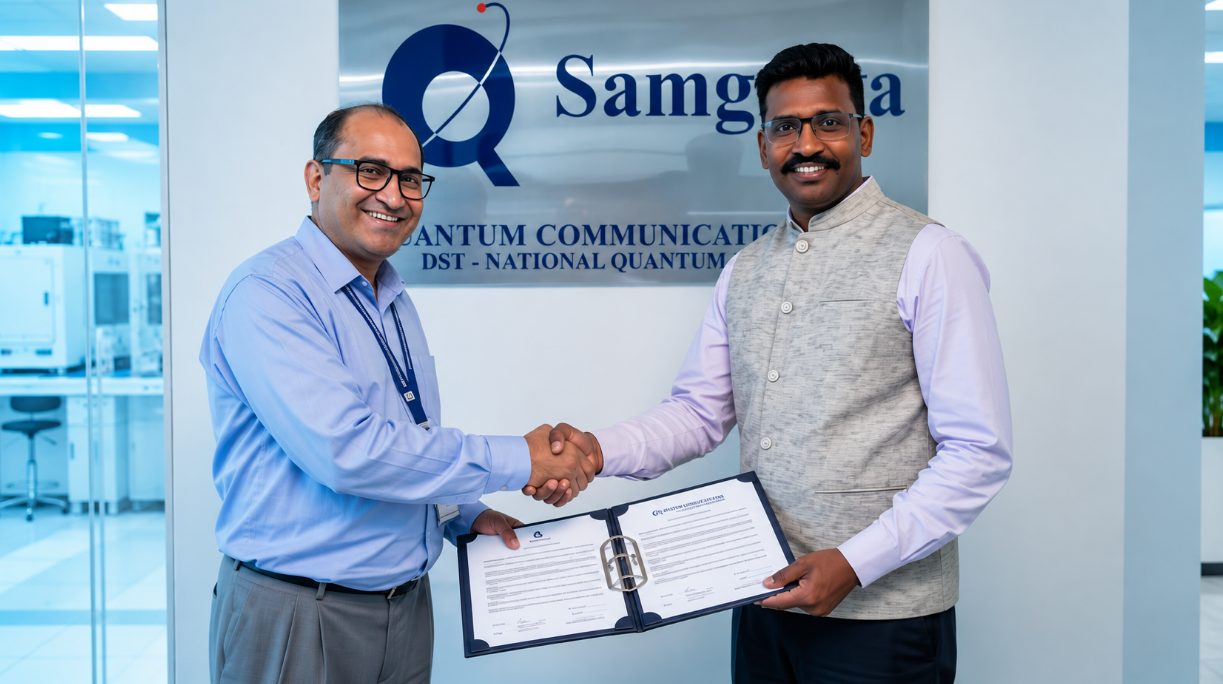
The Quantum Communication Hub at IIT Madras is building India's satellite-based quantum communication network with 2000 km range, establishing the "Samgnya" foundation for secure quantum communications. This hub will enable unhackable communication infrastructure for government and defense applications.

Research Focus

Satellite-based Quantum Key Distribution (QKD)Free-space quantum communicationQuantum network protocolsSamgnya quantum communication foundationQuantum-safe cryptography

Key Objectives

  • Develop 2000 km satellite-based QKD system
  • Establish ground-to-satellite quantum links
  • Create quantum network infrastructure
  • Build Samgnya quantum communication platform
  • Deploy quantum-safe cryptography standards

Key Research Areas

Satellite QKD

Space-to-ground quantum key distribution for long-range secure communications

Samgnya Platform

Indigenous quantum communication foundation for national security

Quantum Networks

Multi-node quantum communication networks and protocols

Key Achievements

Demonstrated free-space QKD over 100+ km
Developed Samgnya quantum communication protocols
Established partnerships with ISRO for satellite integration
Published 40+ papers in quantum communication

Infrastructure & Facilities

Free-space quantum communication testbed
Quantum network laboratory
Satellite ground station facilities
Quantum cryptography systems

QNu Labs and SRMIST Establish Quantum Communications Lab to Train Educator Cohortquantum-computing

QNu Labs and SRMIST Establish Quantum Communications Lab to Train Educator Cohort

QNu Labs and SRMIST Establish Quantum Communications Lab to Train Educator Cohort Indian quantum cybersecurity developer QNu Labs has partnered with the SRM Institute of Science and Technology (SRMIST) to establish a dedicated Quantum Communications Lab and train the university’s first certified cohort of faculty members in quantum communications. Supported by India’s National Quantum Mission (NQM) and the Department of Science and Technology (DST), the workforce initiative focuses on training educators to scale quantum communications coursework across higher education institutions. Incubated at the IIT Madras Research Park, QNu Labs equipped the new laboratory at SRMIST’s Kattankulathur campus with deployed, industry-grade hardware—the same quantum-safe technology utilized across national defense and banking infrastructure. Rather than relying on simulated software environments, the facility provides students and academic researchers with physical quantum key distribution (QKD) hardware and quantum-safe infrastructure to build, test, and benchmark real-world cryptographic applications. Through the QNu Academy framework, the initial faculty cohort underwent training and professional certification in quantum communications. By qualifying educators to deliver standardized quantum communications courses, the joint initiative aims to scale quantum education across SRMIST’s academic programs, creating a direct workforce pipeline of industry-ready quantum engineers and security specialists in alignment with national skilling objectives. The inaugural ceremony was attended by Dr. JBV Reddy (Head of the Quantum Technology Cell at NQM), Dr. C. Muthamizhchelvan (Vice Chancellor of SRMIST), Sunil Gupta (CEO and Co-founder of QNu Labs), and representatives from T-Hub. The lab deployment strengthens SRMIST’s quantum research infrastructure alongside its existing physical hardware initiatives under the National Quantum Mission. Review the announcement on Raksha Anirveda here. Aug

Quantum Computing ReportLoading...0
How 3 engineers are chasing India's quantum computing dream with an IIT professor - India Todayquantum-computing

How 3 engineers are chasing India's quantum computing dream with an IIT professor - India Today

How 3 engineers are chasing India's quantum computing dream with an IIT professor They spent over a decade designing chips, built and sold a semiconductor company, and then started from scratch to enter quantum computing. Now, Sujoy Chakravarty, Ravi Mehta and Biman Chattopadhyay are building one of India's few commercial quantum computers through their Bengaluru-based startup Quanfluence, that hopes to beat what Google has been chasing till now.AdvertisementHow IIT Madras is helping 3 engineers build India's room-temperature quantum computer (In photo: 1st from R: Sujoy Chakravarty, 2nd: Biman Chattopadhyay, 3rd: Ravi Mehta, 1st from L: Sandeep Goyal, 2nd: Anil Prabhakar, 3rd: Aditi Vaidya) (AI-enhanced image)India Today Education DeskNew Delhi,UPDATED: Jul 28, 2026 11:13 ISTWritten By: Princy ShuklaAfter years of working on semiconductor technology, Sujoy Chakravarty, Ravi Mehta and Biman Chattopadhyay had already achieved what many entrepreneurs dream of.Their semiconductor intellectual property company, Silicon and Beyond, was acquired by Synopsys, one of the world's leading electronic design automation companies, in 2018.For many founders, such an exit would have marked the end of a long entrepreneurial journey.advertisement❮❯ Read Full StoryFor this trio, it raised a new question: could India build a quantum computer that businesses around the world would actually use? The answer led them to start Quanfluence, a Bengaluru-based deep-tech company now working on commercial quantum computing technology.A SIX-MONTH DETOUR THAT CHANGED THEIR CAREERSThe move into quantum computing was not a natural next step. Before Quanfluence, the three engineers had spent over a decade together at Texas Instruments, working in chip design and semiconductor engineering. They understood hardware, but quantum computing was an entirely new world.After their exit from Silicon and Beyond, they spent nearly six months studying different quantum technologies.They explored multiple approa

Google News – Quantum ComputingLoading...0
QNu Labs Partners with SAGA Consultants to Expand Quantum-Safe Cybersecurity Infrastructure Internationallyquantum-computing

QNu Labs Partners with SAGA Consultants to Expand Quantum-Safe Cybersecurity Infrastructure Internationally

QNu Labs Partners with SAGA Consultants to Expand Quantum-Safe Cybersecurity Infrastructure Internationally Indian quantum cybersecurity pioneer QNu Labs has executed a strategic partnership agreement with U.S.-based technology consulting firm SAGA Consultants to accelerate the global distribution and deployment of quantum-safe security solutions. Orchestrated by QNu Labs CEO and Co-Founder Sunil Gupta and SAGA Consultants CEO Shamini Wijay, the commercial framework merges QNu Labs’ proprietary post-quantum cryptography (PQC) and secure communications stack with SAGA Consultants’ enterprise IT consulting networks and AI-powered business transformation pipelines. The alliance is structured to help commercial enterprises, government agencies, and critical infrastructure operators protect sensitive data repositories, satellite communications, and digital assets from emerging decryption threats. The enterprise-wide rollouts specifically target the Banking, Financial Services, and Insurance (BFSI) sector, where strict regulatory compliance timelines mandate an immediate migration toward quantum-resistant trust anchors. By combining mathematical PQC algorithms with hardware-driven Quantum Key Distribution (QKD) models, the joint architecture provides a hybrid defense matrix. This unified network layout enables financial institutions to replace vulnerable asymmetric encryption primitives with future-ready security frameworks, isolating transaction data pathways from intercept-and-harvest operations without disrupting active day-to-day business operations. The commercial agreement surfaces as QNu Labs—an investee company of India’s National Quantum Mission originally incubated at IIT Madras—continues to expand its multi-national footprint. Operating a specialized engineering corps of 160 physicists, mathematicians, and software developers, the firm has positioned its indigenous, military-grade cryptographic layers across defense, telecom, and utility networks globally. To c

Quantum Computing ReportLoading...0
Quantum Security Venture Pramatra Space Raises Pre-Seed Fundingquantum-computing

Quantum Security Venture Pramatra Space Raises Pre-Seed Funding

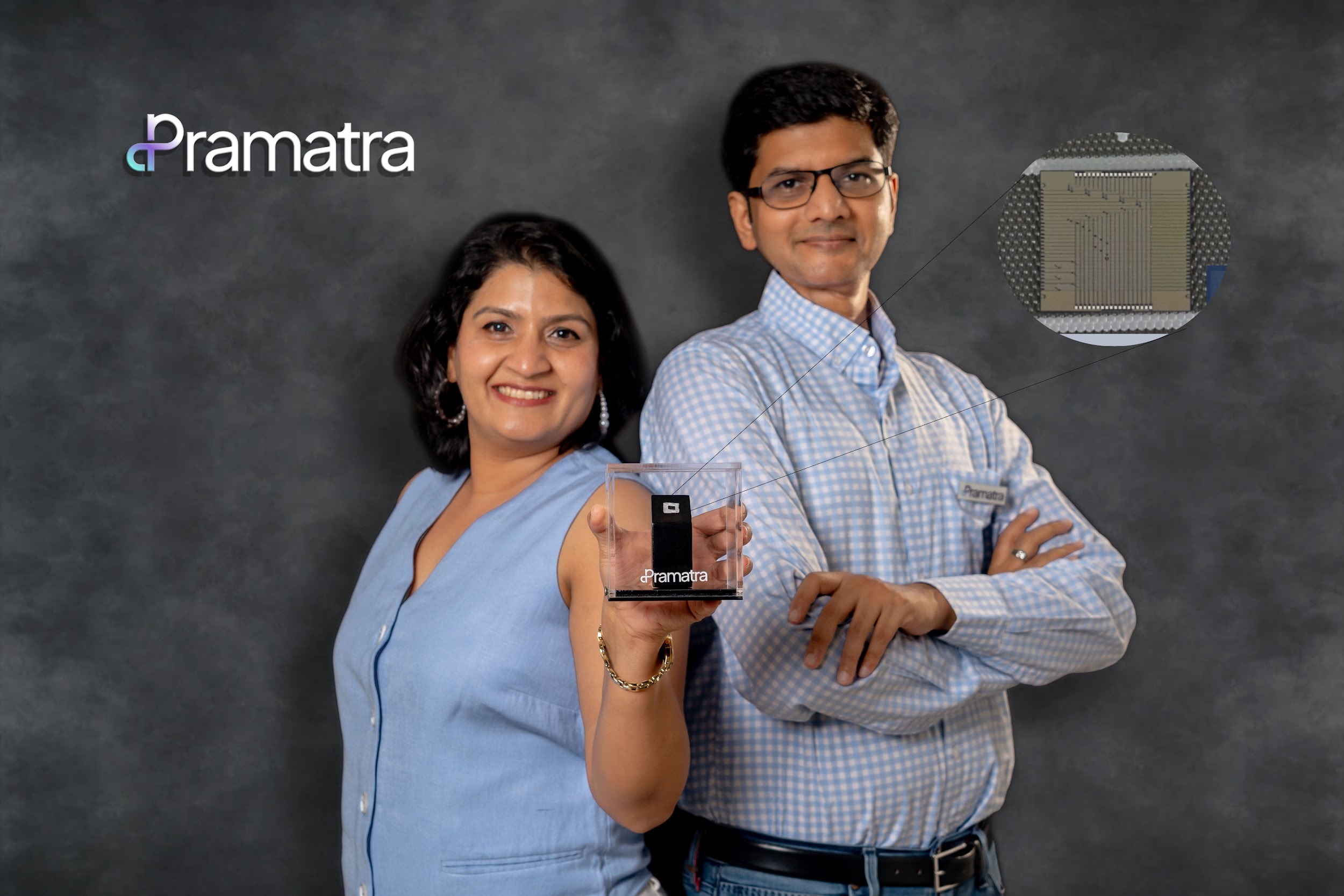
Insider Brief Bengaluru-based Pramatra Space raised an undisclosed pre-seed round led by Seafund Ventures to advance its quantum-secure satellite and terrestrial communications technology ahead of the emerging “Q-Day” cybersecurity threat. The company is developing quantum key distribution systems and has validated its proprietary photonics integrated circuit chip for entanglement-based quantum communications at IIT Madras, with an in-orbit demonstration mission planned for 2027. Investors said the funding reflects growing interest in sovereign deep-tech capabilities spanning quantum technologies, cybersecurity and space infrastructure in India. PRESS RELEASE — Pramatra Space, a Bengaluru-based quantum security venture, has raised an undisclosed pre-seed funding round led by Seafund Ventures. The round also saw participation from Rebalance, Magnivia Ventures with their partner Peaceful Progress Fund,  and from notable angel investors such as Awais Ahmed, Founder of Pixxel Space. Early investors include Techstars (US), Neel Mehta (Founder of Roh Ventures), Raghunath Das (Co-Founder & CEO of Almagest Space), and Bhavya Doshi (Director at KRISS Portfolio), with other angel investors. Founded in 2023 by Richa Hukumchand and Vinay Hukumchand, Bengaluru-based Pramatra Space is on a mission to make enterprises quantum-resilient before Q-Day.  Pramatra Space is building hybrid satellite & terrestrial systems for global quantum-secure communications. Its technologies use Quantum Key Distribution (QKD) to securely generate and distribute encryption keys for data centres and space infrastructure, acting as an additional security layer to prepare enterprises against evolving cyber threats.  They have achieved a key technical milestone of validation and testing their proprietary photonics integrated circuit (PIC) chip for quantum entanglement-based QKD at IIT Madras. The company has booked an in-orbit demonstration mission for its payload in partnership wi

Quantum DailyLoading...0
55,000 Indian University Students Into a Quantum Computing Course - The Quantum Insiderquantum-computing

55,000 Indian University Students Into a Quantum Computing Course - The Quantum Insider

The quantum workforce is getting a big boost, according to Indian media. Andhra Pradesh has enrolled 55,000 university students in a single, coordinated quantum computing course, a scale that signals how quickly India’s states are moving to build a workforce for a technology widely seen as strategic for science, industry and national competitiveness, according to reporting by The Hindu. The course — “Quantum Computing: Quantum Algorithms and Qiskit” — will begin January 19 and is being delivered through the National Programme on Technology Enhanced Learning, or NPTEL, as reported by The Hindu. Andhra Pradesh State Council of Higher Education organized the program and it is open to students across engineering and science institutions in the state. The initiative places Andhra Pradesh among the most aggressive subnational efforts globally to scale quantum education, moving the subject beyond elite research labs and into mainstream university classrooms. According to The Hindu, the course will be taught by faculty from IIT Madras and industry specialists associated with IBM Quantum. Instruction will focus on quantum algorithms, quantum error correction and programming using Qiskit, IBM’s open-source quantum software framework. Rather than emphasizing theory alone, the course is designed to provide hands-on experience with how quantum computers are programmed and stabilized against errors, an area that remains one of the biggest barriers to practical quantum systems, The Hindu reported. Students are being trained in tools and concepts aligned with those used by major technology firms and early-stage quantum startups. Faculty delivering the course include researchers and engineers from academia and industry with experience in both fundamental physics and applied quantum systems, according to The Hindu. Beyond coursework, APSCHE has linked the program to a set of incentives intended to connect high-performing students directly to India’s advanced research ecosystem.

Google News – Quantum ComputingLoading...0
55,000 Indian University Students Into a Quantum Computing Coursequantum-computing

55,000 Indian University Students Into a Quantum Computing Course

Insider Brief Andhra Pradesh has enrolled 55,000 university students in a single NPTEL quantum computing course, marking one of the largest coordinated quantum workforce training efforts undertaken by a state government. The program, organized by the Andhra Pradesh State Council of Higher Education, provides hands-on instruction in quantum algorithms, error correction, and Qiskit programming delivered by faculty from IIT Madras and IBM Quantum. Top-performing students will receive research exposure visits, internships, and placement support, aligning the initiative with India’s National Quantum Mission and the state’s push to build a global quantum talent pipeline. Photo by Big G Media on Unsplash The quantum workforce is getting a big boost, according to Indian media. Andhra Pradesh has enrolled 55,000 university students in a single, coordinated quantum computing course, a scale that signals how quickly India’s states are moving to build a workforce for a technology widely seen as strategic for science, industry and national competitiveness, according to reporting by The Hindu. The course — “Quantum Computing: Quantum Algorithms and Qiskit” — will begin January 19 and is being delivered through the National Programme on Technology Enhanced Learning, or NPTEL, as reported by The Hindu. Andhra Pradesh State Council of Higher Education organized the program and it is open to students across engineering and science institutions in the state. The initiative places Andhra Pradesh among the most aggressive subnational efforts globally to scale quantum education, moving the subject beyond elite research labs and into mainstream university classrooms. Practical Quantum Skills at Scale According to The Hindu, the course will be taught by faculty from IIT Madras and industry specialists associated with IBM Quantum. Instruction will focus on quantum algorithms, quantum error correction and programming using Qiskit, IBM’s open-source quantum software framework. Rather than emp

Quantum DailyLoading...0
Anyone from Andhra to win Nobel in quantum research will get Rs-100 crore award: CM Naidu - Moneycontrolresearch

Anyone from Andhra to win Nobel in quantum research will get Rs-100 crore award: CM Naidu - Moneycontrol

See the top gainers, losers, invest and get updated what's happening in the crypto market Discover the secret world of unlisted shares — analyse India's top pre-IPO companies and invest before they hit the markets Andhra Pradesh Chief Minister N Chandrababu Naidu on Tuesday promised a Rs 100-crore award to anybody who bags a Nobel Prize in quantum computing for their research carried out in Andhra Pradesh. Addressing thousands of students virtually, the chief minister underscored that the southern state will work towards developing next-generation skills, create thousands of high-value jobs, adopt a product-centric approach, develop all types of quantum computers and achieve a complete supply chain in manufacturing quantum computers. Andhra CM unveils vision to catapult Amaravati as top quantum computing hub He unveiled the state's Quantum Vision to catapult the greenfield capital city of Amaravati, which will host the Quantum Valley, as one of the world's top five quantum computing hubs. "Andhra Pradesh Vision: Quantum Valley in Amaravati. Andhra Pradesh will not follow, we will lead...everybody is prepared to produce quantum computers in Amaravati. Almost all 80 per cent or 85 per cent component partners are ready," said Naidu. Within two years, the quantum computers will be produced in Amaravati, and added that if anybody wants to launch any knowledge company or technology, they have to come to Amaravati, the CM expressed confidence. Moreover, he advised students to shun traditional thinking in favour of innovation and a product-based future. The virtual event was attended by representatives of leading technology firms, the directors of IIT Madras and IIT Tirupati, and thousands of technology students. Addressing the gathering, the Chief Minister underscored the significance of the announcement, pointing out that the monetary component of the actual Nobel Prize is far smaller than the reward now being offered by the state.

Google News – Quantum ComputingLoading...0