
Top 10 Quantum Computing Companies in the United Kingdom — Ranked by QuantumNews
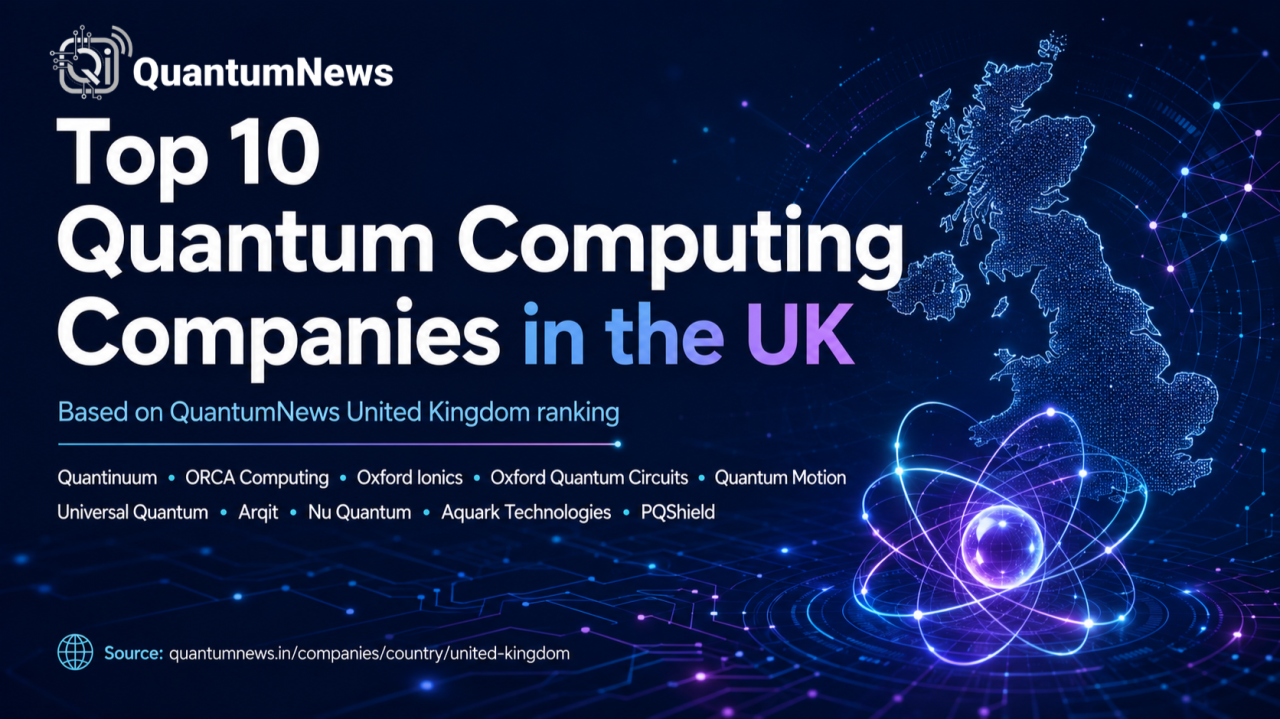
The United Kingdom’s quantum ecosystem matters because it combines several competing and complementary technology pathways rather than relying on a single type of quantum computer. Its leading companies are developing trapped-ion, photonic, superconducting and silicon-spin processors alongside quantum networking, sensing and post-quantum security.
Understand this faster with AI


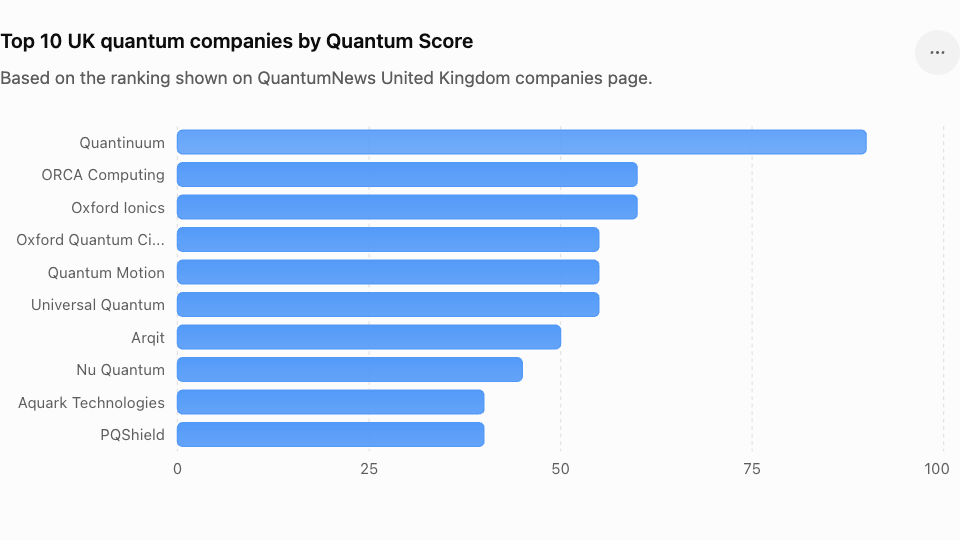
Based on the QuantumNews United Kingdom companies page, which lists 112 UK companies ranked by Quantum Score, here are the top 10 quantum computing companies in the UK.
Source page: https://quantumnews.in/companies/country/united-kingdom
- Quantinuum Company link: https://quantumnews.in/company/quantinuum Quantum Score: 90 Headquarters: Cambridge, United Kingdom Quantum focus: Hardware Qubit technology: Ion-trap
Quantinuum is ranked number one on the QuantumNews UK company list, with a Quantum Score of 90. The company is positioned as one of the strongest quantum computing players in the UK ecosystem, combining hardware, quantum software, quantum algorithms, and quantum cryptography.
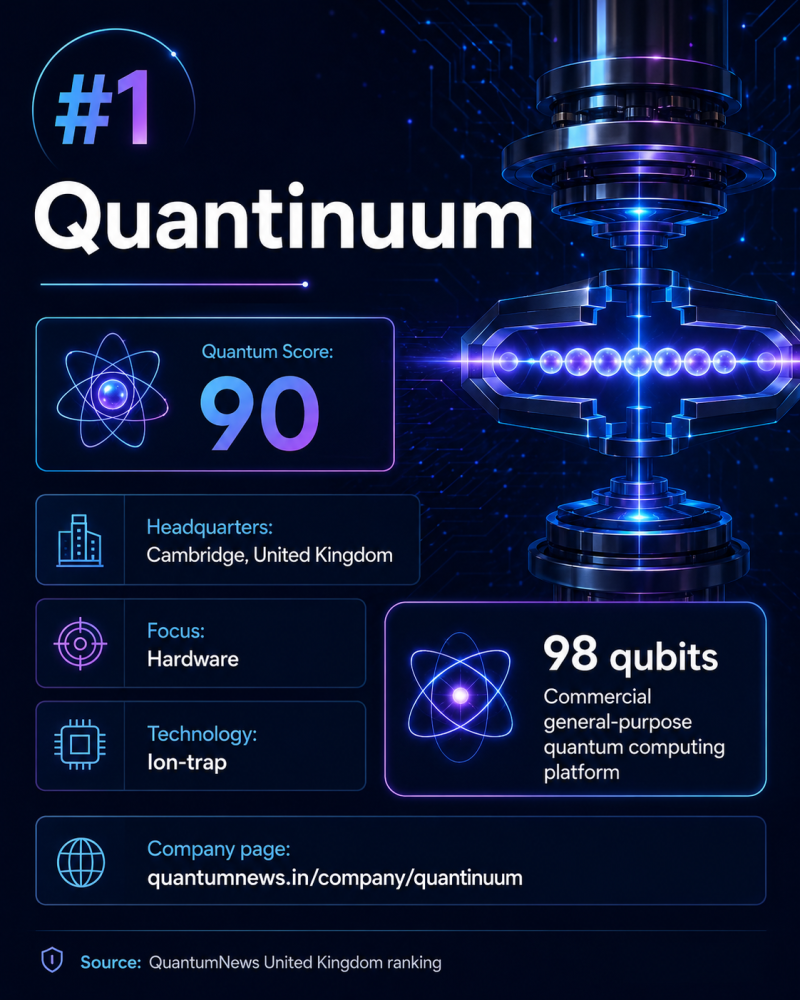
According to its QuantumNews profile, Quantinuum was formed through the merger of Honeywell Quantum Solutions and Cambridge Quantum. The company is pursuing a universal fault-tolerant quantum computer and describes its hardware as a highly accurate commercial general-purpose quantum computer. Its Helios system is listed with 98 physical qubits and 48 logical qubits, along with a 99.921% two-qubit gate fidelity.
What makes Quantinuum important is that it is not just a research-stage name in quantum. Its profile includes commercial momentum, funding history, investor backing, application areas such as drug discovery, materials science, and cybersecurity, and a public-market presence through NASDAQ ticker QNT. In the UK ranking, it stands clearly ahead of the rest of the field by Quantum Score.
For anyone studying the UK quantum ecosystem, Quantinuum is the anchor company to begin with because it represents the high end of the country’s quantum hardware ambition: scalable ion-trap systems, logical qubits, error correction maturity, and a strong commercial narrative.
- ORCA Computing Company link: https://quantumnews.in/company/orca-computing Quantum Score: 60 Headquarters: London, United Kingdom Quantum focus: Hardware Qubit technology: Photonic
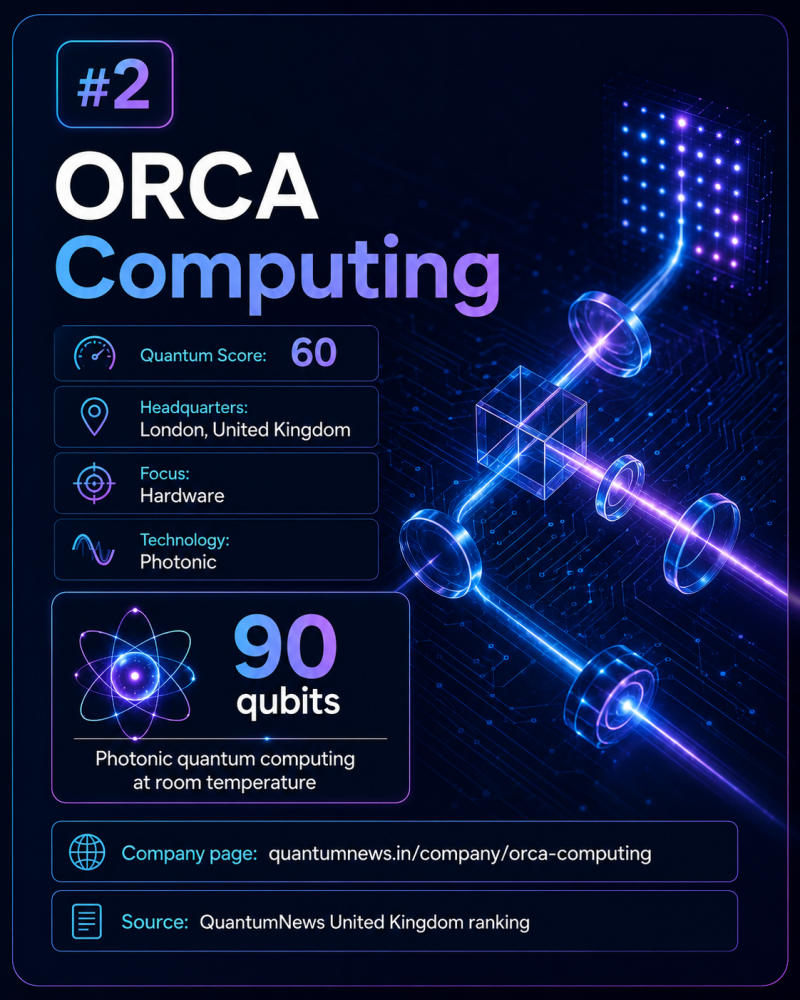
ORCA Computing is one of the most prominent UK companies working on photonic quantum computing. Its QuantumNews profile describes it as a UK-based company building room-temperature quantum memory systems and quantum computers. ORCA uses time-bin encoded photons stored in quantum memory loops, with the goal of enabling quantum-optical computing at room temperature using telecom-compatible photons.
This is an important distinction. While many quantum hardware approaches depend on cryogenic environments or complex ion-trap systems, ORCA’s positioning is centered on photonics, quantum memory, and practical system deployment. The profile lists 90 physical qubits and notes its PT Series systems, including PT-1 and PT-2, with use cases across hybrid machine learning, generative AI workloads, quantum networking, sensing, and industrial AI.
ORCA’s profile also highlights partnerships and deployments involving organizations such as BT, the UK MoD, DSTL, the UK National Quantum Computing Centre, Vodafone, Toyota, and Digital Realty. Its applications include quantum cloud, optimization, and quantum machine learning.
In the UK quantum landscape, ORCA Computing stands out because it is pushing a photonic route to quantum computing that is deeply connected to real infrastructure: data centers, telecom networks, AI workloads, and quantum-classical integration.
- Oxford Ionics Company link: https://quantumnews.in/company/oxford-ionics Quantum Score: 60 Headquarters: Oxford, United Kingdom Quantum focus: Hardware Qubit technology: Ion-trap
Oxford Ionics is ranked alongside ORCA Computing with a Quantum Score of 60. Its QuantumNews profile describes it as a UK-based quantum computing company that built trapped-ion technology on standard semiconductor chips using Electronic Qubit Control, or EQC.
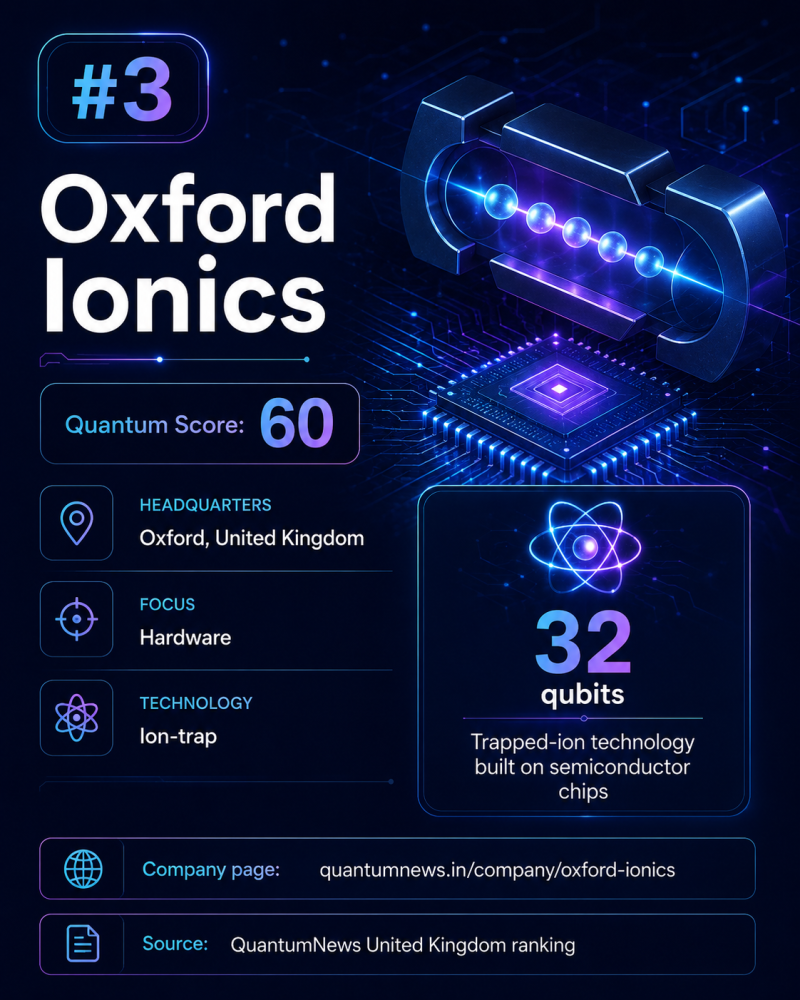
The company’s story is especially significant because it connects two important directions in quantum hardware: trapped-ion performance and semiconductor-style scalability. Oxford Ionics is listed with 32 physical qubits and a 99.97% two-qubit gate fidelity. Its profile says the company achieved world-record gate fidelities and was acquired by IonQ for $1.075 billion in September 2025.
The profile also notes that Oxford Ionics now operates as an IonQ subsidiary in Oxford and that its 32-qubit technology is being integrated into IonQ’s broader quantum computing platform. Before the acquisition, it was selected for DARPA’s Quantum Benchmarking Initiative, joined the UK Quantum Missions Pilot, installed a quantum computer at the UK National Quantum Computing Centre, and partnered with Iceberg Quantum on fault-tolerant computing.
Oxford Ionics is important because it represents a deep-tech UK quantum success story: university spinout, semiconductor-compatible trapped-ion architecture, high gate fidelity, and a major acquisition pathway.
- Oxford Quantum Circuits Company link: https://quantumnews.in/company/oxford-quantum-circuits Quantum Score: 55 Headquarters: Reading, United Kingdom Quantum focus: Hardware Qubit technology: Superconducting
Oxford Quantum Circuits, also known as OQC, is one of the UK’s leading superconducting quantum computing companies. Its QuantumNews profile describes the company as building superconducting processors using Coaxmon and Dimon dual-rail qubit architectures.

OQC is listed with 35 physical qubits. Its GENESIS system uses the dual-rail Dimon architecture, which the profile says is designed to reduce error-correction overhead. The company’s systems are accessible through AWS Braket and its own cloud platform, which is certified to ISO/IEC 27001:2022.
The profile also highlights OQC’s Quantum-AI data centers in New York City, London, and Tokyo, each deploying GENESIS processors alongside NVIDIA GH200 Grace Hopper GPUs. It also mentions OQC’s participation in NVIDIA’s NVQLink program and its role as a co-founder of the Quantum Datacenter Alliance with Cisco, NTT DATA, Nu Quantum, QphoX, Quantinuum, and QuEra.
OQC is important because it connects quantum hardware with cloud access, data center infrastructure, enterprise deployment, and hybrid quantum-AI workflows. Among UK quantum companies, it is one of the clearest examples of superconducting quantum computing moving toward operational infrastructure.
- Quantum Motion Company link: https://quantumnews.in/company/quantum-motion Quantum Score: 55 Headquarters: Oxford, United Kingdom Quantum focus: Hardware Qubit technology: CMOS-compatible silicon spin qubits
Quantum Motion is another major UK hardware company, ranked with a Quantum Score of 55. Its QuantumNews profile describes it as a quantum computing company founded out of Oxford and UCL, focused on silicon CMOS quantum computing.

This is a powerful direction because CMOS compatibility suggests a path toward using established semiconductor manufacturing methods for quantum hardware. Quantum Motion is listed with 6 physical qubits and 99% two-qubit gate fidelity. The profile says the company delivered the UK’s first full-stack silicon CMOS quantum computer to the National Quantum Computing Centre in September 2025.
The profile also highlights its 300mm wafer-based system, a 1,024 quantum dot array validated in under five minutes, compatibility with Qiskit and Cirq, and partnerships involving GlobalFoundries, ORCA Computing, Riverlane, and Goldman Sachs. It also notes work on options pricing quantum algorithms and silicon spin qubit readout.
Quantum Motion is important because it is taking a semiconductor-first view of quantum computing. If scalable quantum systems eventually need manufacturing discipline, chip integration, and compatibility with existing fabrication methods, companies like Quantum Motion could become central to the long-term quantum hardware race.
- Universal Quantum Company link: https://quantumnews.in/company/universal-quantum Quantum Score: 55 Headquarters: Brighton, United Kingdom Quantum focus: Hardware Qubit technology: Trapped ion, microwave
Universal Quantum is ranked with a Quantum Score of 55 and is focused on trapped-ion quantum computers using a quantum charge-coupled device architecture. Its QuantumNews profile says the company was founded by Winfried Hensinger from the University of Sussex.

Universal Quantum is listed with 64 physical qubits. The company’s profile highlights a 67 million euro contract from the German Aerospace Center, described on the profile as the largest EU government investment for quantum technology research. Under that contract, Universal Quantum is building two systems in Germany: a single-chip quantum computer with an electronic chip and a multi-chip system with up to 100 qubits.
Its profile also mentions the company’s first commercial ASIC chip for trapped-ion iQPUs, UQConnect for qubit transfer between chip modules, UQLogic for microwave qubit control, and a partnership with TUHH aimed at scaling toward 100,000 physical qubits. Other listed partnerships include Rolls-Royce and the German Aerospace Center.
Universal Quantum is important because it is focused on modularity and scale. Its approach is not just about demonstrating qubits, but about creating trapped-ion systems that can connect, control, and scale across chip modules.
- Arqit Company link: https://quantumnews.in/company/arqit Quantum Score: 50 Headquarters: London, United Kingdom Quantum focus: Hardware Stock: NASDAQ: ARQQ
Arqit brings a different angle to the UK quantum ecosystem. While many top companies on this list are focused on quantum processors, Arqit’s QuantumNews profile focuses on quantum-safe encryption and symmetric key agreement technology.

The company is listed as serving sectors including post-quantum cryptography, quantum cryptography, quantum consulting, and quantum software. Its profile says Arqit develops symmetric key agreement technology for quantum-safe encryption, with a focus on telecom, government, and defense sectors.
Arqit’s profile highlights commercial activity including a DoD contract, a partnership with Intel for CSfC-compliant mobile communications, a three-year agreement with a Tier 1 network operator covering 32 countries, Fabric Networks taking a commercial license, and NCSC selecting Arqit for UK post-quantum cryptography migrations.
The company also launched SKA Central Controller for managed service providers and Encryption Intelligence for cryptographic discovery, post-quantum migration, risk exposure, migration planning, and continuous monitoring.
Arqit is important because the quantum transition is not only about building quantum computers. It is also about preparing existing digital infrastructure for a future where today’s cryptographic systems may need to be replaced or upgraded.
- Nu Quantum Company link: https://quantumnews.in/company/nu-quantum Quantum Score: 45 Headquarters: London, United Kingdom Quantum focus: Hardware Technology area: Quantum networking and photonics
Nu Quantum is one of the most interesting companies on the list because it is not simply building another quantum processor. Its QuantumNews profile describes it as a UK quantum networking company founded out of Cambridge University, building datacenter-compatible quantum networking infrastructure.

Its core product is described as the Entanglement Fabric, a modular photonic layer designed to interconnect quantum processors for distributed quantum computing. The profile also describes its Quantum Networking Unit, or QNU, as delivering 99.7% entanglement fidelity with 300ns control latency, enabling quantum links between quantum processing units in data centers.
Nu Quantum’s profile says it opened Europe’s first industrial trapped-ion quantum networking laboratory in Cambridge in February 2026. It also co-founded the Quantum Datacenter Alliance with Cisco, NTT DATA, OQC, QphoX, Quantinuum, and QuEra. The profile lists sectors including quantum networking, quantum communications, quantum photonics, and quantum hardware.
Nu Quantum is important because scaling quantum computing may require connecting multiple quantum processors, not just making one processor bigger. If distributed quantum computing becomes a major architecture, quantum networking companies like Nu Quantum could become critical infrastructure providers.
- Aquark Technologies Company link: https://quantumnews.in/company/aquark-technologies Quantum Score: 40 Headquarters: Southampton, United Kingdom Quantum focus: Hardware Technology area: Quantum sensing
Aquark Technologies adds quantum sensing to the UK top 10. Its QuantumNews profile describes it as a UK National Quantum Technologies Programme spinout focused on high-precision measurement and quantum sensing.

The company develops portable quantum sensors for navigation, timing, and gravimetry applications across defense, aerospace, and industrial sectors. Its profile also highlights that Aquark has demonstrated quantum sensing at sea in partnership with the Royal Navy.
The profile mentions the AQuest cold-atom sensor trial on HMS Pursuer, where the company achieved continuous trapping of cold atoms on a Royal Navy vessel. It also notes a later underwater cold-atom trapping demonstration aboard the RRS Sir David Attenborough as part of oceanographic research. Aquark’s listed application areas are navigation, timing, and gravimetry.
Aquark Technologies is important because quantum technologies are not limited to computing. Quantum sensing may become one of the earlier commercially useful parts of the quantum industry, especially in navigation, defense, aerospace, industrial measurement, and environments where GPS or traditional sensing systems have limitations.
- PQShield Company link: https://quantumnews.in/company/pqshield Quantum Score: 40 Headquarters: Oxford, United Kingdom Quantum focus: Software Technology area: Post-quantum cryptography
PQShield completes the top 10 UK list with a Quantum Score of 40. Its QuantumNews profile describes it as a post-quantum cryptography company spun out of Oxford University.

The company develops cryptographic algorithms, hardware implementations, and security solutions designed to protect systems against both classical and quantum attacks. The profile says PQShield serves semiconductor manufacturers, automotive companies, government agencies, and enterprises, offering cryptographic IP and security consulting.
PQShield’s profile also mentions a $37 million Series B round, the first PQC-compliant silicon test chip for post-quantum security, evaluation work around ML-KEM for Japan’s CRYPTREC, and clients including AMD, Microchip Technologies, Collins Aerospace, and Lattice Semiconductor. It was also selected as a vetted provider in the UK NCSC PQC Pilot program for 2025 to 2027.
PQShield is important because post-quantum cryptography is one of the most immediate enterprise challenges connected to quantum computing. Even before large-scale fault-tolerant quantum computers arrive, governments and companies need migration plans, secure implementations, and trusted providers for cryptographic modernization.
Final Thoughts
The UK quantum ecosystem is not one-dimensional.
The top 10 companies ranked by QuantumNews show a broad spread of quantum activity:
• Ion-trap quantum computing: Quantinuum, Oxford Ionics, Universal Quantum • Photonic quantum computing: ORCA Computing • Superconducting quantum computing: Oxford Quantum Circuits • Silicon spin qubits: Quantum Motion • Quantum-safe encryption and post-quantum cryptography: Arqit, PQShield • Quantum networking: Nu Quantum • Quantum sensing: Aquark Technologies
That mix is what makes the UK quantum landscape so compelling. The country is not only producing quantum hardware companies. It is also producing companies working on the surrounding ecosystem: networking, security, sensing, cloud deployment, data center integration, and enterprise readiness.
As quantum computing moves from research headlines into infrastructure, the winners may not only be the companies with the most qubits. They may also be the companies that solve reliability, connectivity, security, deployment, and real-world integration.
This is why the UK quantum ecosystem deserves close attention.
Full UK ranking source: https://quantumnews.in/companies/country/united-kingdom
#QuantumComputing #QuantumTechnology #UnitedKingdom #DeepTech #QuantumHardware #QuantumSoftware #PostQuantumCryptography #QuantumSecurity #QuantumNetworking #QuantumSensing #Photonics #SuperconductingQubits #TrappedIons #TechInnovation #QuantumNews
Source Information
Discussion
0 professional contributions
Sign in to join this professional discussion.
Be the first to add a constructive contribution.