
Silicon-Spin Quantum Computers Move Closer to Integrated Chips
Quantum computers cannot scale by increasing qubit counts alone. They also require compact control electronics, manageable wiring and repeatable manufacturing. The new silicon processing unit addresses these system-level constraints while using technologies related to conventional semiconductor production.
Understand this faster with AI


Why silicon spin qubits attract attention
Silicon spin qubits encode quantum information in the spin states of electrons or atomic nuclei confined inside semiconductor devices.
They are much smaller than many other types of qubits. Their sub-micron footprint creates the possibility of placing very large numbers of qubits within a compact processor. Silicon also offers long coherence times, particularly when researchers use isotopically purified material that reduces magnetic disturbances from surrounding atomic nuclei.
The larger industrial attraction is compatibility with CMOS manufacturing.
CMOS is the foundation of the conventional semiconductor industry. It supports the fabrication of processors, memory and control electronics at enormous scale. A quantum platform that can use established wafer-processing methods, fabrication equipment and semiconductor supply chains could have an important advantage when quantum systems move beyond laboratory prototypes.
That does not mean existing chip factories can simply begin producing complete quantum computers. Qubits require specialised materials, device structures, extreme operating conditions and control techniques. Manufacturing uniform quantum devices is also more difficult than producing conventional transistors.
But recent results suggest that silicon-spin hardware is beginning to move from individually fabricated research devices towards processes that resemble industrial semiconductor production.
Building a complete quantum processing unit
The latest Nature study addresses one of the least visible but most serious barriers to scale: control electronics.
A quantum processor cannot operate by itself. Classical electronics must generate precise signals that initialise qubits, perform quantum gates, create entanglement and read the results.
In small experiments, these signals are usually produced by equipment located outside the refrigerator. Each qubit may require multiple control connections extending from room temperature to the quantum chip operating at extremely low temperatures.
That approach becomes increasingly difficult as qubit numbers rise.
A future fault-tolerant system may require millions of physical qubits and an enormous volume of control signals. Adding a separate cable for every operation would create severe problems involving space, heat, complexity and cost.
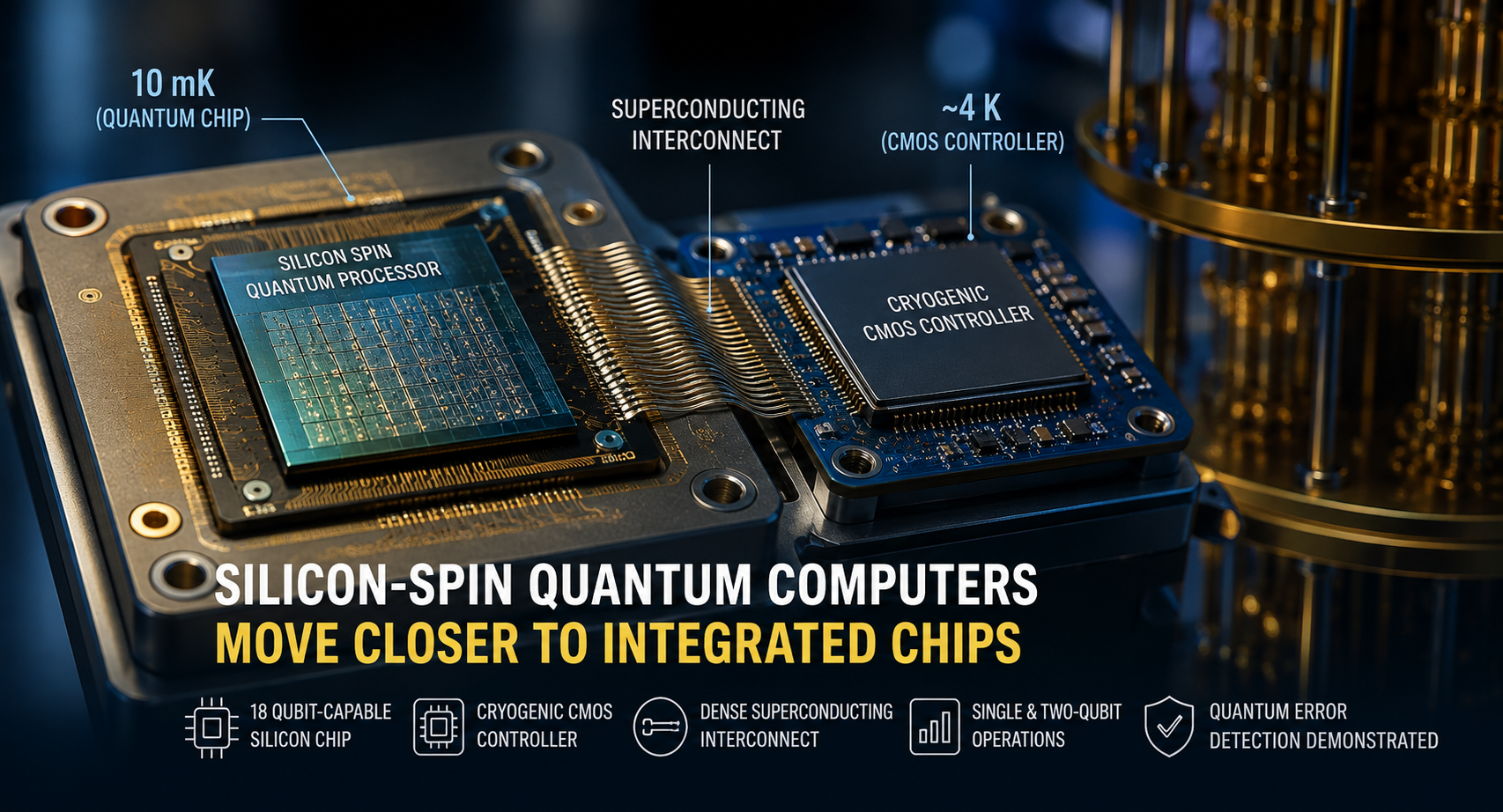
The new system moves much of the signal generation closer to the qubits. Its custom low-power CMOS controller operates at approximately four kelvin, while the quantum device remains at millikelvin temperature. A superconducting ribbon cable delivers the control signals between the two temperature stages while limiting heat transfer.
This architecture separates the relatively warmer control electronics from the more temperature-sensitive quantum chip, but keeps them much closer together than conventional laboratory equipment.
The approach resembles chiplet-based design in classical computing. Instead of forcing every component onto one monolithic chip, specialised chips are packaged and connected as one coordinated system.
For quantum computing, this may provide a practical route towards integration without exposing delicate qubits directly to the heat and electrical noise produced by complex digital electronics.
An 18-qubit-capable silicon device
The silicon quantum chip in the new processing unit consists of 54 exchange-coupled quantum dots arranged across three rails.
Exchange-only qubits use the collective spin states of multiple electrons. Their operations can be controlled electrically through exchange interactions, avoiding the need to provide every qubit with a separate local microwave control line.
The researchers configured and operated parts of the device to evaluate both individual-qubit and entangling performance. They reported an order-of-magnitude improvement over the previous exchange-only state of the art and used the system to implement a distance-five repetition code and a distance-two quantum error-detecting code.
These are limited demonstrations rather than full fault-tolerant quantum computation. A repetition code protects against a restricted class of errors, while an error-detecting code can identify certain failures without necessarily correcting every one of them.
Their importance lies in showing that the integrated control architecture can run coordinated operations across multiple qubits and support early error-management protocols.
A scalable quantum computer will require classical controllers to perform this work continuously. Qubits will need to be measured, errors identified and corrective decisions made quickly enough to preserve logical quantum information.
Control integration is therefore not a supporting engineering detail. It is part of the core architecture of a fault-tolerant machine.
Foundry fabrication is advancing alongside control
The integrated processing unit is one of several recent developments strengthening the case for silicon-spin quantum computing.
In July 2026, imec and Diraq reported the coherent operation and readout of an eight-qubit silicon metal–oxide–semiconductor array fabricated through a 300-millimetre CMOS-compatible foundry process.
All eight quantum dots were tuned and characterised as four double-dot pairs. The researchers reported Ramsey dephasing times of up to 41 microseconds and Hahn-echo coherence times reaching 1.31 milliseconds. They also demonstrated a two-qubit operation between adjacent qubits and read out the central four qubits using a cascaded charge-sensing method.
The study is important because industrial compatibility must be demonstrated across larger arrays, not only through isolated one- or two-qubit devices.
Imec said the result showed that its 300-millimetre process could support systems beyond individual qubit pairs without sacrificing coherence. The readout approach also avoided a proportional increase in sensor count, wiring density and thermal load as the array expanded.
A standard 300-millimetre wafer is widely used in advanced semiconductor manufacturing. Producing spin-qubit devices through such a platform creates the possibility of applying established industrial techniques for process control, uniformity, yield improvement and large-volume fabrication.
The result does not prove that millions of working qubits can already be produced on one wafer. It does, however, show that multi-qubit arrays can be manufactured and operated using processes designed with industrial scaling in mind.
Bringing control electronics into the cold
The latest work also builds on an earlier demonstration of spin-qubit control using cryogenic CMOS electronics positioned at millikelvin temperatures.
That system used a CMOS controller containing roughly 100,000 transistors to operate silicon MOS electron-spin qubits. Researchers demonstrated universal single- and two-qubit logic while finding that the closely integrated controller had little effect on gate performance.
The concern was that placing conventional electronics near qubits would introduce heat, electrical interference and crosstalk. Spin-qubit entangling gates are particularly sensitive to electrical noise.
The results supported a heterogeneous chiplet architecture in which quantum and control chips are fabricated separately, then connected using dense chip-to-chip interconnects.
The newer digitally controlled processing unit takes a related system-level approach but places the CMOS controller at the four-kelvin stage. This reduces the thermal burden on the coldest part of the refrigerator while still removing much of the distance and wiring associated with room-temperature instruments.
Both architectures illustrate an important shift. Researchers are no longer studying only whether a silicon qubit can perform a high-fidelity gate. They are examining how complete processors can be packaged, powered, connected and controlled.
Error correction remains the decisive challenge
Silicon spin qubits are also beginning to demonstrate more advanced logical operations.
A 2026 Nature Nanotechnology study used five nuclear spins in silicon to implement a small logical quantum processor based on the [[4,2,2]] error-detecting code. Researchers demonstrated a universal set of logical gates and used two logical qubits to run a variational quantum eigensolver simulation of the electronic ground state of a water molecule.
This was a small experiment, and the code cannot correct every arbitrary single-qubit error. It nevertheless showed that silicon-based systems can perform encoded logical operations rather than only physical-qubit gates.
The broader challenge remains formidable.
Useful fault-tolerant machines may require millions of physical qubits, depending on qubit performance, error rates, architecture and the applications being attempted. Those qubits must be manufactured consistently, connected efficiently and controlled with error rates low enough for quantum error correction to improve the computation rather than add further noise.
Silicon must still prove that it can preserve high performance as arrays move from tens to thousands and eventually much larger numbers of qubits.
Closer to a chip, but not yet a quantum microprocessor
It would be premature to describe the latest result as the quantum equivalent of a modern commercial microprocessor.
The system operates at cryogenic temperatures. It relies on separate quantum and control chips, specialised superconducting connections and extensive supporting infrastructure. Its qubit count remains far below what would be needed for commercially useful fault-tolerant computation.
The advance is nevertheless significant because it addresses how silicon quantum systems may be assembled at scale.
Individual qubit records will not be enough to build practical quantum computers. Manufacturers will need repeatable fabrication, compact wiring, low-power control, scalable readout and error-correction systems operating together.
Silicon-spin computing is now showing progress across each of these layers: foundry-manufactured arrays, cryogenic CMOS control, chiplet-style packaging and early logical operations.
The field has not yet produced an integrated quantum chip containing millions of error-corrected qubits. But it is moving beyond isolated laboratory devices towards something more recognisable to the semiconductor industry—a quantum processing platform designed as an integrated electronic system.
That may ultimately be silicon’s strongest advantage. Its path to scale is not based only on making better qubits. It is based on learning how to turn those qubits into chips.
Tags
Source Information
Discussion
0 professional contributions
Sign in to join this professional discussion.
Be the first to add a constructive contribution.