
India’s 1,000-Km Quantum-Secure Network Marks a Defining Moment for the National Quantum Mission
The achievement shows that India is moving from quantum communication research towards network-scale deployment. Indigenous QKD capability can strengthen the security of defence, government, banking and critical infrastructure communications while reducing dependence on imported strategic technology. It also demonstrates how the National Quantum Mission can convert public investment, startup innovation and scientific expertise into nationally important infrastructure.
Understand this faster with AI


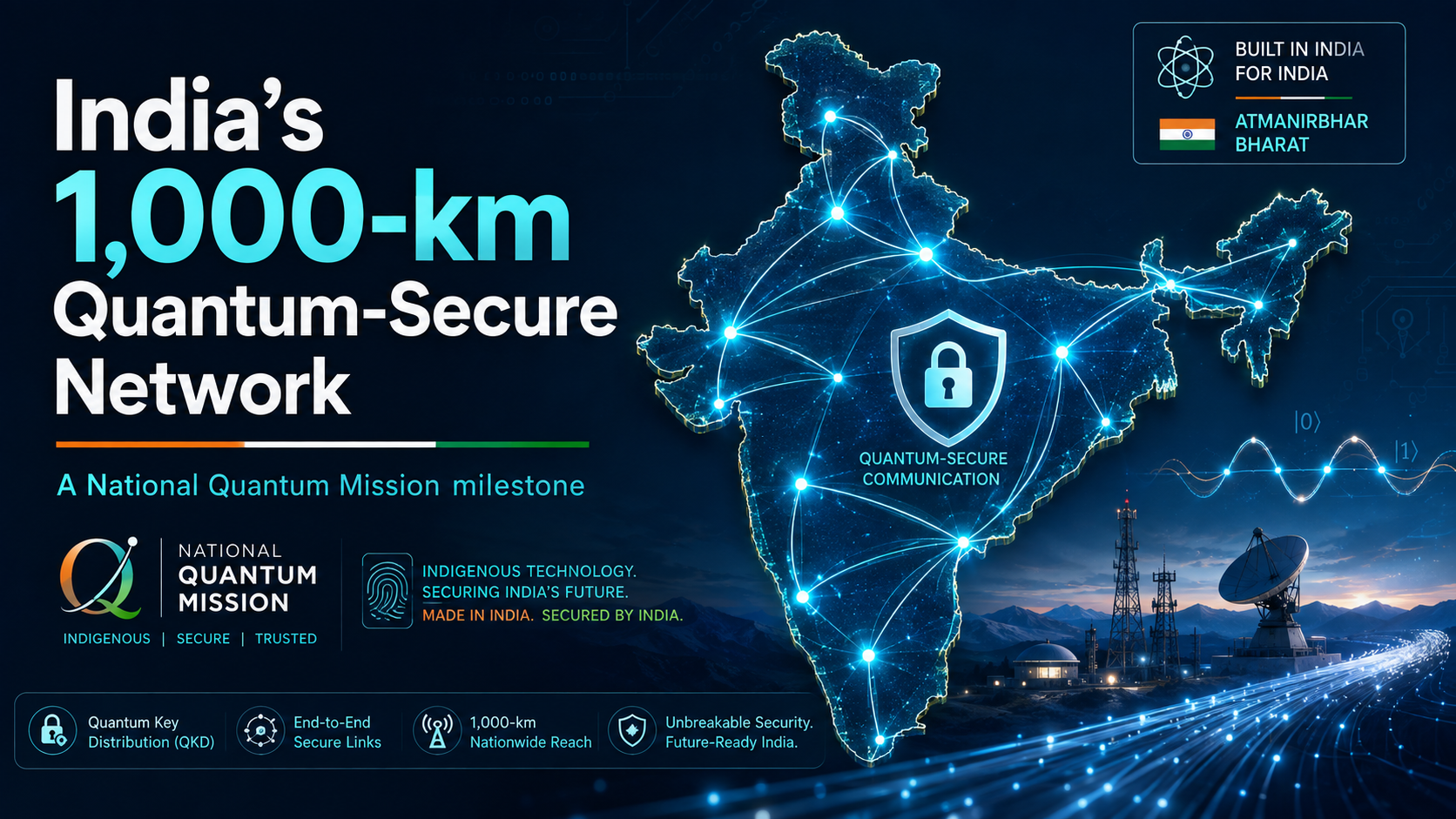
India’s successful demonstration of a 1,000-kilometre quantum-secured communication network is a landmark achievement for the National Quantum Mission. Built with indigenous technology developed by QNu Labs, the milestone places India among the countries building quantum communication systems at national scale.
India has taken a major step towards securing its digital future.
The successful demonstration of a 1,000-kilometre quantum-secured communication network under the National Quantum Mission represents far more than an increase in transmission distance. It shows that India is beginning to convert its quantum ambitions into large-scale indigenous technology capable of addressing real national-security and critical-infrastructure requirements.
Developed using technology from Bengaluru-based quantum cybersecurity company QNu Labs, the network demonstrates India’s growing ability to design and deploy advanced quantum communication systems within the country.
The achievement takes India halfway towards the National Quantum Mission’s objective of establishing 2,000 kilometres of inter-city Quantum Key Distribution connectivity. It also builds on the earlier demonstration of a quantum-secured network spanning more than 500 kilometres.
The speed of this progress is significant.
The National Quantum Mission was approved in 2023 with the objective of building capabilities across quantum computing, communication, sensing, materials and devices. Within a relatively short period, India has moved from outlining a national vision to demonstrating an indigenous quantum-secured network at a scale relevant to future deployment.
This is exactly the kind of outcome a national technology mission must produce.
A strategic cybersecurity achievement
The importance of quantum-secured communication comes from the rapidly changing nature of cybersecurity.
Most modern digital systems depend on cryptographic techniques that protect banking transactions, government communications, defence information, business records and personal data. Powerful quantum computers could eventually challenge some of the public-key cryptographic systems that support this infrastructure.
The threat is not limited to the future.
Sensitive encrypted information can be intercepted and stored today, with the expectation that it may be decrypted later when sufficiently capable quantum computers become available. This is commonly described as the “harvest now, decrypt later” threat.
Countries must therefore begin preparing their most critical systems long before large fault-tolerant quantum computers become operational.
Quantum Key Distribution, or QKD, provides one of the technologies available for protecting highly sensitive communication links. It uses quantum properties to generate and distribute encryption keys between authorised locations.
Any attempt to observe or interfere with the quantum transmission introduces detectable changes. This allows the communicating parties to identify possible interception and reject compromised keys.
India’s 1,000-kilometre network demonstrates that this principle can be extended beyond individual laboratory experiments and organised into a broader communication system.
That has direct relevance for defence networks, government communication, financial infrastructure, energy systems, strategic research facilities and other institutions responsible for information that must remain secure over long periods.
Moving from laboratory research to network-scale engineering
The real strength of the achievement lies in the integration required to build a large quantum-secured network.
A national communication system cannot depend on isolated quantum devices operating under controlled laboratory conditions. It requires quantum transmitters and receivers, optical-fibre infrastructure, conventional telecom equipment, encryption appliances, trusted network nodes, key-management platforms and software capable of monitoring the system.
These components must operate together reliably.
The 1,000-kilometre milestone therefore reflects progress not only in quantum physics, but also in telecom engineering, cybersecurity, networking and systems integration.
This makes the development particularly relevant for India.
India already possesses one of the world’s largest telecom networks, an expanding digital economy, major defence and space capabilities, a rapidly growing financial-services sector and a vast government technology infrastructure.
Quantum communication will become valuable when it can integrate with this existing foundation.
The latest achievement indicates that India is beginning to build that capability.
The architecture envisaged under the National Quantum Mission uses multiple quantum-secured links, trusted nodes and existing optical-fibre infrastructure to create inter-city networks. This is a practical route towards deploying quantum security across real geography.
The objective is not merely to achieve a laboratory distance record. It is to build infrastructure capable of protecting communication between strategic locations.
Viewed from this perspective, the 1,000-kilometre demonstration is an important engineering and deployment milestone.
Indigenous technology gives the achievement greater significance
India’s dependence on foreign technology has long been a strategic concern in advanced sectors.
Quantum technology makes this challenge even more important.
Quantum communication systems involve sensitive hardware, cryptographic key-management platforms, optical components, network-control software and specialised intellectual property. Relying entirely on imported platforms could create long-term dependencies in systems designed to protect the country’s most important information.
The use of technology developed by QNu Labs gives this achievement a deeper national significance.
It demonstrates that an Indian company can build quantum-security systems capable of contributing directly to a major national mission.
This indigenous capability gives India greater control over product design, deployment, testing, upgrades, maintenance and future integration. It also creates an opportunity to build a wider domestic ecosystem around quantum transmitters, single-photon technologies, random-number generators, encryption systems, optical components and security services.
India must now ensure that this technological success produces a larger industrial outcome.
One successful company or demonstration cannot create an entire national ecosystem. But it can establish confidence, attract investment, support specialist suppliers, create employment and encourage more entrepreneurs to enter the quantum technology sector.
The government’s decision to expand National Quantum Mission support from eight startups to 17 is therefore another positive development.
Startups are essential to translating scientific research into deployable technology. They bring speed, product orientation and commercial discipline to areas that can otherwise remain limited to research programmes.
India’s 1,000-kilometre network is evidence that this startup-led model can produce strategic results.
A strong early outcome from the National Quantum Mission
National technology missions are ultimately judged by their ability to create measurable capabilities.
India’s National Quantum Mission was approved with an allocation of approximately ₹6,003.65 crore and an eight-year mandate. Its objectives include developing quantum computers, quantum communication networks, advanced sensing systems, quantum materials and supporting technologies.
The mission’s communication goals include establishing 2,000 kilometres of inter-city QKD connectivity, developing satellite-based secure quantum communication and creating multi-node quantum networks.
Achieving the 1,000-kilometre milestone is therefore not an isolated experiment. It is progress against a clearly stated national objective.
That is important.
Large government missions can sometimes become dominated by funding announcements, committee structures and long-term promises. Their success depends on whether they produce working systems, indigenous intellectual property, trained specialists and technology that can move towards deployment.
The quantum-secured network shows that the National Quantum Mission is beginning to generate visible outcomes.
It also provides a model for the mission’s other technology areas.
The same combination of public funding, academic expertise, startup innovation, industrial collaboration and government adoption will be needed in quantum computing, sensing, materials and component manufacturing.
India has a strong scientific base and a large pool of engineering talent. The challenge has often been converting research and technical expertise into products that can be manufactured, deployed and supported at scale.
The 1,000-kilometre achievement shows what becomes possible when these elements are aligned around a national objective.
Protecting India’s most critical communication systems
The immediate opportunity is to identify high-value communication networks where quantum security can deliver the greatest strategic benefit.
Defence is an obvious priority.
Military communication systems handle information that may remain sensitive for decades. Command networks, strategic installations and communication between defence facilities require security against both present and future threats.
Government communication is another major application.
Sensitive exchanges between ministries, data centres, diplomatic facilities, research institutions and administrative networks could benefit from additional layers of cryptographic protection.
India’s financial sector also presents important possibilities.
Banks, payment systems, stock exchanges and financial-market infrastructure depend on the continuous and secure movement of high-value information. As quantum risks become more widely recognised, financial institutions will need to develop clear quantum-safe migration strategies.
Energy, telecommunications, transportation, space and healthcare infrastructure should also be considered. These sectors increasingly depend on interconnected digital systems, making secure communication a matter of national resilience.
Quantum Key Distribution will operate alongside other security technologies, including post-quantum cryptography, quantum random-number generation and crypto-agile infrastructure.
Together, these technologies can help India develop a layered quantum-safe cybersecurity strategy.
The 1,000-kilometre network provides a foundation on which that strategy can be built.
From indigenous technology to a quantum-security industry
The next phase should focus on transforming this achievement into a sustainable Indian industry.
India will require more than QKD devices. It will need specialist component manufacturers, testing laboratories, certification frameworks, system integrators, telecom partners, cybersecurity professionals and engineers trained to install and maintain quantum communication networks.
Government procurement will play an important role.
Indian startups developing strategic technology need credible early customers. Defence organisations, government departments, public-sector enterprises and regulated industries can provide the initial demand required to move products from limited deployments towards repeatable manufacturing.
Standards and certification must develop alongside adoption.
Users of quantum-security systems need confidence that devices perform as claimed, integrate securely with existing infrastructure and remain reliable under operational conditions. Independent testing will help create trust in Indian products both domestically and internationally.
India should also view quantum communication as an export opportunity.
Many countries will need quantum-safe security solutions but will not develop every component independently. A proven domestic deployment could position Indian companies to serve international markets seeking cost-effective and trusted alternatives.
India’s strengths in software, telecommunications, cybersecurity and engineering services give it a strong base from which to compete.
Quantum communication can become an area where India does not simply adopt technology developed elsewhere, but creates products, standards and expertise for the world.
The beginning of a larger national journey
India’s 1,000-kilometre quantum-secured communication network deserves to be recognised as a major national achievement.
It demonstrates progress against one of the central objectives of the National Quantum Mission. It showcases the capabilities of an Indian quantum technology company. It strengthens the country’s preparedness for future cybersecurity threats. And it shows that India can build advanced quantum systems that move beyond academic research.
Most importantly, it provides confidence.
Quantum technology is often discussed as a distant possibility, accompanied by long timelines and uncertain commercial outcomes. This achievement makes the field more immediate and tangible.
It shows students that India is building real quantum infrastructure.
It shows researchers that their work can become nationally important technology.
It shows startups that government-supported innovation can lead to strategic deployment.
It shows investors that the Indian quantum ecosystem is beginning to produce meaningful outcomes.
And it shows the world that India intends to become a serious participant in the emerging quantum economy.
The country must now build on this momentum.
The remaining journey towards the National Quantum Mission’s 2,000-kilometre objective should be accompanied by expanded deployment, domestic manufacturing, specialist talent development and stronger participation from government and industry.
The 1,000-kilometre network is not simply halfway towards a numerical target.
It is an early indication that India’s National Quantum Mission can deliver technology of strategic national importance.
India has crossed an important frontier in quantum-secured communication.
The next opportunity is to turn that achievement into infrastructure, industry and global leadership.
Tags
Source Information
Discussion
0 professional contributions
Sign in to join this professional discussion.
Be the first to add a constructive contribution.