
World's smallest QR code can store data for thousands of years — but you need an electron microscope to see it
Understand this faster with AI


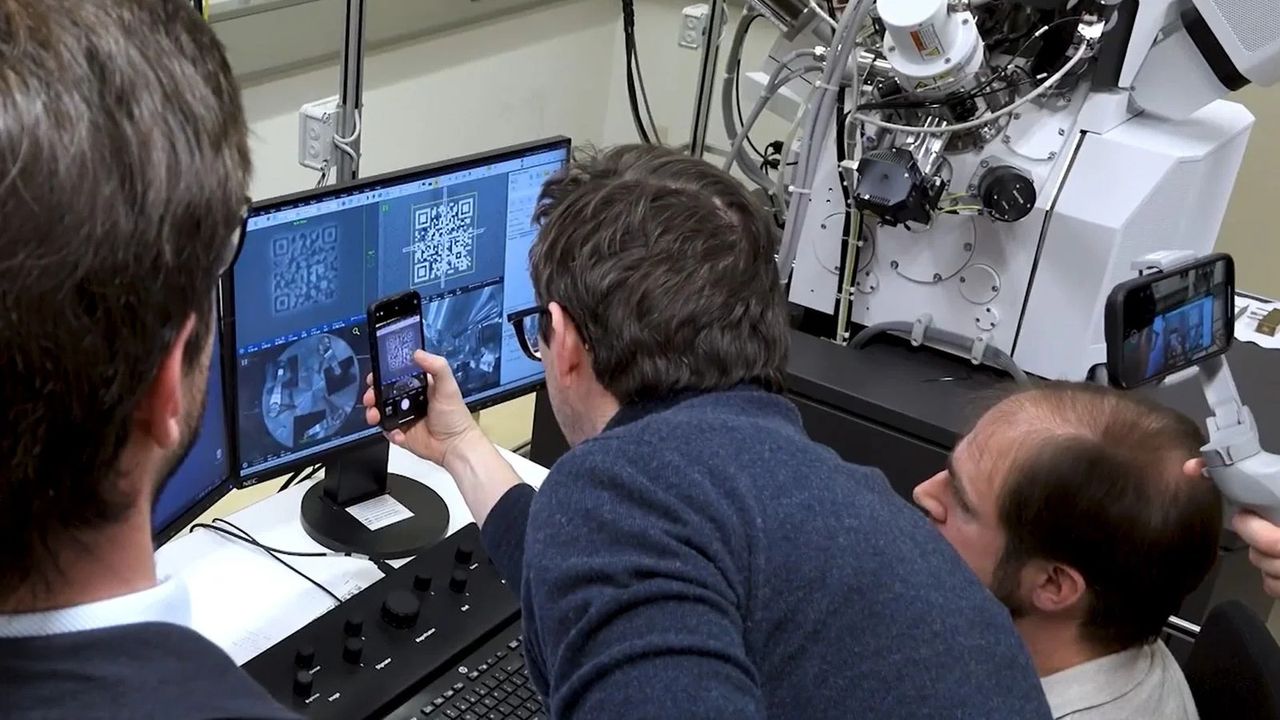
Scientists created a tiny matrix that stores data by etching its grid into a thin ceramic film with a focused ion beam. When you purchase through links on our site, we may earn an affiliate commission. Here’s how it works. Get the world’s most fascinating discoveries delivered straight to your inbox.Become a Member in Seconds Unlock instant access to exclusive member features.You are now subscribedYour newsletter sign-up was successfulWant to add more newsletters?Delivered DailyDaily NewsletterSign up for the latest discoveries, groundbreaking research and fascinating breakthroughs that impact you and the wider world direct to your inbox.Once a weekLife's Little MysteriesFeed your curiosity with an exclusive mystery every week, solved with science and delivered direct to your inbox before it's seen anywhere else.Once a weekHow It WorksSign up to our free science & technology newsletter for your weekly fix of fascinating articles, quick quizzes, amazing images, and moreDelivered dailySpace.com NewsletterBreaking space news, the latest updates on rocket launches, skywatching events and more!Once a monthWatch This SpaceSign up to our monthly entertainment newsletter to keep up with all our coverage of the latest sci-fi and space movies, tv shows, games and books.Once a weekNight Sky This WeekDiscover this week's must-see night sky events, moon phases, and stunning astrophotos. Sign up for our skywatching newsletter and explore the universe with us!Join the clubGet full access to premium articles, exclusive features and a growing list of member rewards.Scientists have created the smallest QR code in the world, measuring just 3.07 × 10⁻⁹ square inches (1.98 square micrometers). It can preserve data for thousands of years and it's so small that you need an electron microscope to see it.Each pixel of the QR code is just 49 nanometers across, even smaller than a bacterium, ensuring its place as a Guinness World Record. It was created by etching its grid into a thin ceramic film with a focused ion beam. It's about 37% the size of the previous world record holder and about 0.0000004% the size of a standard 0.8-square-inch (2 cm2) QR code.The code is too small for even an optical microscope to visualize because the pixels are smaller than the wavelength of visible light and the light waves won't be scattered by its minute details. Only an electron microscope, which fires electron beams with a wavelength in the picometer scale (10-11 inches), can resolve it.The creation of a data-storage unit on such a tiny scale opens up the potential for extremely high storage density. The scientists at TU Wien in Austria, who developed the QR code in collaboration with data-storage firm Cerabyte, estimate that over 2 terabytes of data could fit onto the surface area of a single A4 (8½ x 11) sheet of paper etched with the pixels — that's more data than you can keep on most consumer laptops.In contrast, the same area covered in 0.8 square inch (2 cm2) Version 1 QR codes would hold only about 2.5 kilobytes, the equivalent of a page of plain text. Despite its record-breaking size, the QR code is even more impressive for its durability, the team said."Structures on the micrometer scale are nothing unusual today — it is even possible to fabricate patterns made of individual atoms," Paul Mayrhofer, head of the Thin Film Materials Science Research Group at TU Wien, said in a statement. "However, that alone does not result in a stable, readable code."Get the world’s most fascinating discoveries delivered straight to your inbox.Magnetic storage solutions like hard drives and solid-state drives tend to degrade after about a decade, while optical media, such as CDs and DVDs, may last only 30 years. As a result, all of today's digital data is at risk of being lost to time if a more stable solution is not found.Because of this potential for degradation, the team decided to make their QR code using a film of chromium nitride, a ceramic compound. Ceramics are known to remain stable under even extreme conditions, hence their usage in high-performance cutting tools. The scientists said the data their QR code stores could be preserved for millennia. "With ceramic storage media, we are pursuing a similar approach to that of ancient cultures, whose inscriptions we can still read today," Alexander Kirnbauer, a senior scientist in the Thin Film Materials Science Research Group at TU Wien, said in the statement. "We write information into stable, inert materials that can withstand the passage of time and remain fully accessible to future generations."Another benefit of tiny ceramic QR codes is that they do not require energy input or cooling to preserve the data. Data centers, by contrast, require constant electricity to power servers and maintain cooling systems to prevent damage from overheating. They accounted for around 1.5% of the world's electricity consumption in 2024, according to the International Energy Agency.—New 'DNA cassette tape' can store up to 1.5 million times more data than a smartphone — and the data can last 20,000 years if frozen—Microsoft can now store data for 10,000 years on everyday glass thanks to laser breakthrough—This new DNA storage system can fit 10 billion songs in a liter of liquid — but challenges remain for the unusual storage formatA more environmentally friendly alternative to the massive carbon-guzzling data centers we depend on is urgently needed, especially as our reliance grows with the rapid expansion of artificial intelligence (AI). Market research firm IDC estimates that the amount of data the world produces in one year will have tripled from 173.4 zettabytes (173.4 billion TB) in 2024 to 527.5 ZB in 2029.The team is now looking into other materials for their QR codes, techniques to increase writing speeds, and industrial-scale manufacturing methods. They also want to see if more complex data structures than QR codes can be written onto and read from ceramic films.Fiona Jackson is a freelance writer and editor primarily covering science and technology. She has worked as a reporter on the science desk at MailOnline, and also covered enterprise tech news for TechRepublic, eWEEK, and TechHQ. Fiona cut her teeth writing human interest stories for global news outlets at the press agency SWNS. She has a Master's degree in Chemistry, an NCTJ Diploma and a cocker spaniel named Sully, who she lives with in Bristol, UK.You must confirm your public display name before commentingPlease logout and then login again, you will then be prompted to enter your display name.
Source Information
Discussion
0 professional contributions
Sign in to join this professional discussion.
Be the first to add a constructive contribution.