
Who Will Actually Use Quantum Computers? Study Identifies 11 User Types
Understand this faster with AI


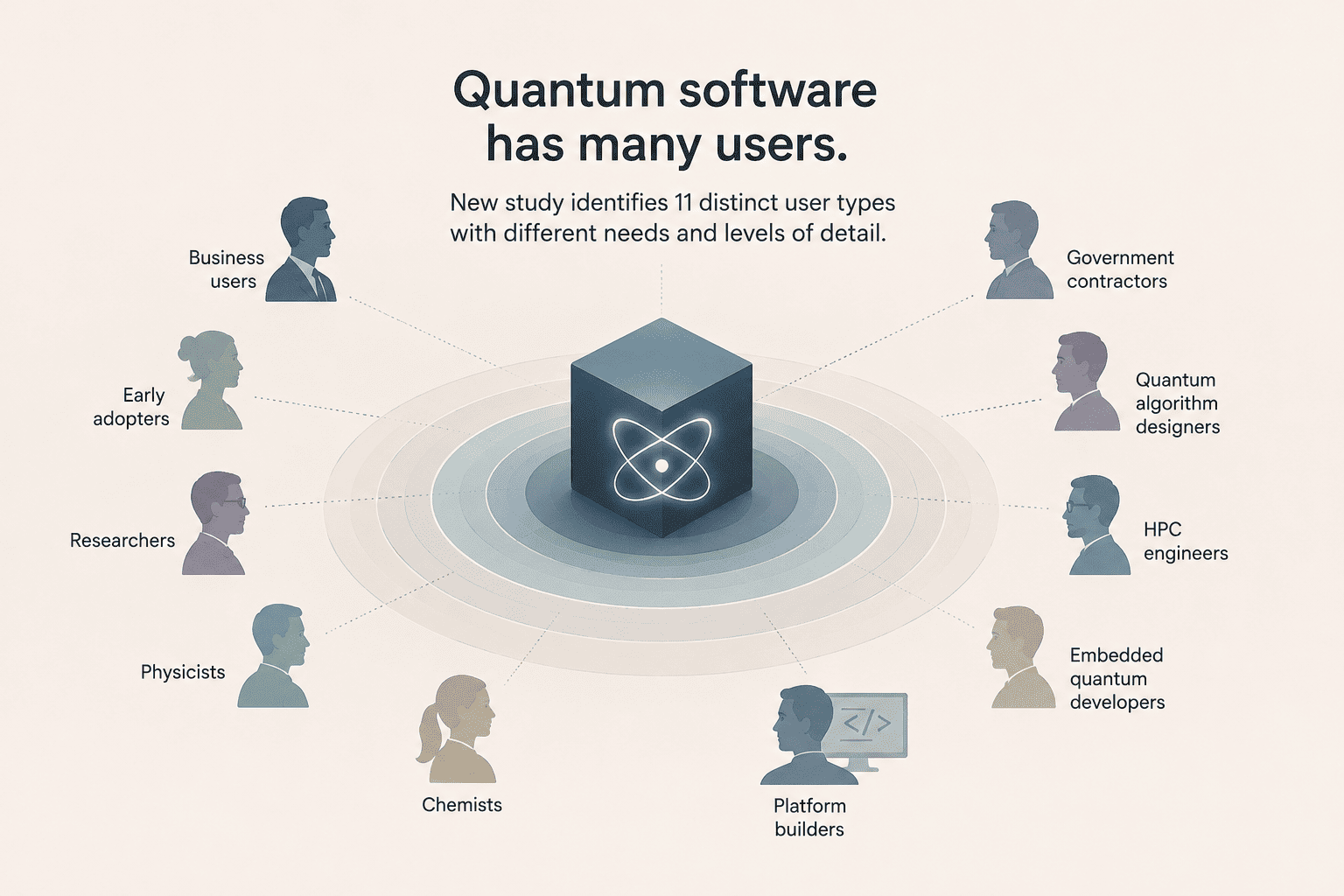
Insider BriefQuantum computing might have a user problem as well as a hardware problem, according to a new study that identifies 11 types of people likely to interact with quantum software.The researchers also found that that these different users can require much different ways of accessing the technology.The study, posted on arXiv and scheduled for the ACM/IEEE 29th International Conference on Model Driven Engineering Languages and Systems, or MODELS Companion 2026, attempts to determine who will actually use quantum computers, a question that could become increasingly important as quantum computers move toward practical applications.Researchers from institutions including the Technical University of Applied Sciences Regensburg, Karlsruhe Institute of Technology, Argonne National Laboratory, the Technical University of Munich and Delft University of Technology developed 11 “personas” representing potential users and stakeholders in quantum software.They range from business users and early adopters to physicists, chemists, quantum algorithm designers, high-performance computing engineers and developers working close to the hardware. To add to the complexity, those groups don’t necessarily want the same quantum computer.A business executive evaluating whether quantum computing can improve an industrial process may want an interface that hides almost everything about the underlying machine. A quantum algorithm designer, on the other hand, may need access to details that would be irrelevant or confusing to the business user.That creates a software-design challenge for an industry that has historically been dominated by physicists, computer scientists and other specialists.The findings suggest that making quantum computers useful to a wider market won’t simply depend on producing machines with more qubits or lower error rates. Software developers will also have to determine which parts of the machine each user needs to understand and which should disappear behind familiar software.The researchers grouped the potential quantum software users into broad categories based partly on how closely they interact with applications or hardware.At the application end are business users, early adopters and government contractors.Business users are expected to focus on commercial results rather than quantum mechanics. Their goals include scalable quantum operations, profit and assessing security implications. They are likely to want a high level of abstraction, allowing them to concentrate on their business domain rather than the mechanics of quantum computing.Early adopters are similarly focused on applications. They are interested in bringing quantum technologies into industry, developing business models and generating revenue. Their concerns include whether quantum technology is relevant to an industry and whether it can scale and adapt.Government contractors represent a different type of application user. Security requirements mean they may need more visibility into how software works. The study suggests such users could require traceable guarantees about software behavior and may be unable to rely on “black-box” implementations whose inner workings aren’t accessible.Researchers, physicists, chemists and simulation engineers occupy more of a middle ground.A physicist trying to verify a theory or simulate condensed matter, for example, may need to interact with mathematical descriptions of physical systems and quantum instructions. Chemists interested in molecular or materials discovery could work through simulation tools and frameworks while still needing access to underlying representations of chemical systems.Researchers can span an even wider range. They may want a high-level interface when investigating a scientific problem but need to move closer to the underlying software or hardware when developing methods.At the other end are people responsible for making quantum systems work.Platform builders develop software development kits, application programming interfaces and other tools connecting users with quantum machines. Quantum algorithm designers develop and improve algorithms and need access to relatively low-level details. HPC engineers focus on integrating quantum processors into larger computing environments, while embedded quantum developers work on system-level integration and potentially distributed quantum computers.The researchers found that the interests across these groups generally fall into three categories — commercial goals, technical objectives and scientific pursuits — and those differences could have direct consequences for companies developing quantum software.The study also sketches a potential path for business adoption as quantum hardware matures. In the short term, the researchers expect quantum-curious companies to conduct pilot projects, which require relatively close attention to the capabilities and limitations of quantum systems. As more capable and error-corrected machines emerge, businesses could begin scaling successful experiments to industry-relevant problems. In the longer term, the researchers envision quantum computing becoming part of industrial-scale operations while users become increasingly removed from the underlying technology. Instead of thinking about qubits, circuits or other quantum-specific details, customers could judge quantum-enabled services much as they judge conventional computing today, based on factors such as cost, runtime, result quality and business value.The researchers focused in on abstraction, an important software concept that essentially determines how much complexity a user has to see.Modern computer users encounter abstraction constantly. A person using a spreadsheet doesn’t need to understand how a processor moves data through its transistors. A programmer using a cloud service generally doesn’t need to know exactly where a server is located or how its processor executes every instruction.Quantum computing has not yet reached that level of separation, according to the paper.Quantum software developers frequently have to account for properties of specific machines, including hardware limitations. Frameworks such as Qiskit and Cirq allow programmers to build quantum programs without dealing directly with every hardware operation, but knowledge of the machine can still matter when trying to get the best performance from today’s systems.The study suggests that the appropriate amount of abstraction depends heavily on the user.Application-oriented users generally don’t want hardware-specific details. Yet those details can still determine whether their proposed application will work.HPC engineers and embedded quantum developers face almost the opposite problem. They need low-level information because their jobs involve communication, integration and optimization across computing systems.Quantum algorithm designers sit somewhere between those extremes, the team writes. They may want algorithms that can operate across different machines, but still need information about the capabilities and limitations of the hardware.The researchers divided quantum software into five broad layers, ranging from end-user applications at the top to simulation and hardware development at the bottom. Between them sit quantum algorithm development, quantum programming languages and software development kits, and the compilation process that turns programs into instructions suited to particular hardware.Some personas primarily occupy one layer while others, including researchers, algorithm designers and platform builders, may move across several.As quantum hardware improves, the implications of quantum software personas could grow.The researchers expect business users, for example, to become increasingly separated from quantum-specific details as the technology matures. In a longer-term scenario, a business application could potentially call on a quantum computer without its user even needing to know precisely how the calculation is performed.The relevant measures would instead look familiar to conventional technology buyers: result quality, runtime, cost and customer value.That would mark an important change from today’s quantum computing environment, where considerable expertise is often required even to determine whether a problem is suitable for a quantum machine.The study is exploratory rather than a large-scale survey of current customers.The researchers used two qualitative approaches. The first involved a focus group during a 2024 Dagstuhl seminar on quantum software engineering. The seminar brought together 24 experts, with the relevant working group consisting of roughly eight to 10 participants depending on the session.That group considered how the quantum software user base might change as hardware develops over the short, medium and long term.The researchers then sought the perspective of practitioners at the IEEE International Conference on Quantum Computing and Engineering, or QCE, in 2025.Eleven participants provided demographic information. Five held master’s degrees and five held doctoral degrees, and most reported substantial experience in quantum computing and software engineering.The researchers ultimately conducted nine voluntary, semi-structured interviews lasting between 15 and 40 minutes. Participants were asked about potential personas as well as their use cases, interests, constraints and preferred level of abstraction.Then, the researchers combined the findings from the expert group and practitioner interviews, along with their interpretation of the data, into the 11-persona framework.Methods, like the ones used in this study, can be useful, but certain limitations should be considered.The participants were not a representative sample of businesses or the general population. They were drawn largely from the existing quantum software community, including specialists attending a Dagstuhl seminar and people at a major quantum computing conference.Participants were also selected through convenience sampling, meaning researchers interviewed available people rather than drawing from a randomized population.The QCE portion included only nine completed interviews. Interviews weren’t audio recorded, in part because of time and confidentiality concerns, and instead relied on manual note-taking. The researchers also acknowledged the possibility of differences among interviewers influencing the results.The choice of a quantum conference could introduce another bias because people attending such an event aren’t necessarily representative of future mainstream quantum software users.The researchers therefore describe the resulting categories as a “persona hypothesis” rather than a definitive map of the quantum market.Still, they reported some agreement between the independent focus-group exercise and the practitioner interviews. They also noted signs that the interviews were beginning to reach saturation, meaning later participants were largely adding information to personas that had already been identified rather than introducing entirely new categories.The study suggests that the quantum industry may face a broader challenge in the future.Quantum computing has spent much of its development focused on whether machines can perform useful calculations. As hardware improves, these companies will need to learn how people outside the quantum computing community will tell those machines what they want them to do.That problem could affect software frameworks, cloud services, application development and even how quantum computing companies package products for customers.The study suggests there may be no single ideal quantum interface.A chemist may want to describe a chemical problem using concepts already familiar from chemistry. A business user may simply want to know the expected cost and performance of a solution. A government contractor may demand visibility and traceability. An algorithm developer may need access to details the other three would rather never see.The researchers see the current work as a starting point rather than a finished classification system. They encourage researchers and practitioners to refine the personas through additional user studies and interviews.Future surveys could provide more detailed evidence about what different stakeholders actually need and the obstacles they encounter.The research team included: Lukas Schmidbauer of the Technical University of Applied Sciences Regensburg; Joshua Ammermann and Ina Schaefer of Karlsruhe Institute of Technology; Laura Schulz of Argonne National Laboratory; Jose Garcia-Alonso of the University of Extremadura; Robert Wille of the Technical University of Munich; Sebastian Feld of Delft University of Technology; and Wolfgang Mauerer of the Technical University of Applied Sciences Regensburg.For a deeper, more technical dive, please review the paper on arXiv. It’s important to note that arXiv is a pre-print server, which allows researchers to receive quick feedback on their work. However, it is not — nor is this article, itself — official peer-review publications. Peer-review is an important step in the scientific process to verify results.TopicsShare Get the latest research, company news, and market intelligence every week. MENTIONED IN THE ARTICLEThe Technical University of Munich, established in 1868, is a public research university situated in Munich, Germany. Its focus lies in engineering, technology, medicine, and applied and natural sciences.The Karlsruhe Institute of Technology, situated in Karlsruhe, Germany, operates as a publicly funded research university. It also serves as a national research center under the Helmholtz Association.Argonne National Laboratory, one of the U.S. Department of Energy's national laboratories for science and engineering research, employs 3,400 employees, including 1,400 scientists and engineers, three-quarters of whom hold doctoral degrees. Argonne's annual operating budget of around $1 billion supports upwards of 200 research projects. Since 1990, Argonne has worked with more than 600 companies and numerous federal agencies and other organizations. The Lab has successfully launched its own Quantum Foundry to accelerate quantum information research.The Delft University of Technology, situated in Delft, Netherlands, is the oldest and largest public technical university in the country. It was established in 1842. In 2022, it holds a position within the top 10 engineering and technology universities globally, as per the QS World University Rankings.More in Research
Tags
Source Information
Discussion
0 professional contributions
Sign in to join this professional discussion.
Be the first to add a constructive contribution.