
Virginia Team Measures 3dB Squeezing on a Photonic Chip
Understand this faster with AI


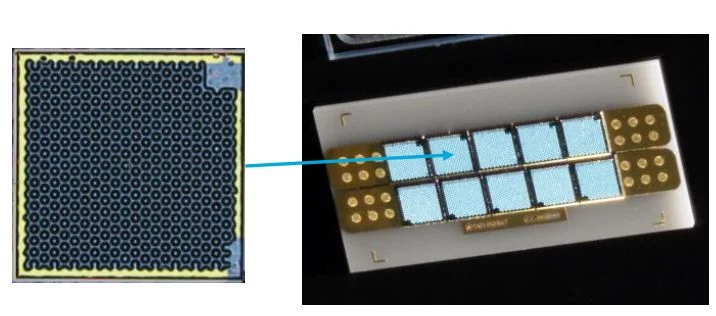
Integrating the generation and measurement of squeezed light onto a single photonic chip previously presented a key challenge due to conflicting material requirements. Haoran Chen of the University of Virginia and colleagues have, for the first time, fully integrated squeezed light generation, routing, and balanced homodyne detection on a single chip using heterogeneous integration. This novel chip design overcomes a longstanding obstacle in quantum photonics by combining light generation and detection. Squeezed light, which enhances precision in measurements, demands materials that both preserve quantum properties and efficiently absorb light for detection; these needs previously required separate components. The design uses a silicon nitride chip combining a light-generating microcavity with photodiodes, achieving approximately 3 decibels of squeezing across 34 quantum modes. Squeezed light, a special state of light where the uncertainty in one property is reduced to enhance measurement sensitivity, is vital for applications like quantum sensing and advanced information processing. Creating and measuring squeezed light previously required separate components due to conflicting material needs; generating it demands materials that preserve quantum properties, while detecting it requires efficient light absorption. This integrated system provides a scalable architecture for quantum technologies, but questions remain regarding the long-term stability and potential for scaling up the number of entangled modes. Integrated quantum microcomb achieves scalable 3 dB squeezing of light Squeezed light measurements now demonstrate 3 dB of squeezing across a two-mode quantum microcomb comprising 34 quantum modes, a substantial improvement over previous systems. Previously, achieving this level of squeezing necessitated a trade-off between preserving delicate quantum states and efficiently detecting photons, limiting scalability. The integrated photonic chip, fabricated using heterogeneous integration, unites these previously conflicting requirements on a single platform, overcoming a longstanding challenge. This breakthrough is vital for advancing quantum technologies, enabling more sensitive measurements and complex computations. A total optical loss of 1.1 dB was recorded within the post-squeezer circuit, including the filter, multimode interferometry coupler, and photodiodes, highlighting the low-loss characteristics of the integrated measurement components. The silicon nitride photonic platform used to fabricate the quantum photonic integrated circuit supports high-Q microresonators, essential for generating the squeezed quantum microcomb. A racetrack-shaped filter exhibited a full-width half maximum of 1.07GHz, enabling precise selection of odd-number comb lines. This filter rejects the strong pump light with an isolation ratio of around 27 dB. Each photodiode, measuring 225×60 μm², achieved a total on-chip quantum efficiency of 72% for the combined filter, coupler, and photodiodes, with potential for improvement to 78% through balancing circuit optimisation. Silicon nitride microchip integrates squeezed light generation and single-photon detection Heterogeneous integration functions similarly to assembling a car from pre-made components, combining different materials optimised for specific tasks to create a single, functional device. These photodiodes, each measuring 225×60 μm², cover 73.2% of their area with metal to maximise quantum efficiency, and exhibit an average dark current of 0.11μA at -3V bias. Integrated squeezed light paves way for scalable quantum technologies For applications ranging from ultra-precise sensors to secure communication networks, scientists have long sought to harness squeezed light, light with reduced uncertainty in certain properties. The demonstration of fully integrated squeezed light generation and detection represents a leap forward, though the current system operates across just 34 modes, a limitation acknowledged by the developers. Scaling to the hundreds or thousands of modes needed for complex quantum computations or large-scale sensing arrays remains a considerable hurdle, despite this progress. Thousands of modes may be required to effectively encode and process information for a fully functioning quantum computer or a large sensing network.
The team has proven the core principle of combining squeezed light creation and measurement onto a single chip, representing a key architectural step. Achieving approximately 3 dB of squeezing across 34 quantum modes within a single chip validates this approach and opens avenues for more complex quantum circuits. This heterogeneous integration approach overcomes the conflicting material requirements of efficient light generation and detection, paving the way for further development. The researchers successfully generated, routed and detected squeezed light on a single photonic chip. This achievement addresses a long-standing challenge in quantum photonics by integrating components with conflicting material needs. The authors note that future work will focus on increasing the number of modes to enable more complex quantum computations and sensing applications. 👉 More information🗞 Heterogeneously Integrated Squeezed-Light Generation and Detection on a Single Photonic Chip✍️ Haoran Chen, Benjamin Westcott, Fatemehsadat Tabatabaei, Xiangwen Guo, Shuman Sun, Zijiao Yang, Gedalia Y. Koehler, Beichen Wang, Shadrach Sarpong, Steven Bowers, Olivier Pfister, Andreas Beling and Xu Yi🧠 ArXiv: https://arxiv.org/abs/2608.13218 Stay currentSee today’s quantum computing news on Quantum Zeitgeist for the latest breakthroughs in qubits, hardware, algorithms, and industry deals. Tags:
Tags
Source Information
Discussion
0 professional contributions
Sign in to join this professional discussion.
Be the first to add a constructive contribution.