
Uncovering the Hidden Disorder in Silicon Quantum Computers
Understand this faster with AI


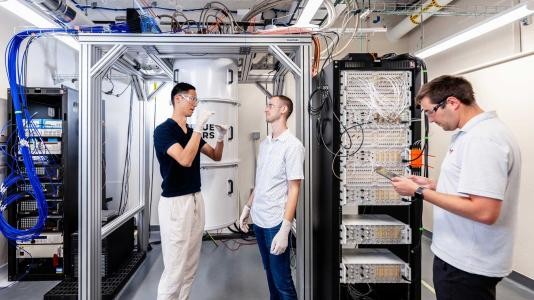
Insider BriefPRESS RELEASE — Qubits are the quantum counterpart to the bits used in conventional computers. Bits have a “0” and “1” state that is defined by electric charge. In a type of qubit called a silicon spin qubit, the “0” and “1” states are defined by electron spin. This spin can point either up or down in a magnetic field, analogous to a tiny compass needle. Scientists build silicon spin qubits by trapping a single electron inside a thin layer of silicon. The thin layer of silicon (called a quantum well) is sandwiched between another semiconductor material. In addition to spin, electrons in silicon also have a quantum property called a valley state. The energy difference between these valley states is called valley splitting. Valley splitting competes with the spin states used for computation. If the valley splitting is too small, the electron can leak into unwanted valley states. This leakage causes errors and loss of fidelity. In this study, researchers examined how the quantum well affected valley splitting. Because silicon spin qubits build on the same technology that underpins today’s semiconductor industry, they are one of the most promising platforms for scalable quantum computing. For years, researchers knew that defects and inconsistencies in the materials used in silicon quantum devices reduce valley splitting and cause failure. This valley splitting has long been known to vary from device to device, but its origin remained unclear. This study revealed that disorder on the atomic scale in the quantum well is the main source of variability of valley splitting. By identifying this root cause, the work turns a long-standing challenge into a tractable materials problem. It gives industry and National Laboratories a clear path towards building more reliable, higher-fidelity silicon qubits.This study was enabled by a unique partnership in which Argonne National Laboratory used the Chicago Quantum Computing Testbed (managed by the Q-NEXT National Quantum Information Science Research Center) to study and measure an industrially fabricated 12-qubit class silicon quantum dot processor from Intel. It combined National Laboratory measurement and analysis expertise with Intel’s manufacturing capability. Using the Chicago Quantum Computing Testbed, researchers studied industrial-grade silicon quantum devices to determine what limits valley splitting in practice.The team used a sensitive electrical spectroscopy method to measure the valley splitting while shifting the position of a quantum dot along the quantum well. This allowed them to build a nanoscale map of how valley splitting changes across the material. By analyzing how these variations correlate with distance, the researchers identified random atomic-scale fluctuations in the alloyed quantum well as the dominant source of valley splitting variability. This work transforms valley splitting from an unexplained obstacle into a materials engineering challenge with clear paths toward improved silicon qubits.Funding was provided by the U.S. Department of Energy, Office of Science, National Quantum Information Science Research Centers as part of the Q-NEXT center. TopicsShare Get the latest research, company news, and market intelligence every week. MENTIONED IN THE ARTICLEArgonne National Laboratory, one of the U.S. Department of Energy's national laboratories for science and engineering research, employs 3,400 employees, including 1,400 scientists and engineers, three-quarters of whom hold doctoral degrees. Argonne's annual operating budget of around $1 billion supports upwards of 200 research projects. Since 1990, Argonne has worked with more than 600 companies and numerous federal agencies and other organizations. The Lab has successfully launched its own Quantum Foundry to accelerate quantum information research.More in Research The Quantum Insider (TQI) is the leading source for the latest quantum technology news, market intelligence, industry analysis, and data covering the global quantum ecosystem.NEWSROOMPLATFORMSERVICESCOMPANY© 2026 Resonance Alliance Inc. All rights reserved.A RESONANCE NETWORK PROPERTYOne of our team will be in touch to learn more about your requirements, and provide pricing and access options.Subscribe to our industry leading leading newsletter for the latest in quantum news and insights. Necessary cookies are always on to ensure the website works. Optional cookies help us understand how the site is used. Privacy Policy
Tags
Source Information
Discussion
0 professional contributions
Sign in to join this professional discussion.
Be the first to add a constructive contribution.