
UCLA Researchers Model Collectively Enhanced Superconducting-Qubit Interfaces for Microwave-to-Optical Transduction
Understand this faster with AI


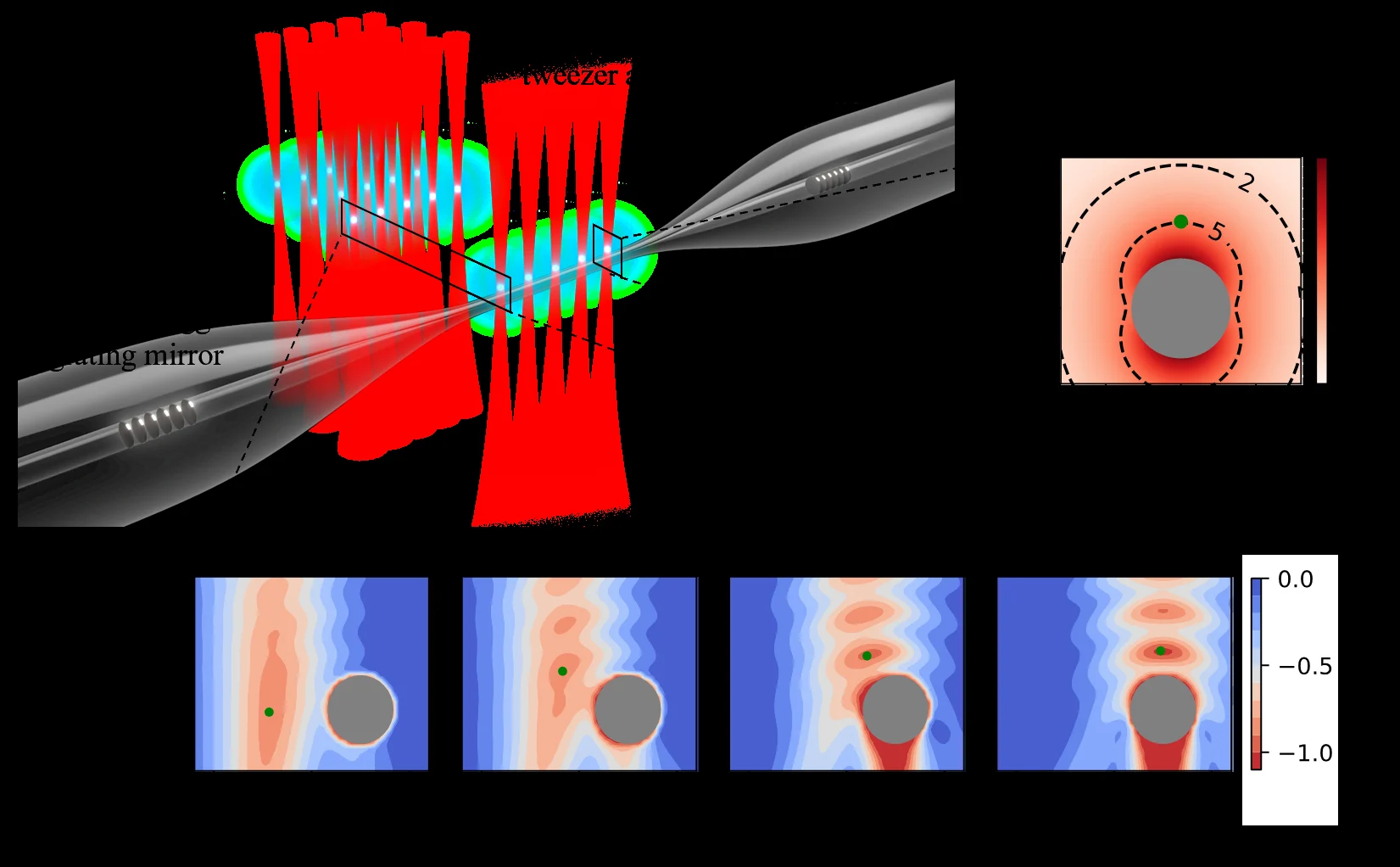
A collective superconducting-qubit interface for microwave-to-optical quantum transduction. Researchers at the University of California, Los Angeles (UCLA) have published a theoretical and numerical study evaluating how ensembles of superconducting transmon qubits coupled collectively to a shared optomechanical resonator can enhance microwave-to-optical quantum transduction. Detailed in a technical preprint, the architecture addresses weak electromechanical coupling bottlenecks in optical interconnects designed to link cryogenic superconducting processors over low-loss fiber networks. Rather than routing signals through a single intermediate microwave resonator, the proposed interface couples multiple electrically distinct superconducting qubits directly to a common mechanical normal mode via displacement-dependent electrodes, while an optical cavity reads out the mechanical vibration through radiation pressure. In weak-excitation input-output simulations across ensembles of 4, 24, and 64 qubits, collective coupling increased peak external conversion efficiency from approximately 20% to 30% and 40% while broadening conversion bandwidth, though optical pump-induced mechanical heating bounded the optimal pump strength. Operating near half excitation in the symmetric Dicke manifold accelerates electromechanical transfer nearly linearly with ensemble size, but the authors showed that this speedup is offset by the proportional relaxation exposure of additional excited qubits, leaving single-qubit coupling and lifetime as the governing coherence requirement. To isolate single-excitation transitions, the team introduced an auxiliary transmon that induces mechanical Kerr anharmonicity, raising lossless single-photon optical target probability in a four-qubit benchmark from 19.6% to 99.7% at 100 kHz anharmonicity, while quantifying how pair-dependent qubit-qubit disorder reduces gated optical retrieval efficiency from 58.1% to 35.4%. Read the full research paper on arXiv here. In GQI Portal The players behind the news The team that writes QCR tracks every company, deal and technology in the GQI Factory, GQI's verified database of the quantum industry. Next up: every story linked to its players, coming to QCR's paid plans. Players →Companies and institutions across the quantum industry, by segment. Scorecards →How the players compare on hardware, software, funding and more. Newsletter QCR Alerts in your inbox The latest reporting and analysis from Quantum Computing Report. Free, unsubscribe any time. Sign up for QCR Alerts Leave a commentCancel replyAll fields are required. Your email address will not be published.CommentName Email Type in the text displayed above Δ
Tags
Source Information
Discussion
0 professional contributions
Sign in to join this professional discussion.
Be the first to add a constructive contribution.