
Smaller, broader, smarter: a new route to superconducting signal amplification
Understand this faster with AI


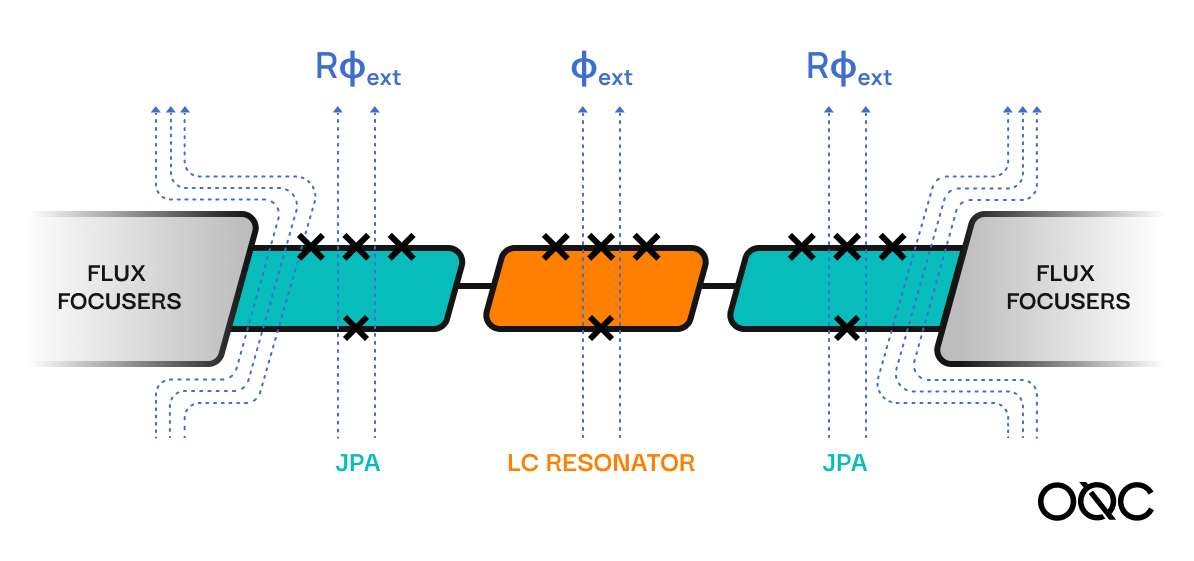
TECHNICAL BLOG Smaller, broader, smarter: a new route to superconducting signal amplification Scaling quantum computers requires compact amplifiers that detect tiny qubit signals across a wider bandwidth, with minimal added noise Our latest research demonstrates a new design using deliberately unequal Josephson elements, tested in arrays of three and five Superconducting Nonlinear Asymmetric Inductive Elements (SNAILs) These elements work together within one compact array: some amplify signals, while others provide tunable impedance matching to broaden bandwidth. Measurements showed up to 5.7x greater bandwidth than a single-SNAIL amplifier, reaching 200 MHz while maintaining strong amplification This approach offers a promising route to compact, tunable readout hardware that could support larger superconducting quantum systems SHARE ARTICLE When we talk about building more powerful quantum computers, it is natural to focus on qubits: how many there are, how long they stay coherent, and how reliably we can operate them. But useful quantum computing depends just as much on the wider system around those qubits. One of the most important parts of that system is readout. To measure a superconducting qubit, we need to detect extremely small microwave signals at cryogenic temperatures. Those signals are delicate. If they are not amplified early, cleanly, and with as little added noise as possible, valuable quantum information can be lost before it reaches room-temperature electronics. That is why Josephson Parametric Amplifiers (JPAs), have become such an important tool in superconducting quantum technology. JPAs can operate close to the quantum limit, making them well suited to qubit readout, quantum sensing, microwave quantum optics, and other low-noise measurement applications. The challenge is that compact, high-performance amplification is not just about gain. Bandwidth matters too. In our new research, we introduce and demonstrate a new approach to broadening JPA bandwidth using arrays of unequal Josephson junction elements. The concept is straightforward – instead of adding a separate impedance-matching circuit, we design the amplifier array so that some elements amplify while others help match impedance in a compact, tunable way. Why bandwidth matters Conventional JPAs can deliver high gain with low added noise, but their instantaneous bandwidth is often limited. Static impedance-matching circuits can help broaden that bandwidth, but they usually add extra circuit elements and can take up valuable chip area. Travelling-wave parametric amplifiers can offer much wider bandwidths, but they are typically more complex to fabricate and may require hundreds or thousands of junctions. For scalable quantum systems, this balance is crucial. We want amplifiers that are performant, compact, manufacturable and flexible enough to support increasingly capable processors. The key idea: make the array intentionally unequal Most Josephson-element arrays are designed so that each element is nominally identical. In that case, each element sees the same applied flux and reaches the same operating point at the same time. Our work explores a different route. We use arrays of unequal Josephson junction elements, focusing experimentally on Superconducting Nonlinear Asymmetric Inductive eLements (SNAILs). In the devices studied, flux focusers cause different SNAILs in the same array to experience different effective flux biases. That difference changes the behaviour of the whole amplifier. Rather than all SNAILs turning on together, the array becomes unsynchronised. At a given flux bias, some SNAILs are active amplifier elements, contributing strongly to three-wave mixing and gain. Others are comparatively inactive as amplifiers, but still contribute flux-tunable inductance. This is the central mechanism behind the result. The inactive elements are not wasted. They act like a small-footprint, tunable impedance-matching circuit inside the amplifier itself. Schematic of a Josephson parametric amplifier based on unequal SNAILs array Self impedance matching Impedance matching is a familiar concept in microwave engineering: to transfer signal power efficiently, the device and its surrounding circuit need to be well matched. For JPAs, impedance engineering can broaden the gain profile and increase usable bandwidth. The difference here is where that matching comes from. In these devices, it emerges from the unequal SNAIL array. Some elements provide gain, while others behave as tunable lumped inductors. Together with the circuit capacitance, they form an effective LC matching network. We describe this as self impedance matching. It uses the same Josephson elements that provide the amplifier nonlinearity, rather than relying solely on additional static matching structures. That gives the approach a practical appeal: it can reduce footprint, preserve design flexibility, and potentially complement existing impedance-matching methods. From model to measurement The paper develops an analytical framework for JPAs based on arrays of unequal Josephson junction elements. This model captures the quasi-non-periodic way that resonant frequency and gain change with applied flux, and shows how the gain profile can broaden when inactive elements act as an impedance-matching network. We then tested this experimentally using two device designs: one with three SNAILs arranged as two different element types, and another with five SNAILs arranged as two different element types. Measurements of resonant frequency versus flux showed the expected quasi-non-periodic behaviour, and the model qualitatively matched the observed gain dependence without adding extra fitting parameters. Most importantly, the devices showed a clear improvement in bandwidth. For an amplifier using a single SNAIL, the bandwidth was less than 35 MHz at 17 dB gain. Using unequal SNAIL arrays made the bandwidth much wider, by about 3 to 5.7 times. These devices reached up to 200 MHz of bandwidth while still providing more than 17 dB gain. One device with three SNAILs kept more than 100 MHz of bandwidth at 17 dB gain across a wide tuning range, from 4.9 to 6.4 GHz. Its best fractional bandwidth was 4 percent, which is a strong early result for this compact self-matching design. Why this matters for quantum systems As quantum processors scale, every supporting component must earn its place. Readout hardware needs to be sensitive, compact, and compatible with increasingly complex cryogenic environments. A JPA that can broaden its bandwidth without requiring large additional matching structures is therefore an attractive direction. There is also flexibility in the concept. Although this work demonstrates the approach using flux-focused SNAIL arrays, the underlying idea can be transferred to other Josephson junction-based arrays, including rf SQUIDs, dc SQUIDs, three-junction SNAILs, and other multi-junction loop designs. It can also be applied in both three-wave and four-wave mixing regimes. Future devices could go further by adding local flux-bias control for individual SNAILs. That would allow the impedance-matching behaviour to be tuned more directly, opening a route to amplifiers whose bandwidth can be optimised in operation. A compact step forward This research shows that making an amplifier array intentionally unequal can be a strength rather than a fabrication imperfection. By allowing different Josephson elements to play different roles, the device can combine amplification and impedance matching in the same compact structure. For quantum computing, progress often comes from this kind of engineering: not only improving individual components, but finding smarter ways for them to work together. Broader, smaller, tunable amplification is one more building block on the path to more capable superconducting quantum systems. READ OUR RESEARCH Join our newsletter for more articles like this By clicking ‘sign up’ you’re confirming that you agree with our Terms & Conditions YOU MAY ALSO BE INTERESTED IN The latest key resources VIEW ALL AllTechnical BlogPublicationsPreprintsCase Study Hybrid Quantum-Classical AI for Radar Pulse DeinterleavingCase StudyHybrid Quantum-Classical AI for Radar Pulse DeinterleavingSeptember 30, 2026 Exploring Quantum–AI for Financial Modelling: OQC, Citi and NQCC Collaborate on Derivative Pricing InnovationCase StudyExploring Quantum–AI for Financial Modelling: OQC, Citi and NQCC Collaborate on Derivative Pricing InnovationSeptember 22, 2026 Quantum Finance Beyond the Benchmark: What We Learned from Pricing, Risk and Hybrid Quantum MethodsCase StudyQuantum Finance Beyond the Benchmark: What We Learned from Pricing, Risk and Hybrid Quantum MethodsSeptember 16, 2026 Smaller, broader, smarter: a new route to superconducting signal amplificationTechnical BlogSmaller, broader, smarter: a new route to superconducting signal amplificationSeptember 15, 2026 The Rise of Superconducting Erasure Qubits – an Industry PerspectiveTechnical BlogThe Rise of Superconducting Erasure Qubits – an Industry PerspectiveAugust 17, 2026 Making Quantum Errors Visible: A New Approach to Reliable Quantum ComputingTechnical BlogMaking Quantum Errors Visible: A New Approach to Reliable Quantum ComputingJuly 1, 2026
Tags
Source Information
Discussion
0 professional contributions
Sign in to join this professional discussion.
Be the first to add a constructive contribution.