
Sizhen Chip Demonstrates Multi-Qubit Photonic Quantum States on Silicon Chip
This advance demonstrates a scalable, hardware-efficient path to large-scale photonic quantum computing by shifting complexity from runtime operations to initial state preparation, unlocking potential for fault-tolerant, million-qubit systems.
Understand this faster with AI


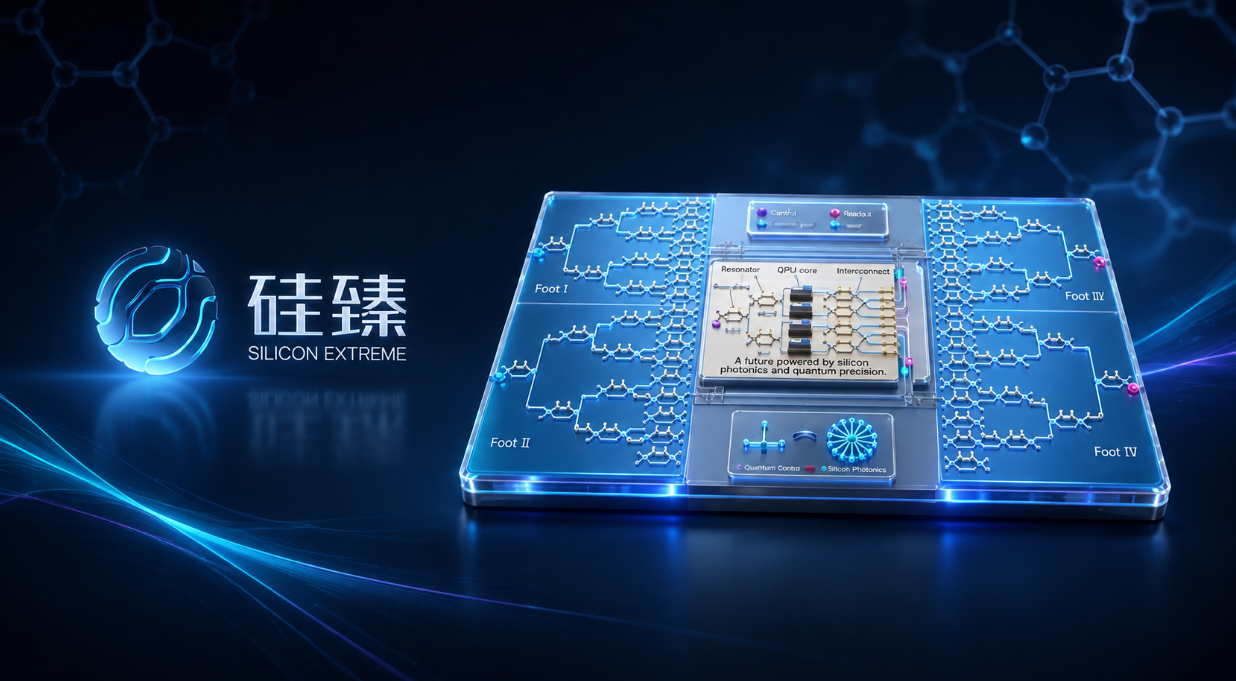
Insider BriefHefei Sizhen Chip Technology Co., Ltd. and the research group of Professor Ren Xifeng at the Key Laboratory of Quantum Information, University of Science and Technology of China have reported a breakthrough in photonic quantum computing chip technology, Jiwei reported.Working with a self-developed programmable silicon photonic integrated chip, the team says it has achieved, for the first time, the stable on-chip generation of a 4-photon 16-qubit GHZ state and a single-photon 4-qubit cluster state. The research has been submitted as a preprint to arXiv under the title “On-chip generation of multi-qubit graph states with high-dimensional encoded single photons.”In optical quantum computing, multi-photon entangled states are the core resource for implementing quantum algorithms. The source notes that the emission efficiency of multi-photon sources is low and that preparation probability decreases exponentially with the number of photons, making multi-photon entanglement a limited resource.To address this, the team developed a method for preparing entangled state resources under a measurement-based quantum computing (MBQC) approach. Using the path degrees of freedom of a single photon to perform high-dimensional encoding, the method transforms the problem of preparing complex multi-photon states into high-dimensional expansion, routing, and hierarchical measurement operations on single photons. A four-layer programmable measurement module is used to achieve efficient preparation of multi-qubit graph states and arbitrary single-qubit measurements, as per Jiwei.The team successfully prepared a 4-photon 16-qubit GHZ state and verified the genuine entanglement of 10 qubits through the entanglement witnessing method. The source describes this as the largest-scale entangled state demonstrated on an optical quantum chip to date.In a separate demonstration, the team used single photons to prepare a 4-qubit cluster state and ran the Grover search algorithm on that basis, achieving an average identification probability of 0.987.MBQC is described in the source as a universal quantum computing model that uses the preparation of large-scale entangled states as a resource and relies solely on single-qubit measurements to drive computation. Compared to the quantum logic gate circuit model in common use, MBQC shifts computational difficulty from executing logic gate operations at runtime to preparing the initial entangled state.According to Jiwei, this approach addresses the absence of efficient deterministic two-qubit logic gates in photonic systems, enabling universal computation without deterministic photon-photon interactions. The source also states that MBQC can achieve a larger qubit scale under the same photon resource conditions, reducing hardware complexity. Its derived architecture, fusion-based quantum computing (FBQC), is noted to offer higher fault-tolerance thresholdsSizhen Chip described itself, in a statement carried by the source, as the first domestic optical quantum computing company to achieve large-scale graph state construction on-chip, adding that the result makes the development of a million-qubit optical quantum computer feasible.For readers looking to go deeper on the technology and the companies building it, TQI’s guide to photonic quantum technology companies in 2026 covers the full landscap.TopicsShare Get the latest research, company news, and market intelligence every week. MENTIONED IN THE ARTICLEHefei Sizhen Chip Technology Co. is a company based in Hefei, China that provides packaging and testing services for integrated circuits. In addition, Hefei is home to Hefei Origin Quantum Computing Technology Co Ltd, which produces quantum chips, quantum measurement and control systems, quantum software products, quantum cloud platforms, quantum applications, and more.The University of Science and Technology of China (USTC) can be traced back to 1958 when it was established in Beijing by the Chinese Academy of Sciences (CAS). The university's founding aim was to nurture the nation's most promising scientific and technological minds. In 1970, USTC was relocated to Hefei, the capital of Anhui Province. Since then, this esteemed research university has continued to welcome talented individuals from around the world.On 37 hectares (nearly 4 million square feet) in Hefei, Anhui Province, China is building a $10 billion research center for quantum applications. This news comes on the heels of the world’s first video call made via quantum-encrypted communications and the completion of a quantum-encrypted fiber optic trunk cable.
The National Laboratory for Quantum Information Sciences, slated to open in 2020, has two major research goals: quantum metrology and building a quantum computer. Both efforts would support military and national defense efforts, as well civilian innovators. Pan Jianwei, a leading Chinese quantum scientist, says that the first general-purpose Chinese quantum computer could have a million times the computing power of all other computers presently in the world. In the computers we use today, information is encoded in a series of bits set as either 1 or 0. In a quantum computer, bits would theoretically be able to hold one, both, or some combination of these states. They could be used to speedily crack encrypted messages or solve complicated research problems involving anything from weather modeling to fusion research and biomedicine, because quantum bits allow certain calculations that happen one by one on a standard computer to occur simultaneously.More in Research
Tags
Source Information
Discussion
0 professional contributions
Sign in to join this professional discussion.
Be the first to add a constructive contribution.