
Six years of SQMS: asking what limits quantum systems and building the answers
Understand this faster with AI


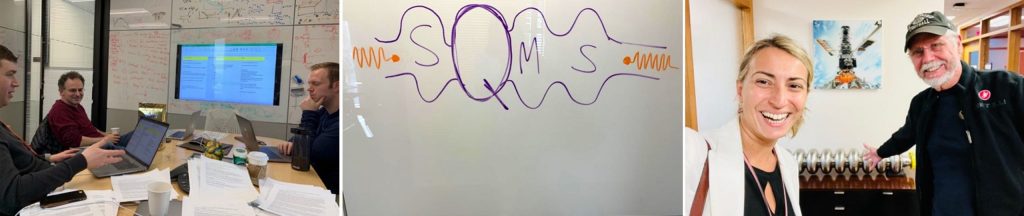
I still remember clearly when, six and a half years ago, a few of us sketched the first SQMS logo on a board in a Fermilab hallway. We knew it had to fit within the shape of a superconducting radio-frequency cavity, a technology that has been at the heart of Fermilab for decades. The name needed to reflect what we believed from the beginning: that better quantum systems require a fundamental understanding of how superconducting materials influence qubit performance, and that an important challenge would be putting everything together at scale. And, of course, it needed a “Q!” At that moment, SQMS was little more than a name, a logo and an idea on a board. From left to right: A war room session with Alexander Romanenko, Roni Harnik and Eric Holland working on the vision and goals of the SQMS Center; the first draft of the SQMS logo, whose modern design remains true to the original concept; and Anna Grassellino and Jim Sauls standing before a nine‑cell SRF cavity, one of the foundational technologies behind SQMS. Credit: SQMS Center I still find it extraordinary to think about what that sketch has become. Six years ago, that idea became a center, and the center became a community of hundreds of people across the United States and around the world. Together, they have built new experimental capabilities, connected scientific disciplines and trained a new generation of scientists and engineers. That transformation did not happen because we set out simply to build a larger quantum research program. From the beginning, SQMS was built around a scientific question: What really limits the performance of quantum systems, and how far could we push them if we understood those limits from first principles — the foundational laws of physics? The origins of that question went back to something Fermilab knew extremely well. Decades of work on superconducting radio-frequency cavities for particle accelerators — structures capable of storing electromagnetic energy with extraordinarily low losses — have produced exceptional expertise in superconducting materials, surfaces, fabrication and processing. Looking at those technologies through the lens of quantum information science revealed that they could preserve quantum information for dramatically longer than many conventional quantum devices. That observation opened a door. What if the remarkable coherence — the ability to preserve a fragile quantum state — of these three-dimensional superconducting cavities could become the basis for a new kind of quantum architecture? What if the materials science techniques developed to understand accelerator cavities could be applied to the microscopic defects limiting qubits? And what if, instead of treating materials, devices, cryogenics, controls, algorithms and applications as separate problems, we assembled the people who understood each piece and asked them to solve the entire problem together? The SQMS multiqudit QPU prototype exploits 3D SRF cavities held at millikelvin temperatures. Credit: Ryan Postel, Fermilab That became the foundation of SQMS. When the Department of Energy selected SQMS as one of its five National Quantum Information Science Research Centers in August 2020, we suddenly had the opportunity — and the responsibility — to turn that idea into something real. What followed has been one of the most rewarding scientific experiences of my life. We built SQMS deliberately as a multi-institutional center that unites expertise from laboratories, universities, companies and multiple disciplines. National laboratories brought unique facilities and engineering capabilities; universities contributed deep scientific knowledge and generations of students; and industry brought fabrication, systems know-how, and the perspective needed to translate discoveries into scalable platforms. Collaborators gather in person for the first time during the SQMS Annual Meeting in 2022. Credit: Ryan Postel, Fermilab And something important happened in those interactions: people did not simply contribute the expertise they already had. They developed new expertise together. We can see that the original idea worked: when we organize around a sufficiently ambitious scientific challenge, the boundaries between disciplines and institutions become less important than the capabilities each person brings to solving it. From atoms and interfaces to quantum coherence One of our starting questions was deceptively simple: Why does a quantum device lose its information? Quantum information is extraordinarily fragile. Tiny disturbances in a material, microscopic defects at an interface, radiation, magnetic fields or imperfections introduced during fabrication can all create pathways through which quantum information disappears. We call this decoherence, and overcoming it remains one of the central challenges to building useful quantum technologies. Fermilab brought an unusual perspective to this problem. Years of work on superconducting radio-frequency cavities for particle accelerators had produced cavities capable of storing electromagnetic energy with extraordinarily low losses. Before SQMS formally began, researchers demonstrated microwave photon lifetimes approaching two seconds in these cavity structures — an extraordinary level of coherence that helped inspire the center’s scientific premise. This work laid the foundations for SQMS to also understand why some superconducting materials and devices perform the way they do, why apparently identical ones sometimes perform differently, and whether that understanding could ultimately allow us to engineer coherence rather than discover it by chance.
The Northwestern University team behind a study identifying how niobium silicide layers, formed during qubit fabrication, affect superconducting qubit performance. Front row, left to right, are Mark Hersam, Michael Bedzyk, James Rondinelli and Xuezeng Lu. Back row, left to right, are Carlos Torres-Castanedo and Dominic Goronzy. Credit: Hannah Adams Brumbaugh, Fermilab That question brought together people who previously spoke very different scientific languages: quantum-device physicists, materials scientists, chemists, accelerator scientists, microscopists, theorists and engineers. Together, they have progressively peeled back the layers of superconducting quantum devices. For example, SQMS researchers connected microwave losses in niobium to the microscopic structure and chemistry of its surface oxides, identifying specific defects and mechanisms that can absorb energy from a quantum system. The center investigated why different superconducting qubit materials behave differently, including detailed studies of the structure and formation mechanisms of tantalum and niobium oxides and interfaces, and work explaining why the native oxide of tantalum can suppress magnetic defects and loss mechanisms that are more prevalent in niobium oxide. Researchers discovered the formation of new defects, such as niobium hydrides, in qubits, which affect performance. And increasingly, SQMS has been able to connect microscopic materials properties directly to the performance spread of actual quantum devices — including understanding why devices fabricated in nominally the same way can nevertheless perform differently. SQMS scientists Anna Grassellino and Akshay Murthy apply state-of-the-art characterization techniques in the Materials Science Lab at Fermilab. April 2024. Credit: Ryan Postel, Fermilab Importantly, this understanding has increasingly translated into methods for actively engineering better, more robust quantum devices. SQMS researchers showed that preventing the formation of lossy niobium surface oxides through surface encapsulation could systematically improve transmon qubit coherence, demonstrating that insights gained from materials science could be translated directly into improved quantum hardware. Transmon qubits are a specific type of superconducting qubit, engineered to be far less sensitive to the small fluctuations in electric charge that can disturb a qubit’s state, making it one of the most widely used qubit designs in superconducting quantum computing today. Today, SQMS routinely fabricates transmon qubit devices with coherence times in the hundreds of microseconds, with some exceeding a millisecond, well beyond the then state-of-the-art 50-100 microsecond values that our partners were observing prior to the center’s inception. At the same time, researchers have looked beyond the material itself to understand how the surrounding environment affects coherence. Researchers have investigated additional mechanisms that can limit superconducting quantum devices, including magnetic flux trapped inside superconductors as they cool. Experiments comparing the same superconducting qubit above ground at Fermilab and deep underground at INFN Gran Sasso National Laboratory helped researchers separate the effects of environmental radiation, such as cosmic rays, from sources of noise within the device itself. The results showed that this intrinsic noise still has the greatest effect on overall qubit performance, but radiation can cause brief, identifiable errors that become more important as qubits improve. SQMS researchers also found that magnetic fields, typically considered harmful to superconducting qubits, can make quantum devices more stable under carefully controlled conditions. This benefit was particularly evident in niobium devices that were surface encapsulated with tantalum metal. In these devices, applying a carefully controlled magnetic flux led to more stable qubit lifetimes without sacrificing long coherence times. Perhaps the most tangible measure of this progress is not a single record device, but how much the entire collaboration has moved forward together. Early in SQMS, we created the first national Nanofabrication Taskforce, and launched the Round Robin experiment, the first international exchange in which identical qubit chips were measured across different laboratories to systematically expose differences in fabrication, packaging, test setups, controls and measurement protocols. The philosophy was simple: share everything, compare everything and improve together. That approach has helped turn isolated know-how into shared capability, contributing to substantial gains in coherence and reproducibility across the collaboration. SQMS-developed techniques such as surface encapsulation have also been adopted and are now used in laboratories around the world to improve qubit coherence. In 2024, SQMS’s Alexander Romanenko, left, and Anna Grassellino, second from left, visited colleagues Stefano Pirro, third from left, and Laura Cardani at INFN in Italy. SQMS worked with INFN in a joint effort to measure radiation effects on qubits at the Gran Sasso underground facilities. Credit: SQMS Center Together, these results show how the SQMS materials program has evolved from identifying sources of decoherence to learning how to control the material, the device and its environment to deliberately improve quantum performance. This progression matters enormously. A future quantum computer cannot depend on finding a few exceptional devices among thousands. Scaling requires reproducibility. We need to understand why one device lives longer than another, which fabrication steps introduce variability, and eventually how to manufacture quantum hardware whose performance can be predicted and controlled. To me, this represents an important evolution of the field: moving from observing quantum coherence, to understanding it, and ultimately toward engineering it. From extraordinary coherence to new quantum systems But understanding coherence was never the final objective. The next question was: What becomes possible if we can preserve quantum information for much longer? Here, one of the technologies that helped inspire SQMS has evolved into something entirely new. Instead of storing quantum information only in conventional two-level qubits, SQMS has been developing architectures that use the many quantum states available inside ultra-coherent three-dimensional superconducting cavities. These higher-dimensional quantum systems — qudits — can encode and manipulate quantum information in ways that go far beyond qubits. We have learned how to couple cavities to superconducting control devices, manipulate increasingly complex quantum states and connect these elements into larger systems. Recent demonstrations have brought multiple ultra-coherent cavity modes together with superconducting controls while preserving long coherence, an important step toward programmable cavity-based quantum processors. Other work has developed architectures and techniques for controlling and scaling superconducting quantum systems. Scaling with Colossus: the world’s largest dilution refrigerator will offer 5 cubic meters of space and cool components to around .01 kelvin. Credit: Anna Grassellino, Fermilab Scaling quantum computing is not simply a matter of making more qubits or qudits. It requires hardware, cryogenics, controls, software and algorithms to operate as one system. SQMS has therefore also worked on the less visible, but essential, technologies of scale, including methods for transferring quantum information between physically separated quantum modules and for efficiently cooling large-scale systems. This is a transition I find particularly exciting: we are moving from asking, “Can we make an extraordinary quantum device?” to asking,“Can we build an extraordinary quantum system?” Quantum technologies becoming instruments for discovery At the same time, technologies developed for quantum science began to find a natural second role in a particle physics laboratory as powerful new instruments for fundamental physics. A cavity capable of preserving a single microwave photon for an extraordinarily long time is not only a quantum memory. It is also an exquisitely sensitive detector – potentially capable of detecting the incredibly faint signatures of particles left over from the early universe. And quantum processors themselves can become part of physics experiments. The DarkSRF experiment, for example, repurposed superconducting accelerator cavities as detectors in a search for dark photons — hypothetical particles that could also be a dark matter candidate. The experiment established world-leading laboratory constraints over part of the dark-photon parameter space, offering new clarity on where these dark photons may or may not exist in terms of their mass and interactions with the electromagnetic sector. SQMS researchers are also adapting single-microwave-photon detection techniques to searches for new particles whose signals would otherwise be buried beneath conventional measurement noise. Members of the team behind DarkSRF in 2019 include, from left to right, Abe Diaz, Roni Harnik, Sam Posen, Oleksandr Melnychuk, Yuriy Pischalnikov, Roman Pilipenko, Oleg Pronitchev, Alexander Romanenko, Sergey Belomestnykh, Anna Grassellino, Dave Burk and Damon Bice.
Credit Reidar Hahn, Fermilab This broader convergence of quantum technology and fundamental physics has also opened new approaches to precision measurements and tests of nature. Perhaps my favorite illustration is an experiment that asked an almost audacious question: Is quantum mechanics itself exactly correct? Researchers used truly random quantum measurements generated by a superconducting quantum processor in a superbly sensitive cryogenic radio-frequency experiment searching for tiny nonlinear deviations from quantum mechanics. No deviation was found, but the experiment established substantially stronger constraints on how large such an effect could be. Other SQMS work is exploring how quantum technologies can test fundamental principles and probe new regimes of physics. There is something beautiful about that scientific circle: we built quantum technologies by learning how quantum mechanics works and then used those technologies to test quantum mechanics itself. That is the kind of unexpected scientific connection that becomes possible when technology and fundamental science develop together. Learning how to compute differently The hardware has also forced us to think differently about computation itself. Much of today’s quantum computing language was developed around the idea of the qubit — a quantum object with two basic states, analogous to the zero and one of classical computing. But SQMS’s cavity-qudit architecture provides access to many quantum levels within a single physical system. That means we cannot simply take algorithms and error-correction techniques designed for qubits and assume they are the best way to use this hardware. SQMS researchers have therefore been developing new ways to control higher-dimensional quantum systems, compile quantum operations and suppress errors. Recent work, for example, developed a precise, repeatable way to translate any operation on a qutrit, a three-level quantum system, into the physical steps needed to run it, an important building block for computation using higher-dimensional hardware. Researchers work in the control room of the SQMS Quantum Garage to develop architectures and gates for SQMS hardware tailored toward high-energy physics quantum simulations. From left to right are: Nick Bornman, Hank Lamm, Doga Kurkcuoglu, Silvia Zorzetti, Julian Delgado and Hans Johnson. Credit: Hannah Adams Brumbaugh, Fermilab This co-design between hardware and algorithms is essential. Rather than building a machine first and then asking scientists what to do with it later, the hardware architecture, control system, error-correction strategy, algorithms and eventual scientific applications need to inform one another from the beginning. From better devices to new science When I put all of this together, what stands out is how interconnected the work has become. We started by asking why quantum information disappears, a question that took us down to atoms, oxides, interfaces and defects. From left to right: Fermilab and Rigetti Computing met at Rigetti’s facility in April 2023 to advance their qubit processor collaboration, which combines Rigetti’s industrial-scale fabrication with SQMS Center materials research. In 2025, Maybell Quantum Industries joined the collaboration to co-develop an energy-efficient cryogenic system based on a liquid-helium cryoplant for future quantum data centers. In April 2026, Fermilab and IBM Research leadership met to align on shared goals and deepen collaboration on scaling superconducting quantum computers, including quantum interconnects and cryogenic technologies. Credit: SQMS Center The challenge in front of us is no longer how far we can push an individual quantum device. It is how rapidly we can bring these technologies together into scaled, integrated and accessible quantum platforms capable of doing science. That raises a larger question: What infrastructure will scientists need to make that possible? In many ways, SQMS has spent its first six years building pieces of the answer. Building more than technology: people, places and a quantum ecosystem Scientific ideas ultimately need somewhere to become real. Building on DOE investments across SQMS and its partner network, we set out to create the specialized environments needed for cutting-edge quantum research. As the science of SQMS grew, so did the places where that science could happen. At Fermilab, spaces that had never housed scientific experiments became some of the most advanced quantum laboratories in the country.
The Quantum Garage, once quite literally a garage, is today a 6,000-square-foot quantum laboratory containing six extra-large Bluefors dilution refrigerators and SQMS-developed experimental platforms for quantum computing, sensing, metrology and communications. Built collaboratively, it now supports more than 60 experiments running in parallel. In the beginningThe SQMS Quantum Garage, shown here on August 23, 2021, was literally a garage.February 6, 2023: A blank canvas – the new Garage space awaits the installation of five new Bluefors dilution refrigerators. Photo credit: Anna Grassellino.Blank canvasOn Feb. 6, 2023, the new Quantum Garage space awaited installation of five new Bluefors dilution refrigerators. Credit: Anna Grassellino, FermilabFebruary 14, 2023: The fridges are coming! The day prior to the delivery of the new fridges, everyone from scientists, to engineers, to techs busy getting the lab ready. Photo credit: Anna Grassellino.The fridges are coming!On Feb. 14, 2023, the day before delivery of the new fridges, everyone from scientists to engineers to techs were busy getting the lab ready. Credit: Anna Grassellino, FermilabFebruary 15, 2023: Delivery day! The new fridges arrived at the Garage and our whole team could not have been more excited. Photo credit: SQMS Center.Delivery dayOn Feb. 15, 2023, the new fridges arrived at the Quantum Garage, and our whole team could not have been more excited. Credit: SQMS CenterOn March 22, 2023, the Quantum Garage was taking shape.Taking shapeOn March 22, 2023, the Quantum Garage was taking shape.The Quantum Garage at the SQMS Center was officially inaugurated in November 2023. The flagship facility is one of the largest quantum research laboratories in the country. Today, the space is humming with activity with as many as 60 experiments running in parallel.Flagship facilityThe Quantum Garage at the SQMS Center was officially inaugurated in November 2023. The flagship facility is one of the largest quantum research laboratories in the country. Today, the space is humming with activity with as many as 60 experiments running in parallel.David van Zanten prepares for a cool down cycle in the Quantum Garage. November 2024. Photo credit: Anna Grassellino.Cool downIn Nov. 2024, David van Zanten prepared for a dilution refrigerator cool-down cycle in the Quantum Garage. Credit: Anna Grassellino, Fermilab The Quantum Garage is one piece of a broader Fermilab infrastructure supporting quantum systems, superconducting materials and devices, high-magnetic-field experiments and cryogenic technologies needed for future scale. SQMS also built a distributed laboratory that connects complementary capabilities across partner institutions, from device fabrication and atomic-scale materials characterization to specialized qubit testbeds and unique experimental environments. Together, these facilities form a scientific tool chain — from materials to devices to systems to experiments — distributed across institutions and connected by a common mission. Building bridges between people When I think about SQMS today, I increasingly think of it as a network of human connections. The collaboration was intentional from the beginning. No single institution, and certainly no single scientific discipline, possesses all the expertise required to solve the problems involved in scaling quantum systems. Our center is global. In March of 2024, collaborators gathered in London for a US-UK workshop focused on strengthening collaboration in QIS. Photo credit: SQMS Center.Our center is globalCollaborators gather in London for a U.S.-U.K. workshop in 2024 focused on strengthening collaboration in quantum information science. Credit: SQMS Center.Our colleagues at Northwestern University hosted a workshop on connecting experimental findings to theoretical understandings of decoherence in superconducting resonators and qubits. February 2024. Photo credit: SQMS Center.Northwestern UniversityOur colleagues at Northwestern University hosted a workshop on connecting experimental findings to theoretical understandings of decoherence in superconducting resonators and qubits, in 2024. Credit: SQMS Center.Principal investigatorsRepresentatives from all five national quantum information science research centers gather in Washington D.C. for a principal investigators meeting in 2024. Credit: Anna Grassellino, FermilabAugust 2024, we welcomed our DOE Program Manager, Zach Goff-Eldredge (center) to Fermilab. Photo credit: SQMS Center.Welcoming our program managerOur DOE Program Manager, Zach Goff-Eldredge, center, is welcomed the SQMS Center at Fermilab in 2024. Credit: SQMS CenterDario Gil’s (center) first visit to Fermilab. (July 2025). Photo credit: SQMS Center.Darío Gil visits the labIn 2025, Darío Gil, Department of Energy under secretary for science and Genesis Mission director, makes his first visit to Fermilab. SQMS therefore embraced a simple model: identify the problem first, then bring together the people with the capabilities needed to solve it, regardless of where they work or what field they come from. To me, this is what a national research center should do at its best. It should not simply distribute work among institutions. It should make the boundaries between them scientifically permeable. Training a workforce by doing the work The same philosophy has shaped how I think about workforce development. Some of the most powerful training happens by giving people difficult, important problems and the opportunities to solve them alongside experts from other fields. Our students and postdocs are not watching quantum science from the sidelines. They are building devices, operating qubits in dilution refrigerators, characterizing materials, developing algorithms, collecting data, commissioning experiments and writing the papers that advance the field. In doing that work, they learn how materials, devices, engineering, computing and scientific applications fit together. The U.S.
Quantum Information Science Summer School featured hands-on lab time focused on qubit measurements and materials characterization: left, Jaeyel Lee points out the different components of a superconducting qubit; center, Matthew Kramer shows students in the Materials Science Laboratory how transmission electron microscopy is used to characterize the surfaces and interfaces of superconducting qubits at the atomic scale and identify sources of decoherence; right, Matthew Hollister explains the fundamentals of a dilution refrigerator. Credit: Dan Svoboda, Fermilab We have also worked to extend that experience beyond the center. In 2023, SQMS hosted the inaugural U.S.
Quantum Information Science Summer School, which brought together 150 undergraduate and graduate students and professionals from national laboratories and industry, supported by more than 40 instructors. Participants combined classroom learning with hands-on experience in superconducting qubit and radio-frequency measurements, materials characterization and quantum algorithms. That is the kind of workforce development I believe we need: not only teaching quantum science but teaching people how to do quantum science together. Growing an ecosystem Over time, the community around SQMS has grown well beyond the center’s formal boundaries. When we inaugurated the Quantum Garage in 2023, the first day of the SQMS annual meeting became an “Ecosystem Day,” bringing more than 300 people to Fermilab. By 2025, during the International Year of Quantum Science and Technology, that idea had grown into “Exploring the Quantum Universe,” which brought together researchers, students, industry, national laboratories, government and the public to discuss both the science and what the field would need next. Challenges and opportunitiesWe value opportunities to bring the right people around a table together to discuss key challenges and opportunities. Oftentimes, one table isn’t big enough! SQMS Annual Meeting, 2023. Credit: Anna Grassellino, FermilabPoster session – Student programs and opportunities for young researchers to present their work are a cornerstone of SQMS events. November 2023. Photo credit: Hannah Adams BrumbaughPoster sessionStudent programs and opportunities for young researchers to present their work, including this poster session in 2023, are a cornerstone of SQMS events. Credit: Hannah Adams BrumbaughNo visit to Fermilab is complete without a tour of the Quantum Garage. Hundreds of guests visit the Quantum Garage at the SQMS Center each year and some are lucky enough to see an open fridge. Here, attendees of Exploring the Quantum Universe capture memories of their visit.Picturing a fridgeAttendees of “Exploring the Quantum Universe” capture memories of their visit during a tour of the Quantum Garage. Hundreds of guests visit the Quantum Garage at the SQMS Center each year, and some are lucky enough to see an open dilution refrigerator.Quantum 101- during Exploring the Quantum Universe, attendees could participate in entry level lectures and demonstrations of quantum programs. Andrew Bestwick (Rigetti Computing), teaches a session on qubit measurements and quantum processors.Quantum 101Andrew Bestwick of Rigetti Computing teaches about qubit measurements and quantum processors during “Exploring the Quantum Universe.” At the event attendees participated in entry-level lectures and demonstrations of quantum programs.How it’s made – Machining Specialist, Eddie Pieszchala (left) shares an overview of highly customized components he makes – many of which are used in the SQMS Center.How it's madeMachining specialist Eddie Pieszchala, left, shares an overview of highly customized components he makes at Fermilab, many of which are used in the SQMS Center.During Exploring the Quantum Universe in December 2025, we hosted a series of topical roundtables that gathered experts to discuss advancements and the future of our field. Photo credit Ryan Postel, Fermilab.Roundtable discussionsDuring "Exploring the Quantum Universe" in 2025, we hosted a series of topical roundtables that gathered experts to discuss advancements and the future of our field.
Credit Ryan Postel, FermilabThe five directors of the National Quantum Information Science Research Centers participated in a panel discussion moderated by Bindu Nair during "Exploring the Quantum Universe," in 2025. From left to right are Bindu Nair, Anna Grassellino, Martin Holt, Travis Humble, Bert de Jong and Chuck Black. Credit JJ Starr, FermilabFive directorsThe five directors of the National Quantum Information Science Research Centers participated in a panel discussion moderated by Bindu Nair during "Exploring the Quantum Universe," in 2025. From left to right are Bindu Nair, Anna Grassellino, Martin Holt, Travis Humble, Bert de Jong and Chuck Black. Credit JJ Starr, FermilabLeadership from the five National Quantum Information Science Research Centers comes together at the centers’ joint booth during the 2026 IEEE Quantum Week. The collaborative presence included the booth organized by communications leaders across the five centers and a panel featuring all five center directors. Photo credit: Anna GrassellinoQuantum WeekLeaders from the five National Quantum Information Science Research Centers gather at the centers’ joint booth during the 2026 IEEE Quantum Week. The collaborative presence included the booth organized by communications leaders across the five centers and a panel featuring all five center directors. Credit: Anna Grassellino, FermilabThe future of quantum – students celebrate the second Saturday Morning Quantum graduation on April 25 at the Olive Harvey College Learning Center. Led by Fermilab’s Office of Education and Public Engagement in collaboration with scientists and engineers from SQMS, the 10-week program introduces Chicago-area high school students to quantum science, technology and career pathways through classroom and hands-on learning. Credit: Keith French, FermilabFuture of quantumStudents celebrate graduation from the second Saturday Morning Quantum educational series on at the Olive Harvey College Learning Center, in Chicago. Led by Fermilab’s Office of Education and Public Engagement, in collaboration with scientists and engineers from SQMS, the 10-week program introduced Chicago-area high school students to quantum science, technology and career pathways through classroom and hands-on learning. Credit: Keith French, Fermilab That community will be increasingly important as quantum technology moves toward larger, more integrated systems. The next stage will require not only advances in individual technologies, but facilities sophisticated enough to bring them together and make them accessible to scientists who want to use quantum systems to pursue their own scientific questions. Looking around SQMS today, at the laboratories we have built, the people we have trained, and the relationships connecting universities, national laboratories and industry, I realize that we have spent six years building many of the ingredients of exactly that future. We built devices. We built laboratories. We built capabilities that did not exist before. But above all, we built connections — and those connections may ultimately be the most important infrastructure we leave behind.
Fermi National Accelerator Laboratory is America’s laboratory for particle physics and accelerator research.
Fermi Forward Discovery Group manages Fermilab for the U.S. Department of Energy Office of Science. Visit Fermilab’s website at www.fnal.gov and follow us on social media.
The Superconducting Quantum Materials and Systems Center at Fermilab is supported by the DOE Office of Science.
The Superconducting Quantum Materials and Systems Center is one of the five U.S. Department of Energy National Quantum Information Science Research Centers. Led by Fermi National Accelerator Laboratory, SQMS is a collaboration of more than 40 partner institutions — national labs, academia and industry — working together to bring transformational advances in the field of quantum information science. The center leverages Fermilab’s expertise in building complex particle accelerators to engineer multiqubit quantum processor platforms based on state-of-the-art qubits and superconducting technologies. Working hand in hand with embedded industry partners, SQMS will build a quantum computer and new quantum sensors at Fermilab, which will open unprecedented computational opportunities. For more information, please visit www.sqmscenter.fnal.gov. Recommended reading View all news New DOE Early Career project uses magnetic vortices to uncover hidden sources of loss in superconducting quantum devices October 8, 2026 Early Career Awardmaterials sciencequantumSQMSFermilab feature Daniel Bafia will develop a new measurement approach that uses magnetic vortices to investigate defects and interfaces that can limit the performance of superconducting quantum devices. The project could provide researchers with a new way to understand and ultimately reduce sources of energy loss in quantum materials. Fermilab to lead two new Genesis Mission awards to accelerate development of microelectronics and quantum October 8, 2026 Genesis MissionmicroelectronicsquantumSISQMSPress release Two new awards will expand Fermilab’s critical role in the Genesis Mission by developing custom microelectronics and advancing quantum information science. SQMS Center uncovers material origins of variations in qubit performance through landmark study October 1, 2026 materials sciencepartnershipquantumSQMSFermilab feature A first-of-its-kind blinded materials characterization study spanning 22 superconducting quantum devices, seven characterization techniques and six leading institutions helps build the scientific foundations of scalable quantum computing.
Tags
Source Information
Discussion
0 professional contributions
Sign in to join this professional discussion.
Be the first to add a constructive contribution.