
Scottish artist marks 100 years of Schrödinger equation with new installation
Understand this faster with AI


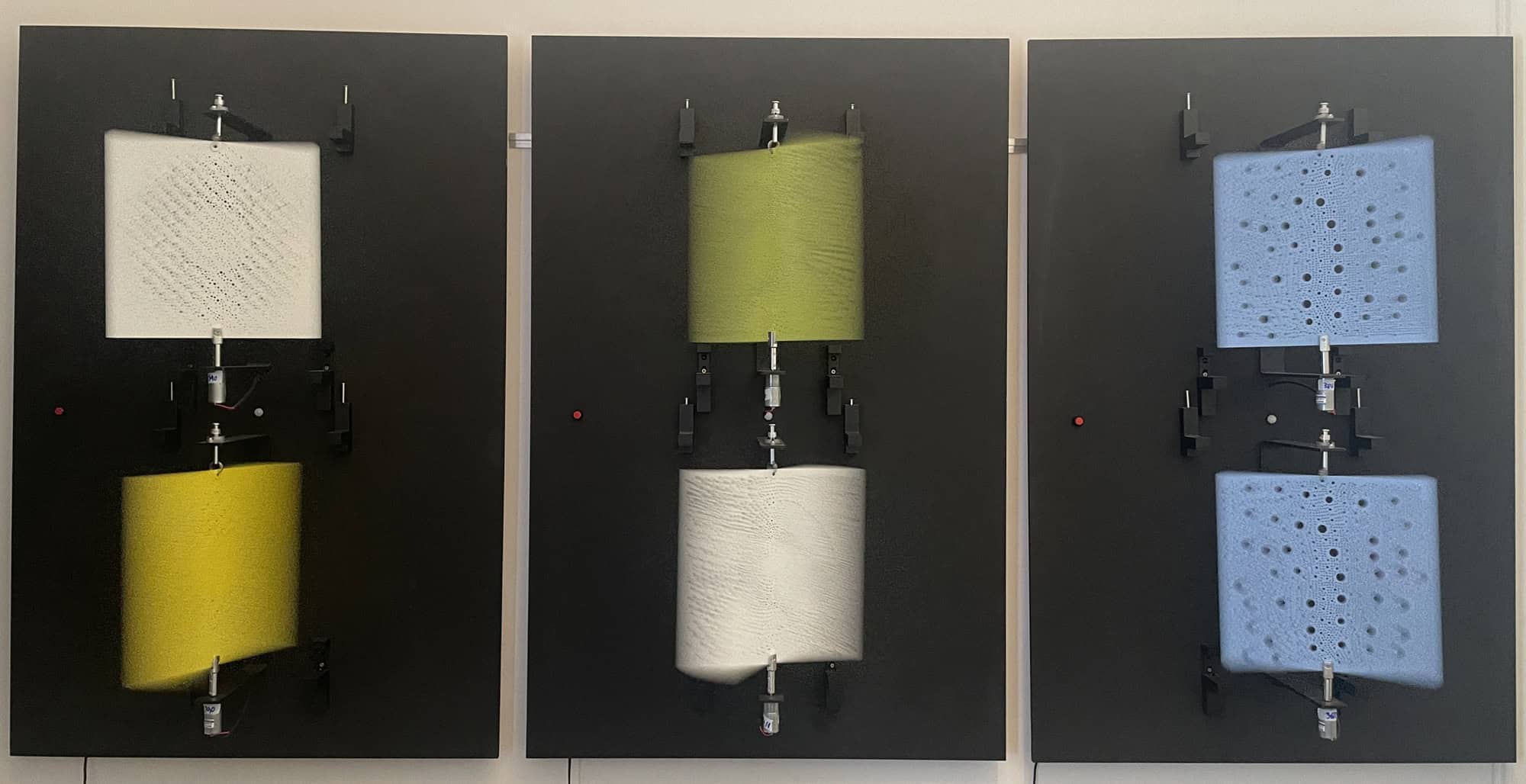
Quantum Quantum Blog Scottish artist marks 100 years of Schrödinger equation with new installation 09 Oct 2026 Michael Banks Reading Time: 2 minutes In a spin: the new quantum-inspired artwork will go on display at the University of Strathclyde in Glasgow on 20–29 October. (Courtesy: Gregor Harvie) Scottish artist Gregor Harvie has created a new artwork to mark 100 years since Erwin Schrödinger published his famous equation that governs how the wave function of a physical system changes over time. Dubbed Superposition, the piece has been created in collaboration with the quantum theory group at the University of Glasgow. The installation explores two of features of quantum physics: superposition and entanglement. It does so via 16 aluminium panels that each have hundreds of holes drilled through them, forming complex patterns. One side is white while the other is coloured and when someone approaches, the panels begin to spin at 400rpm so that their forms “dissolve into shifting three-dimensional illusions”. The panels are arranged in eight pairs and the stopping positions of the panels are random but over time seven pairs show the same side as their partner half the time. This is an analogy for superposition, where the spinning stops is akin to the collapse of the wavefunction. Yet the eighth pair is different. Individually, its two panels still appear to stop randomly, but when seen together they show the same side three quarters of the time – an analogy for entanglement. Harvie, who has a PhD in computational fluid dynamics and previous work Beyond Absolute Zero marked the bicentenary of the birth of Lord Kelvin in 2024, says the artwork puts people inside the quantum universe. The panels are arranged in eight pairs (courtesy: Gregor Harvie) “I wanted to make something you could stand in front of and genuinely not know what you are looking at,” notes Harvie. “The artworks are made of holes, so in a way there is nothing there, but spun fast enough they transform into something remarkable, something the eye can’t quite hold onto. Their form changes depending on where you are looking at them from, and one pair behaves in a way that defies logic.” Theoretical physicist Stephen Barnett at the University of Glasgow says the artwork allows everyone to experience the “strangeness” of quantum mechanics and to question what they are seeing. “Quantum physics challenges our most basic ideas about what it means for something to have a definite state,” he says. “It tells us reality is stranger than anything we encounter in everyday life.” If you want to experience the artwork for yourself, Superposition will be displayed at the Technology and Innovation Centre at the University of Strathclyde during weekdays from 20 to 29 October. Want to read more? Registration is free, quick and easy Note: The verification e-mail to complete your account registration should arrive immediately. However, in some cases it takes longer. Don't forget to check your spam folder. If you haven't received the e-mail in 24 hours, please contact customerservices@ioppublishing.org. E-mail Address Register Michael Banks is news editor of Physics World Back to Quantum Physics World Quantum Briefing 2.0 Read our free digital issue of the Physics World Quantum Briefing today. Read previous Particle physicist Hideki Yukawa: Japan's first Nobel laureate Particle and nuclear Blog Discover more from Physics World Quantum Analysis SPONSORED Festival season finds Quantum Software Lab in high spirits Quantum mechanics Research update Single-photon measurements confirm Richard Feynman’s vision of quantum mechanics Quantum optics Research update What can cutting a photon in half tell us about causality and local equivalence? Related jobs United States | UTC Quantum Center Announcement: Two Tenure-Track Faculty Positions in Quantum Physics Tampere | Tampere University Tenure track position in Computational Physics Singapore | Nanyang Technological University, Electrical and Electronic Engineering Research Fellows, Computational or Experimental X-ray/EUV Nanophotonics Related events Particle and nuclear | Forum NuFor: Nuclear Forensics 2026 13—15 October 2026 | Liverpool, UK Materials | Conference 2026 International Semiconductor Conference (CAS) 14—17 October 2026 | Sinaia, Romania Optics and photonics | Conference International Conference & Expo on Lasers, Optics & Photonics 26—28 October 2026 | Frankfurt, Germany Copyright © 2026 by IOP Publishing Ltd and individual contributors
Tags
Source Information
Discussion
0 professional contributions
Sign in to join this professional discussion.
Be the first to add a constructive contribution.