
Researchers Simulate Near-Error-Free Qubit Coupling with 99.9% Fidelity
Understand this faster with AI


Creating a two-qubit gate for soft 0-π qubits remained an open challenge despite recent demonstrations of single-qubit control in this promising qubit type. Zhenxing Liu, Eli Weissler, and Joshua Combes have proposed an unprotected CZ gate, a fundamental building block for quantum computation, specifically designed for capacitively coupled soft 0-π qubits. A new method controls interactions between quantum bits known as 0-π qubits, achieving remarkably high accuracy in simulations. These qubits offer potential advantages over existing designs by promising longer information storage times due to their unique properties; however, linking two together was previously unresolved. This advance enables multi-qubit operations that were not possible before, potentially leading to more powerful computers utilising this technology. Researchers from the Beijing Key Laboratory of Fault-Tolerant Quantum Computing, University of Colorado Boulder and The University of Melbourne has proposed a new method to link qubits, the fundamental building blocks of quantum computers, specifically those known as soft 0-π qubits. These qubits promise longer information storage times than existing designs, but creating connections between them has been a key hurdle until now.
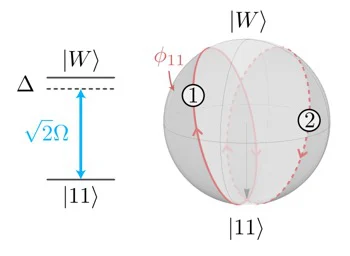
The team’s advance centres around a ‘CZ gate’, which can be likened to a switch allowing two qubits to become linked and influence each other’s state, coordinating actions like players on a team. This newly designed CZ gate operates by moving the qubit into an intermediate energy level, akin to briefly dimming a light before fully switching it on, to enable interaction. Direct qubit control via non-virtual state transitions enables high-fidelity gates A technique centred on manipulating transitions within the qubit’s energy levels was employed for quantum control. It designed a controlled-Z (CZ) gate using a direct transition between a computational state and a higher, non-computational state. A computational state defines whether a qubit registers as ‘0’ or ‘1’, similar to a conventional lightswitch being either off or on, while the non-computational state represents an intermediate level important for manipulation but not directly used for data storage. This approach avoids reliance on virtual energy levels often required in other designs, simplifying implementation and potentially reducing error rates. Capacitively coupled soft 0-π qubits were proposed and simulated as a two-qubit CZ gate; these offer potential advantages over transmon designs due to their longer lifetimes. Simulations achieved approximately 99.9 percent at a gate time of approximately 160ns, assuming minimal device imperfections and modelling noise realistically. Optimisation involved exploring numerous parameters with a ‘differential evolution’ method before validating results within a larger computational space encompassing up to one thousand energy states, ensuring accuracy beyond initial calculations. High-fidelity two-qubit entanglement via capacitively coupled soft 0, π qubits A demonstrated two-qubit controlled-Z (CZ) gate achieves around 99·9% fidelity; this represents an improvement over prior single-qubit operations within the same soft 0-π qubit system where multi-qubit interactions were previously unrealised. Simulations reveal approximately 99·659% fidelity for the CZ gate utilising the nφ drive scheme, with minimal leakage to states such as |10⟩, |19|, and |33⟩. Employing the nθ drive resulted in simulated fidelities reaching about 99·758%, demonstrating improved accuracy alongside faster operation at just 25 nanoseconds. These results were calculated assuming a target lifetime of 30 microseconds, representing both relaxation and dephasing times, and comparable outcomes emerged when varying this parameter between three and 170 microseconds across different gate durations. Notably, driving via nθ consistently outperformed nφ regarding speed and precision throughout these simulations; however, these figures represent performance within an idealised model lacking thorough consideration of real-world device imperfections or complex system interactions. Simulating perfect components versus practical limitations in quantum computing hardware The proposed CZ gate offers a promising solution for enabling multi-qubit operations within the soft 0-π qubit architecture, yet its reliance on idealised conditions presents a clear tension. Simulations assume negligible imperfections in device fabrication and utilise simplified noise modelling which may not reflect reality. Other groups are actively pursuing alternative approaches to achieving fault tolerance, such as physically protecting qubits from environmental disturbances through specialised materials or circuit designs, bypassing the need for exceptionally high gate fidelity altogether. Acknowledging that real-world imperfections in qubit manufacture and environmental noise will certainly present challenges is vital. These unique energy levels offer potentially extended coherence compared with conventional designs; the design establishes a functional two-qubit gate specifically tailored to soft 0-π qubits. The architecture’s potential hinges on overcoming limitations inherent in translating simulations into practical hardware, demanding further research into robust error mitigation strategies and realistic modelling of device behaviour. The researchers demonstrated an unprotected CZ gate designed for capacitively coupled soft 0-π qubits. This development provides a method for performing operations between these specific types of quantum bits, which are intended to have longer operational lifetimes than some existing qubit technologies. Simulations suggest this proposed gate achieves approximately 99.9% fidelity with a duration of around 160 nanoseconds under ideal conditions. Further work is needed to address the impact of real-world imperfections and noise on performance as indicated by the authors. 👉 More information🗞 Two-qubit gates for the soft 0-π qubit✍️ Zhenxing Liu, Eli Weissler and Joshua Combes🧠 ArXiv: https://arxiv.org/abs/2609.16630 More like thisQuantum HardwareMicrosoft Quantum opens Maryland research center with DARPA testingQuantum HardwareTechnion Researchers Simulate Relativistic Particle Motion with Two Dimensions and MassQuantum Computing Business NewsQuEra Computing expands to Maryland’s Capital of QuantumQuantum Research NewsWake Forest opens lab for room-temperature quantum processorsStay currentSee today’s quantum computing news on Quantum Zeitgeist for the latest breakthroughs in qubits, hardware, algorithms, and industry deals. Tags:
Tags
Source Information
Discussion
0 professional contributions
Sign in to join this professional discussion.
Be the first to add a constructive contribution.