
Researchers Send Twin Photons 7 Kilometers Across Brazil’s Guanabara Bay
Understand this faster with AI


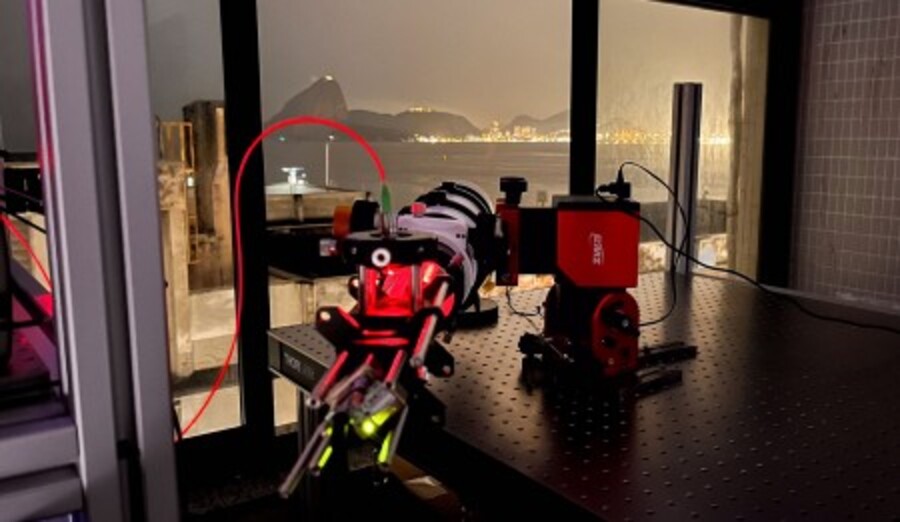
Insider BriefPRESS RELEASE — José Tadeu Arantes | Agência FAPESP — Researchers at Fluminense Federal University (UFF) have taken an important step toward quantum communication and the creation of an ultra-secure internet. They generated pairs of “twin photons,” or particles of light, and showed that the photons maintained a strong correlation even after one traveled about 7 kilometers through the air across Guanabara Bay in Rio de Janeiro. While one photon remained at the UFF laboratory in Niterói, its “twin” crossed the bay to Urca.“A comparison of the two detections showed a number of temporal correlations far greater than could occur by chance,” said physicist Antonio Zelaquett Khoury, a professor at UFF’s Institute of Physics and coordinator of the FAPESP-funded Rio Quantum Network project.The experiment strongly suggests that the photons may have been quantum-entangled and preserved that entanglement even after one member of each pair encountered atmospheric turbulence. If that hypothesis is confirmed, it would mark an important step toward establishing a free-space quantum communication channel.When two particles are entangled, certain properties of each become correlated in such a way that the pair must be described as a single quantum system, even when its components are separated by great distances. This can be used in quantum communication to encode information. One example is the distribution of cryptographic keys with a level of security that cannot be achieved through conventional communication. Any attempt to intercept and measure the photons changes their quantum correlations and could, in principle, reveal the presence of an intruder.“Demonstrating that entanglement survives propagation through kilometers of atmosphere could pave the way for the construction of free-space quantum networks, including those capable of connecting ground stations to satellites,” Khoury said.The twin-photon source was developed by André Luiz da Silva Santos Junior, a doctoral student at UFF’s Institute of Physics, under Khoury’s supervision. The work is funded by FAPESP.“The decisive result appears when the records from the two detectors are compared. Because one photon is detected practically next to the source and the other must cross the bay, there is a short interval of about 20 microseconds between the two detections, essentially corresponding to the second photon’s travel time. Immediately after this interval, a pronounced peak in coincidences appears, proving that the two devices captured the twin pair rather than random light from the environment,” Santos Junior said.The experiment recorded 7,000 accumulated coincidences over a five-second interval, an extremely significant result given that the transmission was horizontal. Information losses are much lower in vertical transmission because the atmosphere becomes thinner farther from Earth’s surface. This means fewer gas molecules, dust particles and water vapor acting as obstacles that can reflect, deflect or absorb light. In horizontal transmission, however, the photons had to cross an extensive layer of air containing turbulence and other sources of loss.Peak in coincidences between detections made at UFF in Niterói and at the Brazilian Center for Research in Physics in Rio de Janeiro. The sharp rise in coincidences at the expected time interval makes it possible to identify photons belonging to the same pairs despite the 7-kilometer distance between the detectors. (Image: André Luiz da Silva Santos Junior)Born togetherPhotons are the elementary units of electromagnetic radiation. In simpler terms, they are the fundamental particles that make up visible light and other forms of radiation. They are called “twins” when they are produced simultaneously in pairs through the same physical process. In the UFF experiment, they are generated when a laser with a wavelength of 405 nanometers, in the blue-violet part of the spectrum, strikes a nonlinear optical crystal.The crystal’s nonlinearity is fundamental to the experiment and requires a more detailed explanation. In ordinary materials, under what is known as linear optics, the electrical polarization induced in an object — meaning the displacement of electric charges caused by light — changes in proportion to the electric field of the light itself. Under these conditions, light can change direction, speed or polarization as it passes through the material, but new frequencies are not generally produced. In other words, if blue light enters the material, blue light with the same wavelength emerges.In some materials, however, the response also contains components that depend on the incoming electric field in a mathematically more complex way. When these components become significant, the process enters the field of nonlinear optics. One consequence is the ability to convert light of one frequency into light of other frequencies.This property makes it possible to generate twin photons. In the process used in the experiment, known as spontaneous parametric down-conversion, or SPDC, a laser photon called the “pump photon” is converted inside the crystal into two lower-energy photons, conventionally called the “signal” and “idler” photons.Conservation of energy requires the combined energy of the two resulting photons to equal that of the original photon, as if they divided the original photon’s energy between them. At the same time, the conditions under which the conversion occurs, particularly what are known as phase-matching conditions, establish relationships among their frequencies, directions of travel and polarizations.As a result, the two photons can be born with strongly correlated properties. Depending on the experimental setup, the resulting quantum state may also be entangled. Certain properties of the two photons then cannot be described independently, as though they shared a single quantum identity even as they moved apart.“The crystal was selected specifically to increase the production of these pairs. Generation is a cumulative process. The farther the light travels through the material, the greater the probability that conversion will occur. The source also becomes brighter, in the sense that it generates more pairs. André [Santos Junior] selected the long-crystal architecture specifically to maximize pair generation,” Khoury said.All of this was carefully planned because the distinguishing feature of the experiment was that it moved into the open air, outside the protected conditions of the laboratory.“To overcome the loss we would inevitably face, we needed to generate many pairs. We therefore investigated different configurations until we arrived at the architecture used in the source,” Santos Junior said.Entanglement or not?There is, however, an important distinction. The fact that two photons are twins does not automatically mean they remain entangled. Entanglement is a specifically quantum and much deeper type of correlation in which certain properties cannot be assigned independently to each particle. Instead, they belong to the state formed by the pair.The source built by Santos Junior was designed to produce photons entangled through their polarization. Polarization concerns the spatial orientation of the oscillation of light’s electric field, which can be horizontal or vertical. Imagine a stretched rope being moved up and down to create vertical waves or from side to side to create horizontal waves.Because two entangled photons form a single quantum state, an entangled pair can exist in a superposition of the possibilities “horizontal and horizontal” and “vertical and vertical.” An independent polarization cannot be assigned to either photon in advance.“Polarization entanglement has already been demonstrated when both photons are measured locally at UFF. The challenge now is to demonstrate that this entanglement remains intact when one of the photons travels across Guanabara Bay,” Khoury said.Khoury added that verifying the correlation, or the photons’ status as twins, represented the largest bottleneck. Researchers overcame that obstacle by detecting coincident signals.“Without the signals, we would have no way to test anything. Once we have proof that we are actually observing a pair of twin photons, with one detected at UFF and the other 7 kilometers away, we can begin working to improve signal quality and seek evidence of entanglement.”That qualification is essential. The experiment has not yet demonstrated that the two photons remain entangled after being separated by 7 kilometers. So far, it has demonstrated the local production of highly entangled pairs and, separately, the remote detection of coincidences between the twins.The next step will be to conduct the polarization measurements needed to determine whether entanglement remains intact after one photon travels across the bay, with the detectors positioned at the two distant locations.A channel through the atmosphereSending a single photon through kilometers of atmosphere and making it arrive at the intended destination is not a simple task. Well before conducting the experiment with photon pairs, the group studied the behavior of the optical channel between Niterói and Urca using conventional laser light.Atmospheric turbulence can sharply alter the spatial distribution of a beam, move it and make it difficult for the receiving telescope to collect. The tests also revealed a favorable property, however. The light’s polarization proved extremely resistant to the journey.“In tests conducted by our group, different polarization states were transmitted across the bay and recovered with fidelity greater than 99%. This indicated to us that polarization was the best property for encoding information in the photons,” Khoury said.The result is particularly important because polarization is the property the group plans to use to establish entanglement between the separated photons and later implement quantum communication protocols.The fact that entanglement has not yet been conclusively demonstrated may give the false impression that the study remains at an early stage. That is not the case. The group has already completed a substantial amount of work.A system for active stabilization had to be developed just to keep the telescopes correctly aimed. Small mechanical and temperature-related changes cause the equipment to drift slowly out of alignment. Over a distance of 7 kilometers, this can be enough to make the beam miss the receiver.A light source installed at the opposite end serves as a reference. A camera tracks its position, and when it detects movement, software directs motors to automatically correct the telescope’s aim.According to Khoury, the characterization of the polarization of light transmitted through the open-air channel and the active stabilization system were developed at UFF’s Institute of Physics by postdoctoral researcher Amanda Kronhardt Fritsch, a FAPESP fellowship recipient, and doctoral student Marcos Gil de Oliveira, who is supported by Brazil’s National Council for Scientific and Technological Development.The work also included contributions from students Altilano Cristino Barbosa, a FAPESP doctoral fellowship recipient, and Iury Prego Grego Correa, who holds a FAPESP undergraduate research fellowship.The two sides of the experiment also had to be synchronized with great precision. Each detector produces an electronic signal when it records the arrival of a photon, and the exact time of that detection must be marked precisely. The signal researchers are seeking emerges from a comparison of those times.To identify which records made in Niterói and Urca could correspond to members of the same pair, researchers had to compare the timestamps. Each station therefore had its own GPS-synchronized clock. The comparison of detection times also required data to be sent from one station to the other.“The rate at which information could be transmitted over the conventional internet was insufficient to properly record the coincidences in real time. The problem was solved when MLS Wireless installed a dedicated radio link between the two stations. The company’s CEO, Rogério Passy, was a graduate-school colleague of mine at PUC-Rio [the Pontifical Catholic University of Rio de Janeiro] in the 1990s and has extensive experience in optical communication,” Khoury said.He added, “In addition to the team working at UFF, Professor Rafael Ferreira Pinto do Rego Barros of the University of São Paulo’s Institute of Physics has collaborated with us on various aspects of the open-air link, providing discussions and suggestions for assembling the entangled-photon source, the detector synchronization system and the link’s optical arrangement.”Some photons come from other sources, and coincidences can occur accidentally. When the pair source is turned on, however, a sharp increase in coincidences appears at the expected time interval.“The figure showing the peak is the result itself. It was the signal we were looking for. By a fortunate coincidence, we obtained the first detections on Aug. 20, 2026, the exact day the Brazilian Physical Society was celebrating its 60th anniversary,” Khoury said.*Note: The release was computer translated into English.TopicsShare Get the latest research, company news, and market intelligence every week. MENTIONED IN THE ARTICLEMore in Research
Tags
Source Information
Discussion
0 professional contributions
Sign in to join this professional discussion.
Be the first to add a constructive contribution.