
QuTech coordinates European effort to build world’s first full-stack quantum internet prototype
Understand this faster with AI


QuTech QuTech will coordinate the next phase of a major European effort to build a full-stack quantum internet prototype.
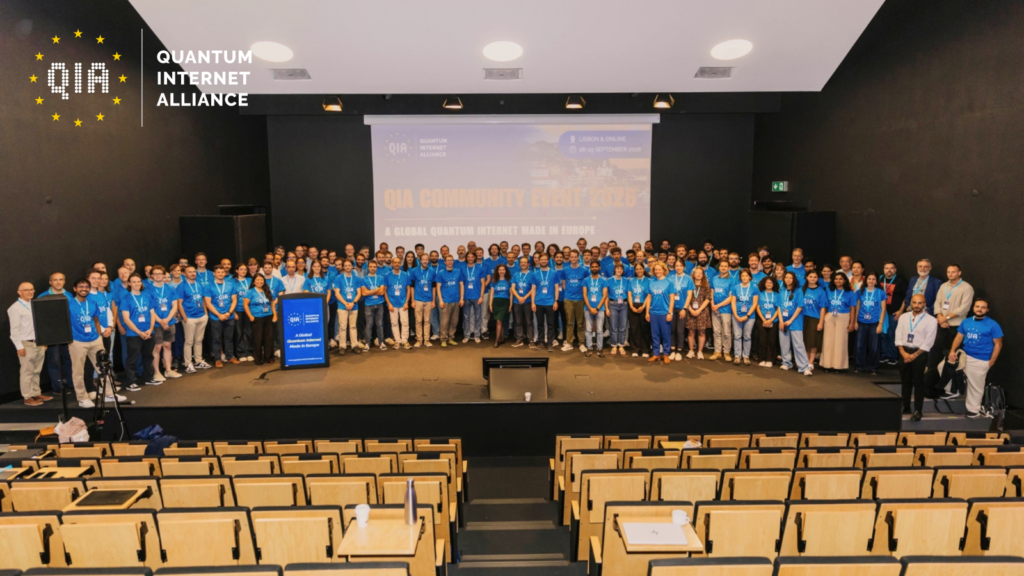
The Quantum Internet Alliance (QIA), a consortium of more than 50 organisations across Europe, has received €47.5 million from the European Commission to advance this ambition. Over the next 3.5 years, the consortium aims to connect two metropolitan-scale quantum networks through a long-distance fibre link, creating a programmable network capable of running quantum applications.The funding marks the second phase of QIA’s programme, building on research carried out between October 2022 and March 2026. During this period, researchers and engineers across Europe developed key technologies for quantum communication and laid the foundations for a prototype quantum network. The next step is to integrate these individual components into a complete system capable of supporting quantum network applications. One of the central goals is to demonstrate a connection between two metropolitan-scale quantum networks using a long-distance fibre link. This requires quantum repeaters, an essential technology for extending quantum connections over larger distances. A quantum internet would enable new forms of communication and computing by using quantum information. Potential applications include fundamentally secure communication and connecting quantum processors to perform tasks across a network. To support such applications, QIA is developing a full-stack prototype. This means integrating not only physical quantum devices, but also the control systems, networking protocols and software needed to operate a programmable quantum network. The ambition is to make it possible to run quantum network applications on an integrated system, rather than working with individual experimental components. “Over the past years, we have developed the core building blocks of a quantum internet. Our mission in this next phase is to integrate these components into a full stack quantum internet prototype,” says Stephanie Wehner, QIA Director and professor at QuTech, part of TU Delft. “Europe is at the very forefront of quantum internet technologies world-wide, and this prototype may become the first of its kind in the world.” Alongside developing the prototype, QIA will take steps towards making quantum networking technologies available to a wider community. This includes preparations for pilot facilities and open-access infrastructure where researchers, developers and companies can explore and test quantum network applications. The programme also aims to strengthen connections between academic research and industry. Technologies developed within QIA have already contributed to commercial products, while startups emerging from the alliance’s wider ecosystem are working to translate scientific advances into practical solutions. QIA brings together universities, research institutes, telecommunications operators, technology companies and startups from 12 European member states. The alliance’s coordination activities are hosted at QuTech in Delft, while research and development take place across the participating organisations. The new funding will allow these partners to combine their expertise and take an important step from individual quantum technologies towards an integrated network. If successful, the prototype could become the first of its kind worldwide and provide a foundation for the development of larger quantum networks and future quantum internet applications. Several research groups at QuTech contribute to QIA, including those led by Stephanie Wehner, Carlos Errando-Herranz and Sophie Hermans, whose work spans quantum network software, integrated photonics and quantum-network hardware. The Delft ecosystem also contributes through companies including Delft Networks, which develops entanglement-distribution systems and networking software, as well as Falqon Systems (formerly Q*Bird) and Qblox, which works on quantum-network components and architectures.This website uses cookies. By clicking "I accept" you give your permission to this website to use cookies. What are cookies?This website uses cookies so that we can provide you with the best user experience possible. Cookie information is stored in your browser and performs functions such as recognising you when you return to our website and helping our team to understand which sections of the website you find most interesting and useful.Strictly Necessary Cookie should be enabled at all times so that we can save your preferences for cookie settings.This website uses Google Analytics to collect anonymous information such as the number of visitors to the site, and the most popular pages.Keeping this cookie enabled helps us to improve our website.
Tags
Source Information
Discussion
0 professional contributions
Sign in to join this professional discussion.
Be the first to add a constructive contribution.