
Quantum computers finally get an upgrade: this chip promises a game-changing breakthrough - Futura, le média qui explore le monde
Understand this faster with AI


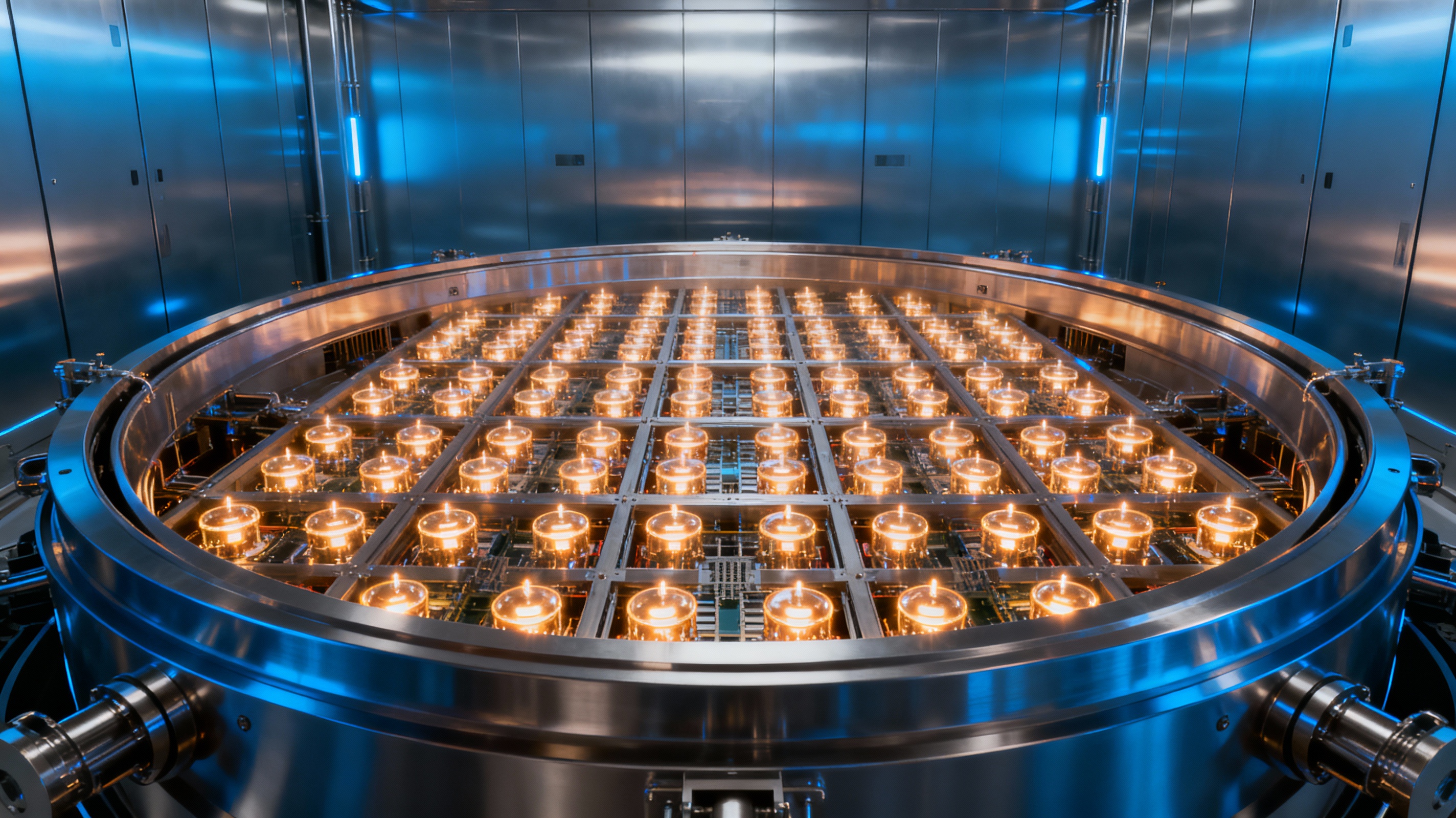
Home News Quantum computers finally get an upgrade: this chip promises a game-changing breakthrough Quantum computers finally get an upgrade: this chip promises a game-changing breakthrough Category : Technology September 9, 2026 3 min A neuromorphic chip developed by researchers at the University of Hong Kong could accelerate the development of quantum computing. ©AP with ChatGPT AI Share facebook twitter linkedin newsletter Futura Team Pia Gray The biggest barrier to scaling up quantum computers might come down to a giant mess of wires. Quantum processors only work near absolute zero, inside sealed dilution refrigerators. As their control systems generate heat, engineers have to keep that hardware completely out of the cold zone. The result is a tangled bundle of cables that grows more crowded and impractical with every qbit added to the system. To solve the problem, researchers at the University of Hong Kong looked where everyone else had stopped. They found a fix by exploiting the unique carrier dynamics inside everyday silicon carbide transistors. Led by Professor Yuhao Zhang and PhD student Xin Yang, the team designed a microchip that operates directly at 10 millikelvin—a fraction of a degree above absolute zero. Instead of running on continuous electrical signals that bleed steady heat into the system, the chip fires energy-efficient pulses that mirror how biological neurons transmit data. How a single transistor mimics a neuron To make the chip run cold, the HKU team focused on a silicon carbide MOSFET. This is a standard industrial transistor. When cooled below 2 kelvin, the material undergoes a physical shift called gate-controlled negative differential resistance, driven by electron-donor impact ionization. At these ultracold temperatures, trapped electrons break free in predictable bursts when an electric field is applied. By carefully tuning the voltage across a single transistor, the researchers coaxed it into producing discrete, spiking electrical signals. By processing instructions in short, precise bursts rather than a continuous stream, the circuit consumes far less power and releases almost no waste heat. Bringing control hardware to the qubits Slashing the heat footprint changes the entire physical layout of a quantum computer. Because the hardware stays cool, control circuits can sit directly alongside qubits in the deepest part of the refrigerator. Shortening that physical distance eliminates meters of cabling, which slashes mechanical complexity, drops background electrical noise, and dramatically simplifies the build of larger quantum rigs. Instead of routing hundreds of individual coaxial lines through complex cooling zones, engineers could run a small handful of high-density cables into a local control module. Silicon carbide also resists high radiation and thermal stress. Beyond quantum hardware, the HKU team points to unheated deep-space probes as another application where instruments must run for years in absolute cold. What still needs to be tested While the team demonstrated working transistor physics at 10 millikelvin, the chip is not yet connected to live qubits inside a working quantum computer. The design provides a clear path past the industry’s wiring problem, but key practical questions remain open. Generating While the team demonstrated working transistor physics at 10 millikelvin, the chip is not yet connected to live qubits inside a working quantum computer. The design provides a clear path past the industry’s wiring problem, but key practical questions remain open. Generating neuromorphic pulses is only the first step. Engineers must now prove that these brain-inspired signals can execute precise quantum logic operations without disturbing delicate superposition states. Future research will show if these circuits can hold up as quantum processors scale toward commercial size. Source: Yang, X., Porter, M., Qin, Y., et al. “Cryogenic neuromorphic circuits using gate-controlled negative differential resistance in silicon carbide.” Nature Communications. Share facebook twitter linkedin newsletter Print article Latest news Category : Health Scientists stunned: These 3 daily habits might shield your brain from dementia Category : Space These light-powered mini-ships could reach another star in just 20 years Category : Environment Scientists fear hundreds of volcanoes could wake up soon Category : Science How to Spot Snake Eggs—And the Shocking Law You Probably Ignore Category : Science Scientists create a “blob”… and discover an unexpected phenomenon Category : Science A Cosmic “Barcode” Has Indeed Been Detected Around Black Holes Category : History Outrage in China: Why a Child’s Tragic Death Remains a Secret Category : Science These Neanderthals were eaten, but no one knows where or by whom Category : Technology Scientists or spies? The incredible top-secret mission behind the discovery of the Titanic Category : Space Is the universe younger than we thought? Scientists weigh in See also Category : Technology 100 Times Faster: The AI Prototype That Could Change Everything Category : Technology How ethanol could power the future of electric vehicle charging Category : Technology Why This Humanoid Robot Is Freaking Everyone Out — And Advancing Faster Than Ever Category : Technology Is China Closing the AI Gap With Silicon Valley?
The Latest Advances Raise New Questions
Tags
Source Information
Discussion
0 professional contributions
Sign in to join this professional discussion.
Be the first to add a constructive contribution.