
QuantrolOx Expands U.S. Presence With Berkeley Quantum Nexus Office
Understand this faster with AI


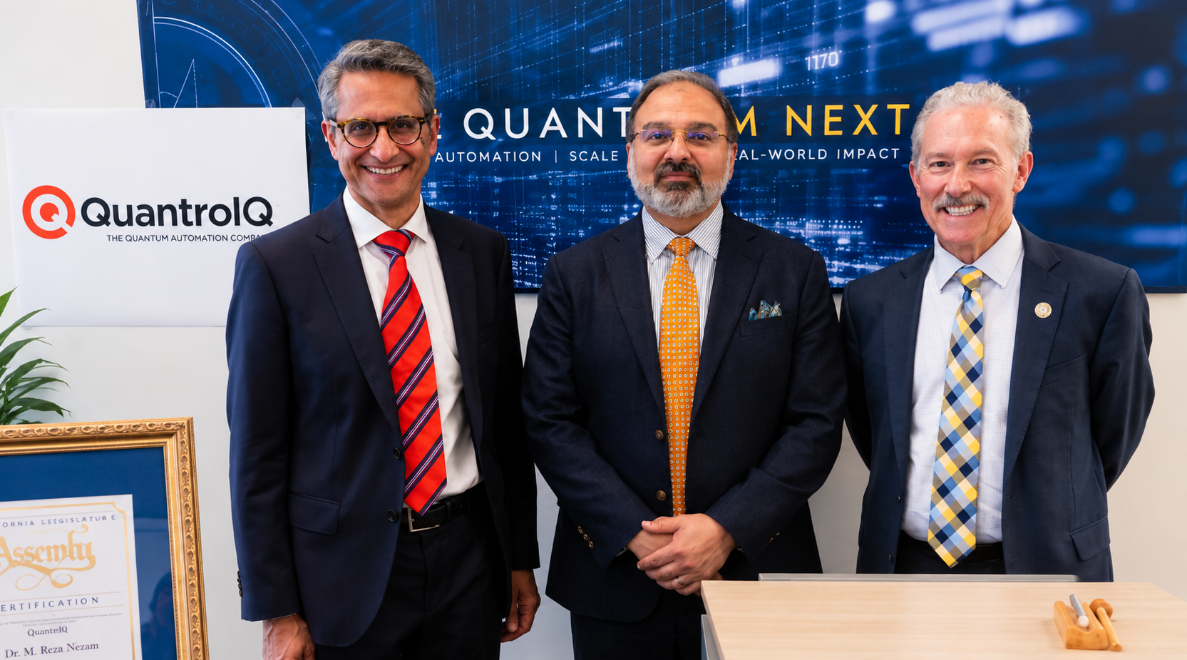
Insider BriefPRESS RELEASE — Quantum researchers and campus leaders heralded the arrival of QuantrolOx at UC Berkeley’s Roger Herst Quantum Nexus. The occasion marks the first U.S. office for QuantrolOx, establishing a foothold for the qubit automation company at a leading quantum research hub.QuantrolOx works closely with UC Berkeley physics professor Irfan Siddiqi’s lab to accelerate quantum research and development. The partnership spans research through commercialization, centered on the end-to-end industrialization of quantum processing units (QPUs) — bringing software-defined quantum control from the laboratory toward scalable, real-world deployment.“UC Berkeley excels in the fundamental and translational aspects of quantum information science,” said Siddiqi. “By formalizing this close-knit partnership, we are primed to harness QuantrolOx’s commercial expertise and automation breakthroughs to advance quantum computing toward its next era of information processing.”“No physicists want to waste time tuning qubits, they want to use them,” said Vishal Chatrath, the co-founder and CEO of QuantrolOx. “In any case, there aren’t enough physicists qualified to tune all the qubits this industry is about to build, and with $12.6 billion pouring into quantum technologies last year alone, that shortage is about to get a lot more expensive to ignore. Berkeley is where more of tomorrow’s quantum hardware is being built than almost anywhere else. That’s exactly where we need to be standing to close the gap.”Chancellor Rich Lyons welcomed the new tenant with remarks that focused on UC Berkeley’s role as a hub of innovation and entrepreneurship(link is external). “I am thrilled to welcome QuantrolOx into our advanced quantum ecosystem,” said Lyons. “This is the latest example of how UC Berkeley fuels the open exchange of ideas between academia, industry, and the government to revolutionize technology and advance society.”The Quantum Nexus was launched in 2025 as a dedicated interaction and incubator space for California’s quantum community. Located in downtown Berkeley just one block from campus, the historic building maintains over 6,000 square feet of office space and meeting rooms for scientists, engineers, entrepreneurs, and policymakers.Siddiqi serves as the director of the Quantum Nanoelectronics Laboratory (QNL) and the chair of the Department of Physics at UC Berkeley. The QNL partners with companies like QuantrolOx to evaluate novel emerging technologies, train scientists and engineers on the latest tools, and advance quantum processor and algorithm development. On July 4, one of his lab’s superconducting QPUs was included in California’s contributions to a time capsule(link is external) buried in honor of the nation’s 250th birthday.UC Berkeley has gained a reputation as a neutral arbiter for the quantum industry thanks to a host of researchers exploring a broad range of quantum technologies and approaches. That advanced research regime has also been recognized multiple times by the Nobel Prize committee, including the 2025 Nobel Prize in Physics(link is external), which was awarded to three researchers who performed trailblazing experiments demonstrating quantum effects in superconducting circuits — the basis of today’s qubit chips — at UC Berkeley in the 1980s. Last month, the U.S.
National Science Foundation (NSF) announced it would renew its support(link is external) for the NSF Quantum Leap Challenge Institute for Quantum Computation, a multi-institutional research center led by UC Berkeley.QuantrolOx is a multinational company that spun out of research from the University of Oxford. Its hardware-agnostic, machine-learning-based software allows for automated qubit characterisation, calibration, and control. Qubits — the basic unit of information used to store data in quantum computers — can take days to develop. As a result, researchers need to find efficient ways to conduct their work. QuantrolOx’s flagship product, Quantum EDGE, automates tuning and optimizing superconducting quantum computers, cutting fundamental experiment times to seconds and simplifying complex tasks like randomized benchmarking.By deepening its US presence within the Berkeley quantum ecosystem, QuantrolOx joins the researchers and institutions advancing scalable quantum computers. The Berkeley office will serve as QuantrolOx’s base for U.S. market development and research collaboration as the company continues to grow its presence across North America. Claire Cramer, the executive director of Berkeley Quantum, said that hosting QuantrolOx in the Roger Herst Quantum Nexus is a momentous first step towards a new paradigm for quantum industry partnerships at Berkeley.“This event is a tangible win for the state’s Quantum California initiative, with UC Berkeley and the Roger Herst Quantum Nexus realizing the vision to make the state the global epicenter of the quantum economy,” said Cramer. “The Quantum Nexus is where Berkeley’s academic rigor meets industrial expertise, serving as the launchpad for global innovation in the quantum space.”TopicsShare Get the latest research, company news, and market intelligence every week. MENTIONED IN THE ARTICLEQuantrolOx develops automated machine learning based control software for quantum technologies to tune, stabilize, and optimize qubits. QuantrolOx’s software is technology agnostic and applicable to all types of quantum technologies, and their goal is to maximize quantum computer uptime and make their hardware more accessible.More in Research
Tags
Source Information
Discussion
0 professional contributions
Sign in to join this professional discussion.
Be the first to add a constructive contribution.