
Quandela Seeks South Korean Partners for Photonic Quantum Computing
Understand this faster with AI


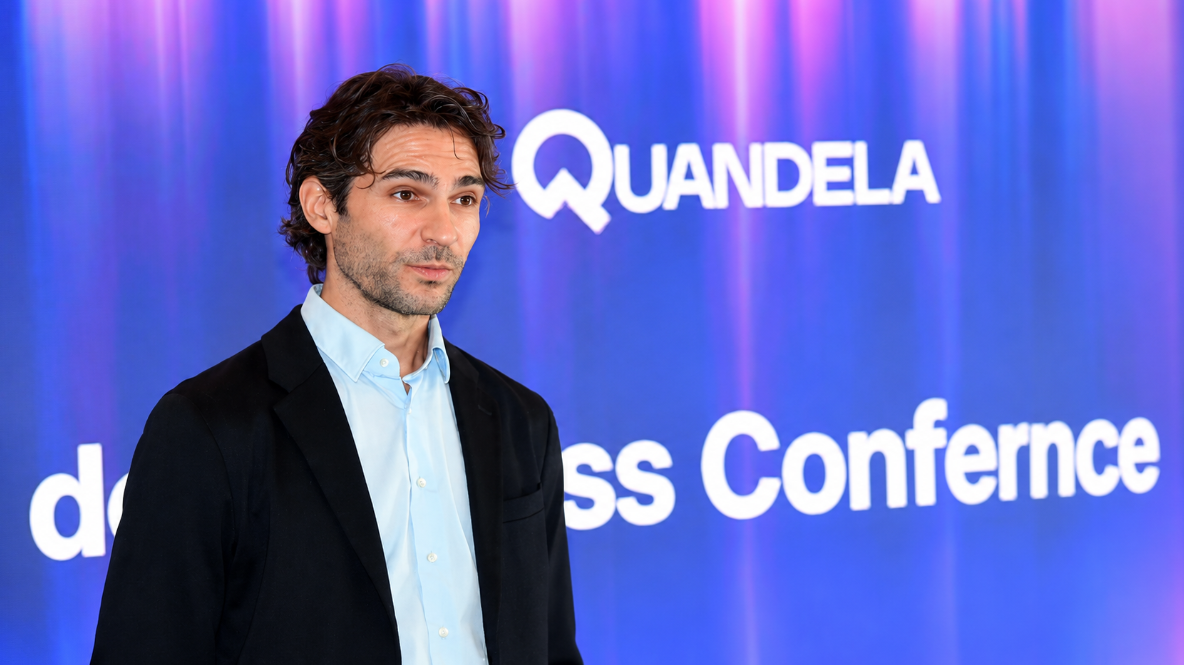
Insider BriefFrench photonic quantum computing company Quandela intends to spend the next two years lining up strategic partners in South Korea, with joint work expected to cover quantum chip manufacturing, system integration, demonstration, and real-world operation, Seoul Economic Daily reported.CEO Niccolo Somaschi presented the company’s Korea strategy and a medium- to long-term roadmap toward fault-tolerant quantum computing (FTQC) at a press conference held at Centropolis in Seoul’s Jongno district on the 28th.Quandela‘s quantum computers run on photons. The company has recently worked with NVIDIA to connect quantum processing units (QPUs) with graphics processing units (GPUs), part of an effort to pair quantum machines with existing computing infrastructure. Mass-producing photonic quantum computers and scaling their performance over time depends on semiconductor-grade precision manufacturing and inspection, which is why the company wants to deepen technical ties with Korea’s manufacturing base.“Combining Quandela‘s quantum computing expertise with Korea’s semiconductor manufacturing technology would make a perfect match,” Somaschi said. “Over the next two years, we will identify partners in Korea, review whether photonic modules are suitable for mass production, and reflect the results in our technology roadmap toward FTQC.”Quandela plans to work with Korean companies and research institutions on quantum hardware manufacturing, cryogenic control and system integration, and the quantum operating stack, according to Seoul Economic Daily.Manufacturing — the company aims to develop photonic modules suited to mass production, drawing on Korean semiconductor and photonic technology. It plans to test whether mass production is feasible using advanced packaging, wafer-level inspection, and precision optical alignment, then produce a joint manufacturing roadmap.System integration — the cryogenic environment and high-speed control devices that quantum computers need would be combined into one system. The goal is a control system that cuts computational latency, along with an integrated environment for testing it.Operations — Quandela plans to co-develop error correction technology and methods for linking quantum computers to existing infrastructure such as GPUs for artificial intelligence, high-performance computing (HPC), and cloud services. It also intends to run a proof of concept in Korea connecting QPUs with HPC.The company is weighing the creation of a quantum manufacturing consortium made up of Korean companies and research institutions, the source reported. Quandela would contribute its own technology and system roadmap, plus its experience building and running QPUs in Europe. Korean participants would supply strengths in semiconductors, photonics, advanced manufacturing, and system integration. Under the proposed structure, each institution would keep its existing intellectual property, while newly created IP would be shared based on each party’s role and contribution.Cooperation with Korea’s three main quantum clusters, Seoul, the Jeonnam-Gwangju region, and the southeastern region, was also raised as an option. “We see room for cooperation centered on quantum computing in Seoul, quantum communications in Jeonnam-Gwangju, and quantum sensing in Busan, Ulsan and South Gyeongsang Province,” Somaschi said.Samsung, SK hynix, and LG Innotek were named as possible corporate partners, as cited by Seoul Economic Daily. “There is potential for cooperation with each company in semiconductor manufacturing capabilities and module integration,” Somaschi said. “We will build tangible cases of cooperation with Korean companies and research institutions, and over the long term develop Korea into a key hub for cooperation across Asia.”Readers looking to learn more about Photonic Quantum Computing Landscape, can check out Photonic Quantum Technology Companies in 2026. TopicsShare Get the latest research, company news, and market intelligence every week. MENTIONED IN THE ARTICLEQuandela is a French startup that specializes in photonic quantum computing by providing modular, scalable, and energy-efficient photonic quantum computers, accessible both on the cloud and on premise. They provide prototyping services with their Perceval simulator alongside their general purpose chips optimized chips, and development of algorithms and protocols which provide photonic solutions for applications ranging from pharmaceutical and material design, to quantum machine learning, networking and optimization.NVIDIA Corporation is an American multinational technology company and a global player in accelerated computing and Artificial Intelligence (AI). Founded in 1993, the company pushes the aerospace frontier with the Space-1 Vera Rubin Module, a platform for orbital data centers that delivers massive AI-compute Space Computing. This NVIDIA technology enables satellites and autonomous spacecraft to process and fuse sensor data rapidly Space Computing.More in Research
Tags
Source Information
Discussion
0 professional contributions
Sign in to join this professional discussion.
Be the first to add a constructive contribution.