
Qedma, IBM, RIKEN, and BlueQubit Resolve Prethermal Floquet Dynamics on 74 Qubits Beyond Classical Convergence Limits
Understand this faster with AI


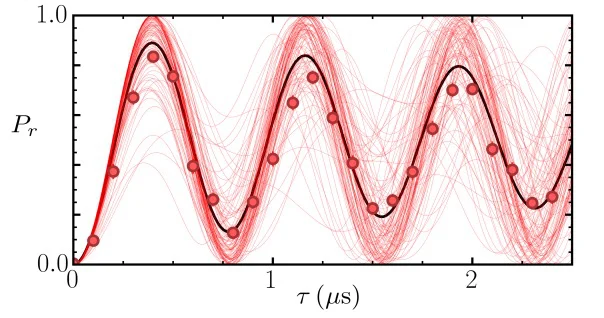
(a) Schematic of Floquet prethermalization. (b) Runtime and accuracy frontier for estimating the magnetization of the 51-qubit Floquet circuits Researchers from Qedma Quantum Computing, IBM Quantum, RIKEN, and BlueQubit have resolved long-lived subharmonic magnetization oscillations in a driven Floquet Ising magnet on heavy-hex lattices of up to 74 qubits, demonstrating error-mitigated quantum dynamics in a regime where state-of-the-art classical tensor-network and Pauli-path simulations fail to converge. Executed primarily on IBM’s 156-qubit Heron r3 processor (ibm_boston) using Qedma’s QESEM error-mitigation software and cross-checked on Quantinuum’s H2 and Helios trapped-ion processors, the experiment provides strong finite-size scaling evidence that the subharmonic oscillatory response persists in the thermodynamic limit of heavy-hex ladders.
Prethermal Floquet Ising Experiment & Classical Comparison BenchmarksDimensionExperimental & Simulation MetricsQuantum Hardware & Geometries51-qubit (6-loop) and 74-qubit (9-loop) heavy-hex patches on IBM Heron r3 (ibm_boston, effective 2Q infidelity 0.22%–0.31%), with cross-platform checks at cycles 16, 17, and 19 on Quantinuum H2 and HeliosError Mitigation ProtocolsQESEM-Unbiased (probabilistic error cancellation, cycles 1–16, 38M shots) and QESEM-Extrapolated (noise-amplified ZNE, up to 30 cycles, 83M shots on 51Q; cycles 15–27, 47M shots on 74Q) at ~5 × 10⁻³ precision (~30× circuit-volume boost)Thermodynamic Scaling FindingPeriod-4T oscillations on coordination-two sites yield an asymptotic offset c = 9.6 × 10⁻³ (8.7σ above zero) and decay scale ξ = 0.7 across 21- to 74-qubit systemsClassical Tensor-Network Limits2D PEPS-BP (up to bond dimension D = 700, 600 hrs, 280 GB RAM) loses convergence after ~12 cycles; Heisenberg PEPO-BP breaks down at ~7 cycles; heuristic-corrected 1D TEBD (χ = 4096) fails to generalize to 74 qubitsSparse Pauli-Path (SPP) LimitsFugaku supercomputer runs (ORQA across 12,888 nodes retaining O(1012) Pauli strings) diverge by cycle 7 and develop phase inversions by cycle 15; converged 51Q simulation estimated at ~1030 Pauli strings To probe non-equilibrium dynamics that resist rapid thermalization without relying on high-frequency approximations, the team tuned fractional-angle nearest-neighbor ZZ rotations alongside single-qubit X and Z drives to maximize both state and operator entanglement while preserving measurable magnetization over 30 Floquet cycles. While unmitigated hardware measurements decayed into noise by cycle 4, QESEM-Unbiased and QESEM-Extrapolated estimators tracked exact small-system benchmarks and agreed with independent gate-folded ZNE runs on Quantinuum trapped-ion systems, revealing period-four subharmonic oscillations whose amplitude decays much more slowly with system size than 21- to 35-qubit statevector simulations alone could resolve. Benchmarking the 51- and 74-qubit circuits against complementary classical solvers underscored the difficulty of capturing simultaneous state and operator complexity growth. Both Schrodinger-picture PEPS-BP and Heisenberg-picture PEPO-BP tensor networks exhibited nonphysical upward magnetization drift after truncation errors accumulated, while massive Sparse Pauli-Path runs on RIKEN’s Fugaku supercomputer and noise-extrapolated GPU Pauli-path simulations suppressed the high-weight Pauli strings responsible for the late-cycle oscillations. Access the technical paper on arXiv here, and review QCR’s prior coverage of Qedma’s QESEM integration with Quantinuum here and cross-stack error-mitigation benchmarks on 156-qubit IBM Heron hardware here. In GQI Portal The players behind the news The team that writes QCR tracks every company, deal and technology in the GQI Factory, GQI's verified database of the quantum industry. Next up: every story linked to its players, coming to QCR's paid plans. Players →Companies and institutions across the quantum industry, by segment. Scorecards →How the players compare on hardware, software, funding and more. Newsletter QCR Alerts in your inbox The latest reporting and analysis from Quantum Computing Report. Free, unsubscribe any time. Sign up for QCR Alerts Leave a commentCancel replyAll fields are required. Your email address will not be published.CommentName Email Type in the text displayed above Δ
Tags
Source Information
Discussion
0 professional contributions
Sign in to join this professional discussion.
Be the first to add a constructive contribution.