
QCOS™ by SoftQuantus: Technical Claims, Scientific Computing Services, and Verifiable Quantum Execution
Understand this faster with AI


QCOS™ by SoftQuantus: Technical Claims, Scientific Computing Services, and Verifiable Quantum Execution Engineering Quantum Computing for Reproducible Science and Enterprise Infrastructure Technical Article | SoftQuantus innovative OÜ | October 2026 Abstract Quantum computing is advancing from experimental algorithms toward increasingly accessible computational infrastructure. However, significant engineering challenges remain in workload orchestration, hardware interoperability, scientific reproducibility, execution governance, and the verification of computational results. SoftQuantus is developing QCOS™ (Quantum Computer Operating System) as a vendor-neutral software execution and governance layer designed to address these challenges. QCOS provides interfaces for quantum simulations, structured execution records, cryptographic evidence verification, and integration with scientific applications and AI agents. Its architecture is designed to extend toward heterogeneous quantum processing units (QPUs), high-performance computing (HPC), and hybrid quantum-classical environments. Rather than claiming universal quantum advantage, SoftQuantus focuses on a measurable engineering objective: making advanced computational workflows accessible, traceable, reproducible, and independently verifiable. Technical Architecture and Computational Model QCOS operates as a software abstraction between scientific applications and their computational execution environments. Its logical architecture consists of five interconnected layers: Application Layer: Scientific software, enterprise applications, research notebooks, AI agents, and custom algorithms.
Execution Interface Layer: REST APIs, Python SDKs, command-line interfaces, and Model Context Protocol (MCP) integration. Runtime and Governance Layer: Workload validation, execution configuration, operational policies, job management, and result tracking.
Computational Backend Layer: Currently available simulation runtimes, with an architecture designed for expansion toward GPU/HPC infrastructure and physical QPUs. Evidence and Verification Layer: Structured execution metadata, cryptographic integrity records, and offline result verification. A scientific workload can be represented abstractly as: W = (C, θ, B, N, P) Where: C represents the quantum circuit or computational model. θ represents algorithm parameters. B identifies the selected computational backend. N defines the requested number of measurement shots or sampling operations. P specifies execution and governance policies. The resulting execution can be described as: R = (Y, M, E) Where Y contains computational outputs, M describes execution metadata, and E represents the associated evidence. This mathematical representation describes the architecture conceptually rather than prescribing a single internal QCOS data schema.
Core Technical Claims Claim 1 — Vendor-Neutral Quantum Execution Interfaces QCOS provides software interfaces intended to reduce direct dependencies between scientific applications and individual quantum computing providers. The documented integration surface includes REST APIs, Python tooling, command-line execution, and MCP-compatible agent tools. This allows developers to build workloads around shared software contracts rather than creating an entirely separate application for each computational provider. Technical significance: Provider interoperability improves workflow portability and reduces the engineering cost of integrating additional execution environments. Current scope: Simulation interfaces are available. Generalized commercial access to heterogeneous physical QPUs remains under development. Claim 2 — Cryptographically Verifiable Execution Evidence QCOS associates execution results with evidence records that can be checked independently. The available evidence architecture uses SHA-256 hashing and Merkle-root sealing to establish tamper-evident integrity relationships between recorded artifacts. The open-source softquantus-verify package enables offline verification without requiring the reviewer to trust the original execution service. This establishes an important distinction: Cryptographic verification establishes the integrity of recorded evidence; it does not independently prove the physical accuracy of an experiment or the correctness of its scientific interpretation. For regulated research environments, this distinction enables more rigorous separation between computational output, recorded provenance, and scientific validation. Claim 3 — Reproducible Scientific Simulation QCOS supports quantum simulation workflows involving parametrized circuits, measurement statistics, and algorithm-specific computational outputs. The publicly documented execution capability includes CPU state-vector simulation for systems of up to 24 qubits, subject to workload and memory constraints. Scientific simulation services can evaluate: Variational Quantum Eigensolver (VQE) workloads for molecular energy estimation.
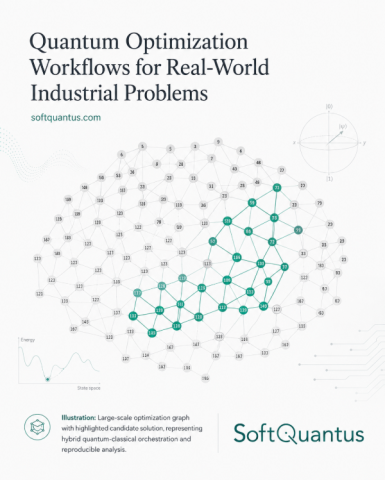
Quantum Approximate Optimization Algorithm (QAOA) experiments. Entanglement preparation and measurement using Bell and GHZ circuits. Quantum dynamics and error-correction simulations. Parameter sensitivity, execution variance, and reference-model comparisons. For shot-based experiments, estimated measurement probabilities may be computed as: p(x) = n(x) / N Where n(x) is the observed frequency of an outcome and N is the total number of shots. Meaningful scientific validation also requires appropriate reference calculations, uncertainty estimates, and, when applicable, comparisons against classical numerical methods. Claim 4 — AI-Agent Integration with Scientific Computing QCOS exposes computational functionality through MCP interfaces, allowing compatible AI agents to interact with quantum experiments using defined tool contracts. The published QCOS service catalogue documents 140 MCP tools. This creates an integration path for scientific workflows in which an AI agent assists with experiment preparation, calls authorized computational tools, retrieves results, and organizes the resulting evidence. The associated SynapseX environment provides a complementary scientific AI interface. The technical objective is not to replace scientific judgment with AI-generated answers. It is to connect AI-assisted research to executable and inspectable computational processes. Claim 5 — Separation of Classical Data Processing and Quantum Workloads QCOS follows a hybrid computing model in which large scientific datasets remain within classical computational environments. Classical systems handle data preprocessing, feature generation, numerical optimization, and statistical interpretation. Quantum-oriented execution receives compact workload representations such as circuits, Hamiltonians, observables, parameters, and QUBO or Ising formulations. This separation is particularly relevant for genomics, molecular modeling, industrial optimization, and materials research, where the original datasets may be significantly larger than practical quantum workload representations. Claim 6 — Evidence-Based Hardware Evaluation SoftQuantus is developing a methodology for comparing quantum execution environments using observable computational characteristics rather than assumed hardware performance. A scientifically interpretable comparison requires hardware-specific compilation evidence, including qubit count, single-qubit and two-qubit gate counts, circuit depth, two-qubit depth, measurement count, and relevant logical circuit metrics. These measurements are necessary to distinguish changes introduced by compilation from those associated with the physical backend. The current development analysis identifies outstanding observability gaps. Therefore, hardware-specific causal performance conclusions are not yet established as a general QCOS capability. This methodology provides the foundation for future backend benchmarking and evidence-based execution decisions. QCOS Scientific and Enterprise Services Quantum Simulation and Algorithm Development SoftQuantus offers QCOS-based simulation capabilities and technical services for developing, testing, and evaluating quantum algorithms. Research engagements can include workload formulation, algorithm implementation, numerical benchmarking, reproducibility testing, and technical reporting. HPC and Hybrid Computing Integration SoftQuantus develops integration services for scientific workflows that combine classical computation, accelerated infrastructure, and quantum-oriented algorithms. Large-scale HPC delivery through SoftQuantus Cloud remains a preview offering subject to access and deployment conditions. Scientific Proofs of Concept Organizations can commission focused technical studies around research questions or operational problems. A typical engagement defines the computational objective, establishes classical baselines, implements an experimental workflow, evaluates measurable results, and produces a report identifying performance, uncertainty, and limitations. API, SDK, and MCP Integration SoftQuantus provides an integration pathway for connecting enterprise applications, scientific environments, and authorized AI agents to QCOS capabilities. Projects may include custom adapters, workflow automation, execution interfaces, and evidence-export mechanisms. Execution Evidence and Independent Verification QCOS evidence services support structured result preservation, artifact integrity verification, and independent review. These capabilities are relevant to collaborative research, laboratory validation, technical procurement, and environments requiring defensible computation records. Enterprise Deployment and Quantum Infrastructure Research SoftQuantus also develops private and hybrid deployment architectures and conducts feasibility studies for emerging QPU infrastructure. Generalized hardware services, specialized installations, and sovereign deployments must be evaluated individually against their current technical readiness and operational requirements. Scientific and Industrial Applications Computational Chemistry and Molecular Research Quantum algorithm research can investigate molecular Hamiltonians, electronic structure approximations, variational energy estimation, and hybrid computational chemistry workflows. Materials Science and Energy Potential workloads include molecular and material-property models, optimization formulations, and computational research supporting batteries and energy systems. Pharmaceutical and Biomedical Research Scientific teams can explore computational modeling workflows, molecular simulations, and quantum machine learning research. Such experiments require independent biochemical and experimental validation before conclusions about drug efficacy or biological activity. Industrial Engineering and Optimization QAOA-inspired approaches and classical optimization baselines can be evaluated for production scheduling, resource allocation, manufacturing logistics, and constrained decision problems. Universities and HPC Research Centers QCOS provides a framework for teaching, prototyping, benchmarking, scientific software integration, and reproducible quantum computing research. Across these domains, the availability of a simulation or algorithmic implementation must not be confused with a demonstrated advantage over established classical approaches. Technical Validation and Research Integrity SoftQuantus distinguishes between three categories of technical evidence. Available software capabilities: Execution and interface functionality supported by released software and documented workflows. Measured experimental outcomes: Results obtained under explicitly defined conditions, including the method, execution environment, numerical parameters, and limitations. Research and development objectives: Planned capabilities that require further engineering, operational evidence, or external validation. This distinction is particularly important for physical QPU execution, automated backend selection, quantum error correction, and hardware-specific performance optimization. Historical experience executing workloads on third-party quantum systems can establish operational expertise, but does not alone validate a complete commercial QCOS hardware execution service. Similarly, a reproducible quantum simulation is not evidence of fault-tolerant quantum computing or quantum computational advantage. QCOS therefore emphasizes explicit execution modes, traceable evidence, transparent limitations, and independently inspectable artifacts. Current Capability and Development Boundaries As of October 2026, SoftQuantus publicly identifies the following product stages: Capability Published stage QCOS quantum simulation Available REST, Python and CLI interfaces Available QCOS MCP integration Available Offline evidence verification Available QuantumLock signing and licensing In production as a separate product SoftQuantus Cloud HPC Preview Unified commercial access to physical quantum hardware In development These classifications describe the published product lifecycle, not an independent third-party certification of every implementation. QuantumLock cryptographic services are independently licensed and should not be treated as automatically included in every QCOS deployment.
The Engineering Objective The central challenge of quantum computing is not simply executing more qubits. For scientific and enterprise adoption, computational infrastructure must also support reliable orchestration, measurable performance, controlled access, reproducibility, and verifiable evidence. QCOS addresses this infrastructure problem through a software architecture designed to connect scientific applications to increasingly heterogeneous computational resources. SoftQuantus is building the execution and verification layer for the next generation of scientific computing. The objective is to make quantum computation more useful not through unsupported claims of universal superiority, but through measurable engineering, scientific validation, and transparent computational evidence.
Technical References SoftQuantus — https://softquantus.com QCOS Documentation — https://docs.softquantus.com Product Capabilities and Lifecycle — https://softquantus.com/offerings Public Validation and Technical Milestones — https://softquantus.com/investors GitHub — https://github.com/softquantus Hugging Face — https://huggingface.co/softquantus SoftQuantus innovative OÜ — Estonia Quantum Computing Infrastructure | Scientific Software | Hybrid Computing | Verifiable Execution Tags: #permanent #quantum computing #quantum algorithm #quantum many-body system Follow Softquantus work at https://github.com/softquantus
Tags
Source Information
Discussion
0 professional contributions
Sign in to join this professional discussion.
Be the first to add a constructive contribution.