
A power grid problem tests Quantum Inspire’s connection to DelftBlue
Understand this faster with AI


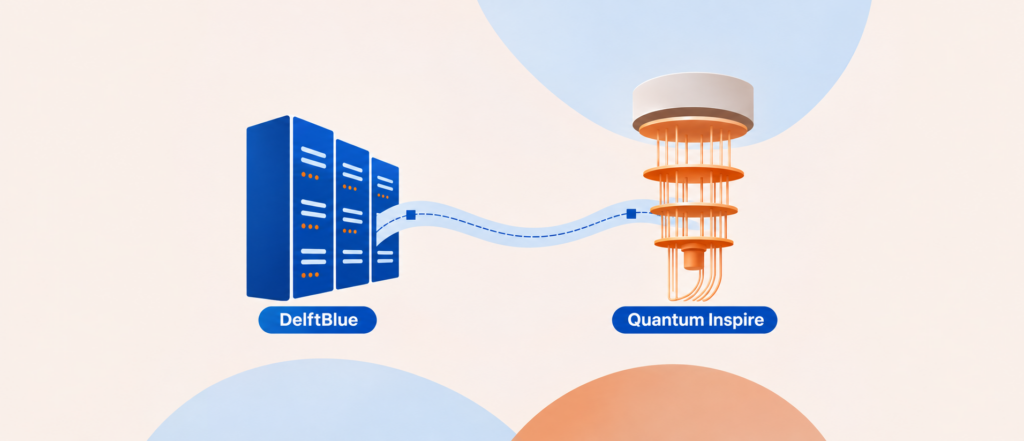
QuTech TU Delft researcher Zeynab Kaseb is the first user to test Quantum Inspire’s integration with DelftBlue, TU Delft’s high-performance computer. The workflow lets researchers use DelftBlue for classical calculations, then send quantum circuits through Quantum Inspire to run on real-world quantum computers. Kaseb tested the connection with a small power system problem, tracing how a calculation moves from classical preparation for measurements on QuTech’s Tuna-17 quantum processor. TU Delft’s supercomputer DelftBlue prepares and optimises the calculation; Quantum Inspire, QuTech’s open cloud quantum computer, provides access to Tuna-17 and returns the processor’s measurements for analysis. That connection gives researchers a way to test quantum algorithms on hardware while using classical computing to prepare the work and assess the results. Kaseb, a researcher at TU Delft‘s Faculty of Electrical Engineering, Mathematics and Computer Science, used the workflow to study power flow in a small network with two connected points, known as buses. Power flow calculations determine the voltages in an electrical grid. She explored the Quantum Approximate Optimization Algorithm, or QAOA, which represents possible answers as bitstrings and uses a quantum circuit to sample candidate solutions. DelftBlue constructed the mathematical objective and optimised the circuit parameters using a simulator. Kaseb then submitted the circuits to Tuna-17 through Quantum Inspire. The processor’s measurements were decoded into candidate voltages and compared with the original power flow equations. Credit: Marieke de Lorijn for QuTechTwo versions of the calculation were run on the Tuna-17, a 17-qubit quantum processor. The circuits used four and six qubits, with 1,024 measurements in each run. An exhaustive classical calculation established the best candidate available in each encoding, giving a reference for interpreting the hardware results. In the four-qubit run, the best candidate appeared 215 times, or about 21 per cent of measurements. The six-qubit encoding represented voltage more finely and produced a lower best residual: 0.003262, compared with 0.01053 in the four-qubit run. A residual measures how accurately a candidate satisfies the power flow equations; lower values mean a closer fit, with zero being the optimum. The more detailed encoding also required a deeper circuit: 165 layers, compared with 30. Its best candidate appeared 16 times, or 1.56 per cent of measurements, close to the frequency expected from uniform sampling across the 64 possible bitstrings. The results show what researchers can learn by using Quantum Inspire to run circuits on a real quantum hardware: a better candidate may be possible, but the measurements also reveal how often it appears and how circuit complexity affects the outcome. For Kaseb, the test demonstrates a complete route from a classical calculation on DelftBlue to circuit execution on Tuna-17 through Quantum Inspire, and back to analysis of the measurements. Martin van Gijzen, scientific director of the Delft High-Performance Computing center, is enthousiastic about the results of Kaseb. “We expect much of the integration of classical HPC computers and quantum computers. In the past year we integrated Quantum Inspire with DelftBlue and now Kaseb is the first to obtain results on our integrated infrastructure. This paves the way for many more exciting results!” This website uses cookies. By clicking "I accept" you give your permission to this website to use cookies. What are cookies?This website uses cookies so that we can provide you with the best user experience possible. Cookie information is stored in your browser and performs functions such as recognising you when you return to our website and helping our team to understand which sections of the website you find most interesting and useful.Strictly Necessary Cookie should be enabled at all times so that we can save your preferences for cookie settings.This website uses Google Analytics to collect anonymous information such as the number of visitors to the site, and the most popular pages.Keeping this cookie enabled helps us to improve our website.
Source Information
Discussion
0 professional contributions
Sign in to join this professional discussion.
Be the first to add a constructive contribution.