
Penn Researchers Demonstrate Room-Temperature Diamond System That Entangles Four Qubits 10 Times Faster
Understand this faster with AI


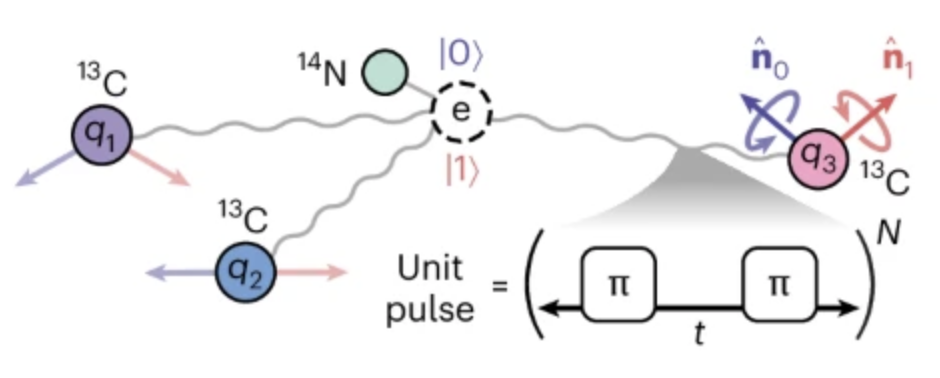
Insider BriefResearchers have entangled four qubits inside a diamond at room temperature using a single gate, cutting the operation time by about 90% while improving its accuracy over the conventional approach.The experimental system produced a four-qubit entangled state in 14.8 microseconds, which researchers report was about 10 times faster than a sequence of two-qubit gates. According to the study published in Nature Nanotechnology, the parallel gate achieved a fidelity of 0.92, meaning its operation closely matched the intended result. The conventional method, which entangled the qubits two at a time through a series of separate operations, achieved a fidelity of 0.69.The findings could lead to more capable room-temperature quantum sensors and more efficient error correction in solid-state quantum processors. They also demonstrate a way to turn unwanted interactions among qubits, normally treated as a source of errors, into a tool for controlling several qubits simultaneously.The team used a nitrogen-vacancy center, or NV center, in diamond. An NV center is a small defect formed when a nitrogen atom replaces one carbon atom in the diamond’s crystal structure and an adjacent position remains empty. The defect can trap an electron whose quantum state can be prepared, controlled and measured using light and microwave pulses.Unlike many quantum systems, NV centers can preserve useful quantum behavior at room temperature. That feature has made them a major platform for quantum sensing, networking and quantum computing.The researchers used the electron in the NV center as a central qubit and three nearby carbon-13 nuclei as additional qubits. They then created a four-part Greenberger-Horne-Zeilinger state, commonly called a GHZ state, in which the four qubits shared a collective quantum state.GHZ states are an important form of multipartite entanglement, which means linking more than two quantum objects so their states must be described as a single system. Such states are used in quantum algorithms, error correction and sensors designed to measure weak magnetic fields or other small physical effects.Quantum systems commonly create multipartite entanglement through a series of two-qubit gates. A central qubit is first entangled with one nearby qubit, then another and then another.That process becomes slower as more qubits are added. Each additional gate also provides another opportunity for noise, control errors and unintended interactions to damage the quantum state.The problem is particularly important in diamond quantum registers. The electron in an NV center continually interacts with the nuclear spins around it. Researchers can use carefully timed microwave pulses to control a selected nuclear qubit, but those pulses can also affect neighboring qubits, which is often referred to as crosstalk.The University of Pennsylvania team developed a control sequence that acts on three nearby nuclear qubits at the same time. Rather than isolating each qubit and suppressing all the interactions affecting the others, the method uses those interactions to produce the desired collective state.The researchers used carefully timed microwave pulses to control the electron and its interactions with nearby nuclear qubits. These pulses normally help shield the system from interference while controlling one nuclear qubit at a time.In this experiment, the researchers identified a pulse timing that allowed the electron to make conditional rotations of all three nuclear qubits in parallel. The result was a single four-qubit entangling gate instead of three consecutive two-qubit gates.The parallel operation took 14.8 microseconds — that’s about 70 times faster than the blink of an eye. The typical approach took about 139.9 microseconds, according to the study. The researchers reported that the parallel gate was close to the fundamental speed limit set by the strength of the physical interactions among the electron and nuclear spins.The team also implemented parallel three-qubit gates using different combinations of the nuclear qubits.Beyond the speed increase, the shorter gate time also reduced the amount of time during which errors could accumulate.The four-qubit parallel gate achieved a fidelity of 0.92, with an uncertainty of 0.04. Its sequential counterpart achieved a fidelity of 0.69, with an uncertainty of 0.03.Fidelity measures how closely an actual quantum operation or state resembles the intended one. A fidelity of 1 would represent a perfect match. Higher fidelity is important because small errors can compound as a quantum circuit grows.The parallel method also required fewer pulses and was less exposed to that unwanted crosstalk. The sequential approach took longer, used more electron-control pulses and allowed unwanted rotations to build up across the register, the researchers reported.For three-qubit gates, the advantage was more modest but still measurable. The parallel gates had an average fidelity of 0.83, compared with 0.78 for the sequential approach, and operated almost twice as fast.The researchers verified the size and coherence of the entangled states using measurements known as multiple quantum coherences. They also repeatedly applied the gates and measured how the resulting states deteriorated, allowing them to separate gate errors from errors associated with preparing and reading the qubits.While quantum computing is often the focus of such research, the method may be implemented in quantum sensing. Diamond NV centers can detect magnetic fields at extremely small scales and are being investigated for applications such as nanoscale nuclear magnetic resonance and scanning magnetometry.Entangled qubits can make a sensor more sensitive than independent qubits under the right conditions. GHZ states are especially relevant because their collective response can amplify the effect of a weak signal.Creating those states quickly is important at room temperature, where quantum coherence generally lasts for less time than it does in cryogenic systems. A sensor that spends less time preparing an entangled state has more time available to measure the target signal before noise destroys the quantum information.The findings could help move entanglement-enhanced sensing toward practical devices that operate outside specialized low-temperature laboratories. Such devices could eventually be used to study magnetic structures, materials and molecules at scales beyond the reach of conventional instruments.The work may also have implications for quantum error correction. Error-correcting codes spread quantum information across multiple physical qubits and use repeated operations to detect and correct faults. Faster gates that act on several qubits at once could reduce the depth of those circuits and limit the opportunities for errors to accumulate.The researchers wrote that the speed increase could open new approaches to quantum error correction and potentially support fault-tolerant operations at room temperature. Fault tolerance would allow a quantum system to continue calculating accurately even when some of its physical components make errors.That possibility remains a future goal rather than a result demonstrated in the study.The researchers reported some of the limits of the study and offered some next steps for future work. First, because the experiment involved four qubits in one diamond register, it did not demonstrate a large processor, a complete error-correction cycle or a useful quantum computation.The system also continued to face errors in state preparation and measurement, often shortened to SPAM errors. These problems are more severe at room temperature because reading the electron’s state is less efficient and its coherence time is shorter than under cryogenic conditions.The researchers identified several possible ways to reduce those errors without abandoning room-temperature operation. These include repeated readout at high magnetic fields, converting spin states into charge signals and using methods that more reliably align nearby nuclear spins.Operating at cryogenic temperatures could also improve measurement fidelity, although, admittedly, that would remove one of the system’s practical advantages.Scaling the parallel method will depend on finding or engineering registers with suitable arrangements of nuclear spins. The three nuclear qubits used in the four-qubit experiment had similar coupling strengths to the central electron, allowing one control sequence to address all of them.To examine how often such arrangements might occur, the researchers simulated 500 randomly configured, weakly coupled NV-center registers. Their analysis indicated that parallel gates involving two or three nuclear qubits should be available in most suitable configurations. Some simulated registers could support the parallel entanglement of four or five nuclear qubits.Five nuclear qubits would be particularly important for certain fault-tolerant operations, according to the study. The researchers did not experimentally demonstrate a gate at that scale.The method could extend beyond nitrogen-vacancy centers.
The team said the same principles may apply to other defects in diamond and to quantum registers made from silicon carbide or silicon. Isotopic engineering could also be used to adjust the density and arrangement of nuclear spins, improving the likelihood of finding groups that can be controlled in parallel.The research was conducted by Joseph D. Minnella, Mathieu Ouellet, Amelia R. Klein and Lee C. Bassett of the University of Pennsylvania. Klein is now at Cornell University.TopicsShare Get the latest research, company news, and market intelligence every week. MENTIONED IN THE ARTICLEThe University of Pennsylvania, a member of the Ivy League, ranks among the oldest and most esteemed universities in the United States. It comprises 12 schools, including those for Arts and Sciences, Nursing, Engineering and Applied Science, and the Wharton School of Business.Cornell University, a private Ivy League research university, is situated in Ithaca, New York. It was established in 1865 by Ezra Cornell and Andrew Dickson White.More in Research
Tags
Source Information
Discussion
0 professional contributions
Sign in to join this professional discussion.
Be the first to add a constructive contribution.