
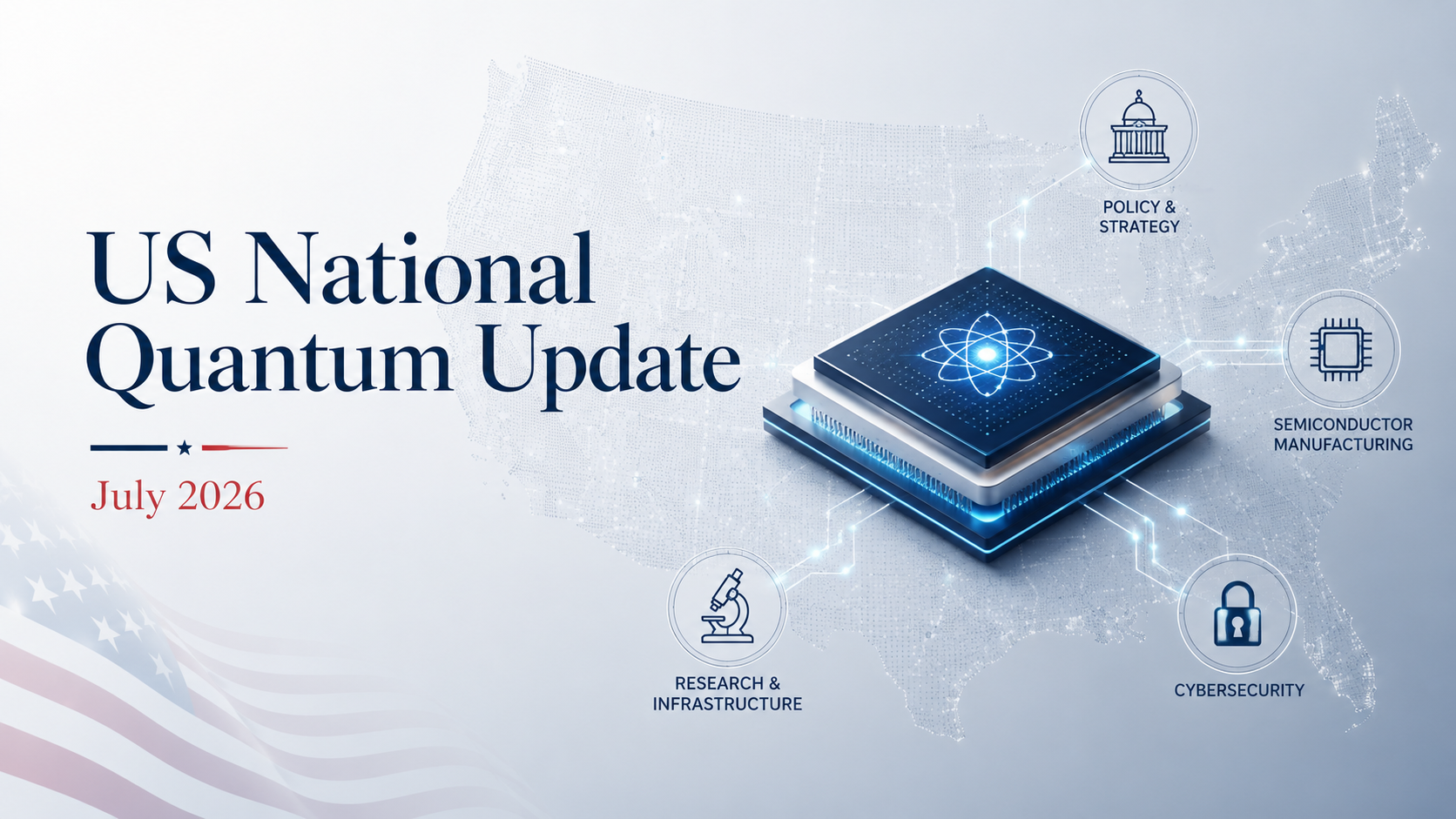
US National Quantum Update: July 2026
July 2026 showed the US quantum sector moving from research funding towards execution. Government benchmarking, fault-tolerance work, domestic manufacturing and post-quantum security are now converging. The wider lesson is clear: quantum leadership will depend on reliable systems, strong supply chains, trusted performance and practical value—not qubit counts alone.
Understand this faster with AI


Policy, Manufacturing and Fault Tolerance Move to the Centre of America’s Quantum Strategy
July 2026 was an important month for the United States quantum ecosystem—not because one machine suddenly transformed computing, but because federal policy, industrial capacity and technical progress began moving in the same direction.
The US government increased its focus on fault-tolerant computing, domestic manufacturing, quantum benchmarking and post-quantum cybersecurity. At the same time, companies including PsiQuantum, IonQ, Infleqtion, Quantinuum, IBM, Google Quantum AI and Rigetti featured in developments spanning government contracts, research, manufacturing and engagement with policymakers.
QuantumNews.in currently tracks 349 quantum companies and organisations in the United States. Atom Computing and QuEra lead the directory by Quantum Score, followed by companies including Infleqtion, IonQ, Rigetti, Google Quantum AI, IBM Quantum and PsiQuantum. This depth gives the United States an advantage that extends beyond any single processor: it has companies across neutral atoms, trapped ions, superconducting systems, photonics, software, sensing and enabling infrastructure.
The central message from July was clear. America’s quantum strategy is moving beyond research grants and processor demonstrations. It is increasingly focused on building a complete domestic industry capable of producing useful systems, securing sensitive data and supporting national scientific and defence priorities.
July 2026 at a glance
Federal quantum orders enter implementation → QED-C brings quantum companies to Capitol Hill → PsiQuantum expands its DARPA agreement → Quantinuum demonstrates a new fault-tolerance route → IonQ completes its acquisition of SkyWater
Washington broadens the quantum agenda
The policy direction for July was shaped by two quantum-related executive orders issued by the White House in June.
One order called for an updated national quantum strategy covering computing, sensing, networking, workforce development, commercialisation and critical supply chains. The second focused on preparing government systems for the security threat posed by future cryptographically capable quantum computers.
This broader approach reflects a more mature understanding of the industry.
Building a useful quantum computer requires much more than increasing physical-qubit counts. It depends on fabrication, control electronics, lasers, cryogenics, packaging, error correction, software, scientific applications and access to high-performance classical computing.
The US ecosystem already contains companies working across these layers. The QuantumNews.in directory includes major hardware developers such as Atom Computing, QuEra, Infleqtion, IonQ, Rigetti, Google Quantum AI, IBM Quantum, PsiQuantum and Microsoft Quantum, alongside software, networking, semiconductor and component businesses.
The emerging US strategy is therefore less about backing one machine and more about building a nationally useful quantum supply chain.
Quantum companies take their technology to Capitol Hill
The connection between government and industry became visible on July 14, when the Quantum Economic Development Consortium hosted its 2026 Quantum Technology Showcase on Capitol Hill.
The event brought members of Congress, federal officials and more than 20 quantum and enabling-technology companies together in Washington.
Participants included IBM Research, Google Quantum AI, Quantinuum, Rigetti, Infleqtion, D-Wave Quantum, Quantum Computing Inc., NVIDIA, Bluefors and several specialist hardware suppliers.
The companies demonstrated technologies covering quantum computing, communication, sensing, cryogenics and supporting infrastructure. Discussions focused on domestic supply chains, workforce development, government acquisition and the possible reauthorisation of the National Quantum Initiative.
The showcase was important because it placed the industry directly in front of those responsible for funding and procurement.
For years, quantum computing has largely been supported through research budgets. The next stage may require the federal government to act as an early customer, particularly in areas such as defence, scientific computing, sensing and secure communications.
Government purchasing played an important role in the development of semiconductors, aerospace and the internet. Quantum companies are increasingly making the case that a similar model may be needed to move their systems from laboratories into dependable infrastructure.
PsiQuantum receives a major DARPA commitment
One of the largest company-specific developments covered by QuantumNews.in during July came from PsiQuantum.
The photonic quantum-computing company secured a $125 million expanded tasking agreement with the Defense Advanced Research Projects Agency under the Quantum Benchmarking Initiative.
The performance-based agreement supports the independent evaluation of PsiQuantum’s hardware architecture, photonic manufacturing processes, cryogenic systems and fault-tolerant computing roadmap. It represents the company’s largest US government contract so far.
DARPA’s approach is notable because it is designed around verification rather than promotional milestones.
Quantum companies often publish roadmaps promising large numbers of qubits or fault-tolerant machines later in the decade. DARPA is asking whether those plans can withstand detailed technical examination.
Its teams are expected to evaluate areas such as component manufacturing, chip-to-fibre assembly, cryogenic infrastructure and estimates of the resources required to run fault-tolerant algorithms.
PsiQuantum is developing a photonic architecture that uses semiconductor manufacturing techniques to produce quantum-computing components at scale. Its strategy depends on manufacturing a very large number of photonic devices and integrating them into a fault-tolerant system.
The DARPA agreement does not prove that PsiQuantum will deliver such a machine. It does show that the company’s roadmap is being subjected to deeper government scrutiny—and that Washington is prepared to support companies that can meet measurable engineering milestones.
The programme is also linked to America’s wider manufacturing ambitions. PsiQuantum is developing manufacturing capacity in California and is an anchor tenant of the Illinois Quantum and Microelectronics Park in Chicago.
Fault tolerance moves beyond one technical route
Fault-tolerant computing remained one of July’s central technical themes.
Quantinuum researchers reported an alternative approach that could reduce dependence on magic-state distillation, one of the most resource-intensive processes in many quantum error-correction architectures.
The experiment used Quantinuum’s H2 trapped-ion processor to create a topologically ordered state across 54 qubits. Researchers encoded information using non-Abelian anyons and combined braiding and fusion operations to demonstrate a universal set of quantum gates.
The work involved researchers from Quantinuum, Caltech, the University of Chicago and Harvard University.
Magic states are specialised quantum resources needed to perform operations that cannot be implemented directly using many error-corrected gate sets. Producing them can require substantial numbers of physical qubits, increasing the cost and complexity of fault-tolerant systems.
The Quantinuum demonstration suggests that topological operations may offer another way to prepare these resources.
The result does not remove the need for quantum error correction, and the method has not yet been shown to scale into a full computing system. But it illustrates why the US quantum ecosystem remains technically diverse.
Superconducting systems, trapped ions, neutral atoms and photonics are all pursuing different routes towards reliable logical computation. No architecture has yet established itself as the definitive winner.
For national policy, this means the US should continue supporting multiple credible approaches while applying common standards for logical performance, manufacturability, operating cost and scientific usefulness.
IonQ brings semiconductor manufacturing in-house
The month ended with one of the most consequential corporate transactions in the American quantum industry.
IonQ completed its acquisition of SkyWater Technology, a semiconductor foundry operating entirely within the United States.
The deal gives IonQ direct access to domestic chip design, fabrication, packaging and manufacturing capabilities. It also positions the company to become a component and manufacturing supplier to the wider quantum industry, rather than focusing only on its own trapped-ion computers.
The acquisition reflects a wider trend towards vertical integration.
Quantum systems depend on specialised chips, photonics, electronics, packaging and materials. Many of these components are produced through fragmented international supply chains that may not yet be able to support large-scale manufacturing.
By acquiring SkyWater, IonQ is trying to gain greater control over production schedules, intellectual property and the development of future devices.
The deal also aligns closely with US national-security priorities.
SkyWater already serves commercial and government customers, and its domestic manufacturing facilities provide a trusted production base for sensitive technologies.
For IonQ, the strategic opportunity is significant. It can potentially combine quantum computing, networking, sensing and semiconductor manufacturing within a broader technology platform.
The risks are equally real. Semiconductor foundries require substantial capital and specialised operational expertise. IonQ will need to prove that the acquisition accelerates its quantum roadmap rather than adding cost and complexity.
Even so, the transaction demonstrates how the industry is changing. Leading quantum companies are no longer preparing only to build experimental processors. They are securing the manufacturing capacity required to produce systems at industrial scale.
Neutral atoms strengthen the US hardware portfolio
The QuantumNews.in US directory also highlights the growing position of neutral-atom computing.
Atom Computing and QuEra currently hold the highest Quantum Scores among US companies listed on the platform, while Infleqtion is also placed among the leading hardware developers.
Neutral-atom systems use arrays of atoms held and controlled by laser fields. The architecture has attracted interest because large numbers of highly uniform atoms can be arranged into flexible geometries.
During July, Infleqtion was reported as securing three projects connected to the Department of Energy’s Genesis Mission, strengthening the company’s role across neutral-atom computing and quantum sensing.
The wider significance is that America’s quantum strategy is not being built around superconducting processors alone.
Neutral atoms may prove valuable for quantum simulation, optimisation and fault-tolerant architectures. They also connect computing with sensing and precision measurement, areas that may reach operational deployment earlier than general-purpose quantum computing.
Companies such as Atom Computing, QuEra and Infleqtion therefore represent an important part of the national portfolio, even when public attention remains concentrated on IBM, Google and IonQ.
Quantum security becomes an infrastructure challenge
Post-quantum cybersecurity remained another major component of the US agenda in July.
The threat is based on the possibility that a sufficiently powerful fault-tolerant quantum computer could eventually break widely deployed public-key cryptography.
Such a machine does not exist today. The immediate danger is that attackers can collect encrypted information now and store it until future technology makes decryption possible.
Migrating away from vulnerable systems is not a simple software update.
Government agencies and companies must identify cryptography embedded in applications, network equipment, cloud services, certificates, industrial systems and long-lived devices. They must then introduce post-quantum methods without disrupting existing services.
The United States already benefits from the cryptographic standards developed by the National Institute of Standards and Technology. The harder challenge is now implementation.
This will require software companies, cloud platforms, cybersecurity providers and government contractors to coordinate testing and migration schedules.
Quantum security may therefore become one of the first areas in which quantum technology produces large commercial demand—even before fault-tolerant quantum computers are available.
What July means for the US quantum industry
July did not produce one decisive breakthrough.
Instead, the month showed the different layers of the American quantum strategy beginning to connect.
Policymakers met directly with technology companies. DARPA expanded its technical evaluation of PsiQuantum. Quantinuum demonstrated another possible route towards fault-tolerant operations. IonQ secured domestic semiconductor manufacturing capacity. Neutral-atom companies continued gaining importance across computing and sensing.
The United States’ strength lies in this diversity.
Its ecosystem includes large technology companies, specialised quantum startups, universities, national laboratories, semiconductor manufacturers and investors. QuantumNews.in’s directory of 349 US organisations illustrates the scale of that base.
But scale alone will not guarantee leadership.
The industry must still show that it can convert research progress into reliable logical qubits, scientifically valuable applications and economically sustainable systems.
Federal agencies will also need to avoid measuring progress through spending announcements or physical-qubit counts. Public support should remain tied to independent benchmarks, manufacturing milestones and performance against the strongest available classical computing methods.
A month of industrial preparation
July 2026 will not be remembered as the month the United States completed a fault-tolerant quantum computer.
It may be remembered as a month when the country began treating quantum technology more seriously as an industrial system.
The US is linking government demand with technical validation, fault-tolerance research, cybersecurity and domestic production.
PsiQuantum’s DARPA agreement shows that public funding is becoming more closely connected to technical auditing. Quantinuum’s experiment shows that the route to fault tolerance remains open to multiple architectures. IonQ’s acquisition of SkyWater shows that manufacturing capacity is becoming part of quantum-company strategy.
The next test will be delivery.
By the end of the decade, the United States will need to demonstrate more than strong companies and ambitious roadmaps. It will need reliable systems, secure supply chains, independently verified performance and applications that justify continued public and private investment.
July showed that the foundations are being assembled. Whether they produce useful quantum infrastructure will depend on what these companies and government programmes deliver next.
Tags
Source Information
Discussion
0 professional contributions
Sign in to join this professional discussion.
Be the first to add a constructive contribution.