
Jülich Launches Trapped-Ion Quantum Computer For Supercomputing Integration
Understand this faster with AI


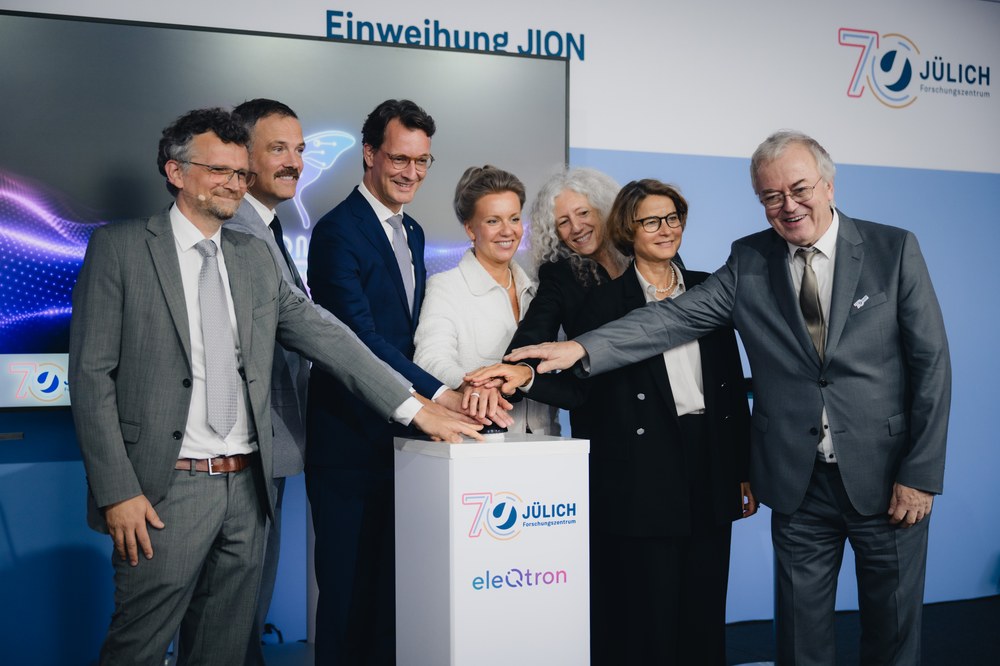
Insider BriefGermany’s Forschungszentrum Jülich has inaugurated a quantum computer intended to help researchers and companies test how quantum processors can work alongside conventional supercomputers.The system, called JION, is operational at the Jülich Supercomputing Centre, according to the research center. Its first public calculation was performed during the inauguration ceremony.JION will be integrated into the Jülich Unified Infrastructure for Quantum Computing, or JUNIQ, which provides access to different quantum systems and connects them with the center’s high-performance computers. The arrangement allows selected computing operations to be assigned to quantum processors as part of a larger calculation.Researchers and companies are expected to use JION to develop and test these combined computing methods. Potential applications include logistics, materials research, chemistry and machine learning, the center said.JION, short for Jülich trapped-ion quantum computer, stores quantum information in electrically charged ytterbium atoms. Electromagnetic fields hold these atoms in a vacuum, where they serve as qubits, the basic units of quantum information.The machine performs calculations through a sequence of controlled operations called quantum gates. Unlike superconducting quantum processors, JION’s processor does not require operation at temperatures close to absolute zero, according to the center.Its control method, developed in Siegen, uses microwaves and carefully varied magnetic fields to control individual qubits and couple them to one another. Known as magnetic gradient induced coupling, or MAGIC, the approach simplifies control and could help support larger systems, the center said. Scaling that technology remains a development goal.JION was developed through EPIQ, a partnership between the supercomputing center and quantum computing company eleQtron. Launched in March 2024, the project set out to combine a quantum module with several conventional computing modules.North Rhine-Westphalia’s Ministry of Culture and Science is providing about 21 million euros over four and a half years. The partnership will also offer service, support and training to help scientific and industrial users work with JION.Two additional funding approvals presented at the inauguration extend the state’s quantum computing investment beyond the newly launched machine.EleQtron’s SQALING project will receive up to about 25 million euros in European Union funding administered through North Rhine-Westphalia. The independent development project aims to turn the company’s trapped-ion technology into scalable, chip-based platforms that could eventually serve industrial users.A separate project, Q-STAR.NRW, will receive up to about 25 million euros from funding for the Rhenish mining area and the state. It aims to procure a semiconductor quantum computer with up to 200 qubits and integrate it into JUNIQ.That planned system would add another hardware approach to Jülich’s computing infrastructure. Together, the projects are intended to expand access to quantum hardware and support industrial development in the region, although the announcement provides no timetable for demonstrating practical computing advantages.“Quantum technologies offer huge opportunities. North Rhine-Westphalia has long been leading the way. Our goal is clear: we want Germany to become the world’s leading location for quantum technology, with North Rhine-Westphalia acting as a powerful driving force. We are the pioneering region for quantum technology; it was here that the first breakthroughs in quantum hardware in Germany were achieved. The new JION quantum computer demonstrates what can be achieved when we connect our strong quantum computing start-up ecosystem with our cutting-edge research. The race for technological leadership in quantum computing is still wide open on the international stage. Our state has every opportunity to be right at the forefront. To achieve this, we are bringing science and industry together in the field of quantum technologies in a targeted and systematic manner. We want to make North Rhine-Westphalia’s quantum ecosystem indispensable.“ — Hendrik Wüst, Minister-President of the Federal State of North Rhine-Westphalia“Fast, resource-efficient computers will be the key to innovations that make people’s lives better and safer in the future – in medicine, materials research, and cyber security. By integrating JION into Forschungszentrum Jülich’s computing network, we are creating unique opportunities across Germany for science and industry to accelerate innovation. My sincere thanks go to everyone involved who have made this milestone possible: Forschungszentrum Jülich, eleQtron – the start-up founded by the University of Siegen – and the “EIN Quantum NRW” platform, which has contributed significantly to the success of this project by bringing all stakeholders together.“ — Ina Brandes, Minister of Culture and Science of the Federal State of North Rhine-Westphalia“A sovereign Europe needs technological strength – and that is what we are creating here in the Rhenish mining area. Quantum technologies are among the most exciting and promising technologies of our time, as they offer enormous opportunities for fast and secure digital processes and intelligent solutions to the major challenges of our times. Here, cutting-edge technology is being developed that benefits many companies in the chemical, pharmaceutical, and logistics sectors – and, through their products, everyone.” — Mona Neubaur, Minister of Economic Affairs, Industry, Climate Action and Energy of the State of North Rhine-Westphalia“With JION, we are bringing together a quantum computer developed in North Rhine-Westphalia with our high-performance supercomputing infrastructure here at Jülich. In doing so, we are creating the conditions for combining quantum computing and high-performance computing, allowing us to use quantum computing to address specific problems in research and industry.” — Prof. Astrid Lambrecht, Chair of the Board of Directors at Forschungszentrum Jülich“JUNIQ provides access to a range of quantum computers and allows their performance to be compared. With JION, we are expanding this unique user platform to include a trapped-ion system from North Rhine-Westphalia and connecting it to our HPC infrastructure – for research and industrial applications.” — Prof. Kristel Michielsen, head of the Jülich Supercomputing Centre“With JION, we are integrating our trapped-ion and MAGIC technology into one of Europe’s leading user infrastructures for quantum computing. Together with the Jülich Supercomputing Centre, we are creating the conditions to further develop the system, integrate it into hybrid computing architectures, and ultimately make it accessible to industry and science.” — Jan Henrik Leisse, co-founder and CEO of eleQtronTopicsShare Get the latest research, company news, and market intelligence every week. MENTIONED IN THE ARTICLEeleQtron builds ion-trap quantum computers with an eye to commercial applications of quantum computing.The Jülich Supercomputing Centre (JSC) is a research center located in Jülich, Germany, that provides leading-edge supercomputer resources, IT tools, methods, and know-how. The center has approximately 250 experts working on all aspects of supercomputing and simulation. The JSC is part of the John von Neumann Institute for Computing (NIC) and the Gauss Centre for Supercomputing (GCS). The JSC is also home to the Jülich Unified Infrastructure for Quantum Computing (JUNIQ), which is a uniform quantum computing Platform as a Service (QC-PaaS) that offers European users support and access to quantum computer emulators and quantum computing technologies of different types and levels of technological maturity. JUNIQ will integrate quantum computers in the form of quantum-classical hybrid computing systems into the modular HPC environment of the Jülich Supercomputing Centre. They operate a quantum annealer with more than 5,000 qubits as part of JUNIQ, making them the first site in Europe to operate a latest-generation system by the Canadian manufacturer D-Wave. The JSC collaborates with renowned hardware and software vendors like IBM, Intel, NVIDIA, and ParTec to meet the challenges that arise from the development of exaflop.A major investment from the Canada First Research Excellence Fund led to the creation of the Institut quantique (IQ) in 2016, a research institute at the Université de Sherbrooke that focuses primarily on science and technology in quantum. They bring together scientists specializing in quantum materials, quantum information and quantum engineering with the aim of carrying out high-quality fundamental research and developing the quantum technologies of the future.More in Research
Tags
Source Information
Discussion
0 professional contributions
Sign in to join this professional discussion.
Be the first to add a constructive contribution.