
Japan switches on its first full-stack room-temperature quantum computer — and scientists plan to scale it up to 10,000 qubits
Understand this faster with AI


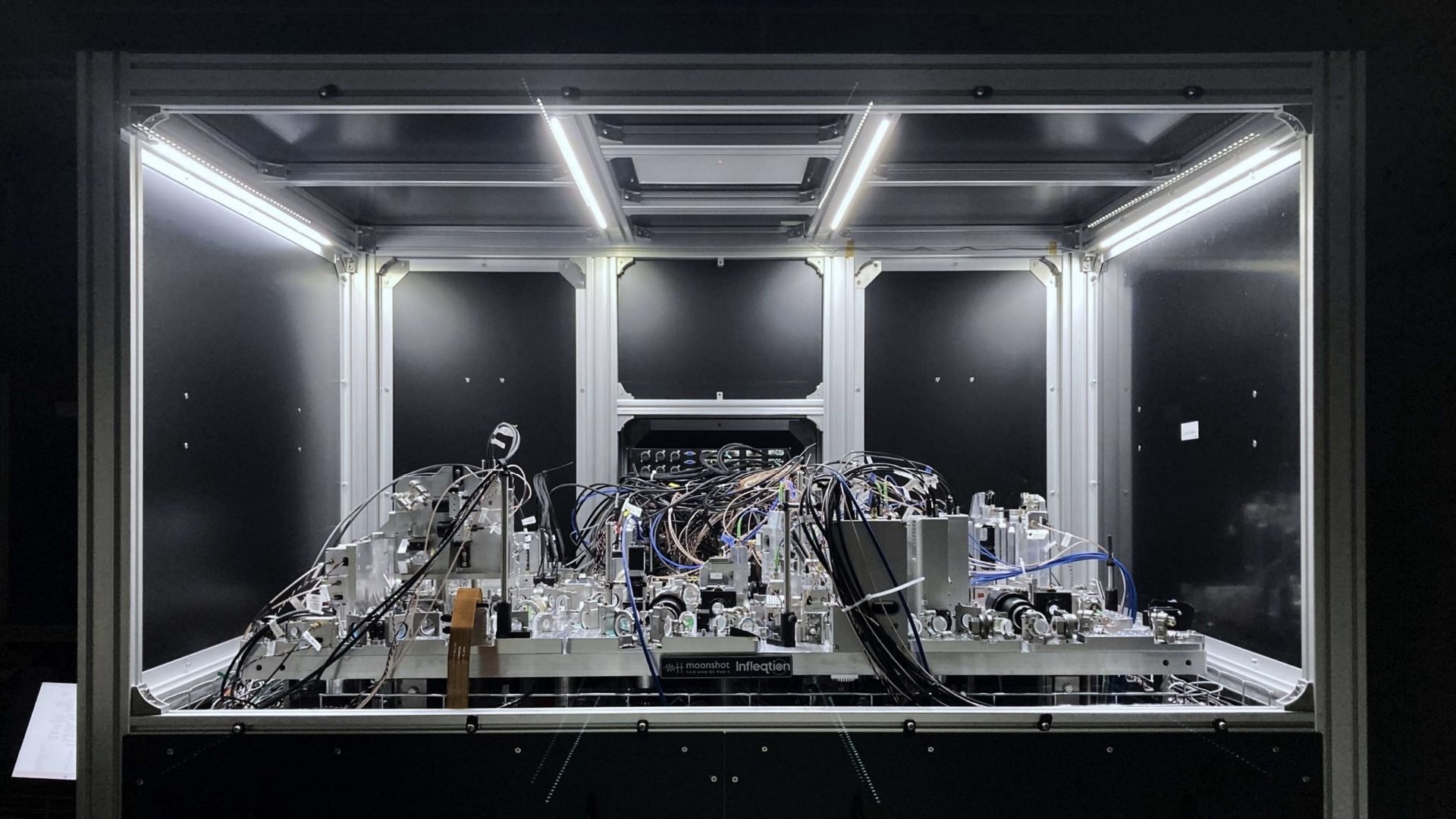
Japan's new quantum system, Shunkai, uses "optical tweezers" to trap and rearrange atoms, and will be available to researchers working on quantum error correction. When you purchase through links on our site, we may earn an affiliate commission. Here’s how it works. Researchers in Japan have switched on "Shunkai," a neutral atom quantum computer that scientists hope to scale into a 10,000-qubit behemoth by March 2031.Shunkai is the first full-stack system of its kind in Japan, meaning it features the software, control and hardware layers needed to read user inputs and return a result — not unlike a conventional PC. In theory, that means it should be easier for researchers to get some meaningful use out of the machine, with the team behind Shunkai planning to open it up to external users over the coming years.In a statement, project lead Kenji Ohmori, a professor of photo-molecular science at the Institute for Molecular Science, said researchers' use of Shunkai would "lead to ripple effects on various fields in industry, academia, and government around the world."The team behind the new machine plans to integrate it into an existing shared supercomputing facility to create a quantum-GPU hybrid computing center.Unlike traditional, or "classical," computers, quantum computers operate according to the strange laws of quantum physics. In quantum systems, qubits — in the form of superconducting circuits, trapped ions or photons (among other modalities) — represent the fundamental building blocks of quantum information. These can exist as a 1, 0, or a "superposition" of both states at once.However, qubits are notoriously fragile. Even minor environmental interference can destabilize or destroy the information they contain, making accuracy an ongoing challenge in the world of quantum computing. The error rate in qubits is thought to be roughly 1 in 1,000, compared with around 1 per billion or even 1 per trillion operations in classical computing bits.It's why a huge amount of research is dedicated to quantum error correction. This field seeks to alleviate this inherent unreliability by building redundancies into the way information is encoded in qubits so that small errors don't scrap entire computations.Get the world’s most fascinating discoveries delivered straight to your inbox.The broad aim is to create higher-quality qubits and then scale up the number of qubits in a system so quantum computers can finally compete with the world's fastest supercomputers.This thorny issue, combined with quantum systems' need for elaborate cooling systems to keep them operational, makes them impractical outside of finely tuned lab environments.Shunkai, named after 17th-century Japanese astronomer Harumi Shibukawa, shirks at least some of those constraints. Rather than using supercooled circuitry, Japan's new system incorporates neutral atoms as qubits, captured and suspended using "optical tweezers."These tightly focused laser beams capture atoms and arrange them inside a vacuum chamber, while microwaves or laser light are used to manipulate the atoms' quantum states and perform calculations. The results are then read by observing the fluorescence from each individual atom with a camera.Importantly, Shunkai's use of neutral atoms as qubits instead of superconducting circuits means it can operate at room temperature. Because the arrangement of qubits in neutral-atom systems can be fine-tuned during calculations, researchers can also adjust which qubits interact with each other and create entanglement — a bizarre state of information sharing between particles over time and space — between different pairs.This could help overcome two of the biggest obstacles facing practical quantum systems: scaling machines to large numbers of qubits, and correcting the errors that inevitably creep into quantum calculations.To that end, Shunkai will be partially opened to external researchers to develop applications and test and improve the system's quantum error correction capabilities, representatives from Japan's National Institutes of Natural Sciences said in the statement.The quantum system will initially operate with around 50 qubits before expanding to roughly 500. The longer-term goal is considerably more ambitious: By March 2031, the team aims to scale Shunkai into a "large-scale, high-performance neutral-atom fault-tolerant quantum computer, with 10,000 physical qubits and quantum error detection and correction capabilities." Doing so would place it comfortably above the 6,100-qubit, neutral atom array demonstrated by Caltech researchers in October 2025."Neutral atom-based quantum computers have recently been rapidly attracting attention around the world as a new modality that could exceed the limits of the superconducting modality," Ohmori said. "I think it is extremely significant that now we have developed Japan's first full-stack quantum computer in this cutting-edge modality and started its operation."Can you match these ancient devices to their pictures? Find out with our computing quiz!Owen Hughes is a freelance writer and editor specializing in data and digital technologies. Previously a senior editor at ZDNET, Owen has been writing about tech for more than a decade, during which time he has covered everything from AI, cybersecurity and supercomputers to programming languages and public sector IT. Owen is particularly interested in the intersection of technology, life and work – in his previous roles at ZDNET and TechRepublic, he wrote extensively about business leadership, digital transformation and the evolving dynamics of remote work.You must confirm your public display name before commentingPlease logout and then login again, you will then be prompted to enter your display name.
Tags
Source Information
Discussion
0 professional contributions
Sign in to join this professional discussion.
Be the first to add a constructive contribution.