
Imperial engineers build a reconfigurable photonic quantum chip
Imperial’s breakthrough accelerates photonic quantum computing’s scalability, offering a modular, upgradeable architecture that could shift the UK’s strategic position in the global quantum race.
Understand this faster with AI


Researchers from Imperial’s Department of Physics have built Clavina, a reconfigurable photonic quantum chip that overcomes limitations in previous designs. Published in Nature Photonics, the study demonstrates a programmable platform combining both linear and nonlinear quantum operations within a single system, allowing for adaptable computation without hardware redesign. “We set out to build a photonic quantum processor that provides a step change in functionality over our previous designs,” said Dr. Shang Yu, Marie Skłodowska-Curie Fellow at Imperial. The architecture, inspired by modern computer processors, is scalable and allows new functions to be added as needed.
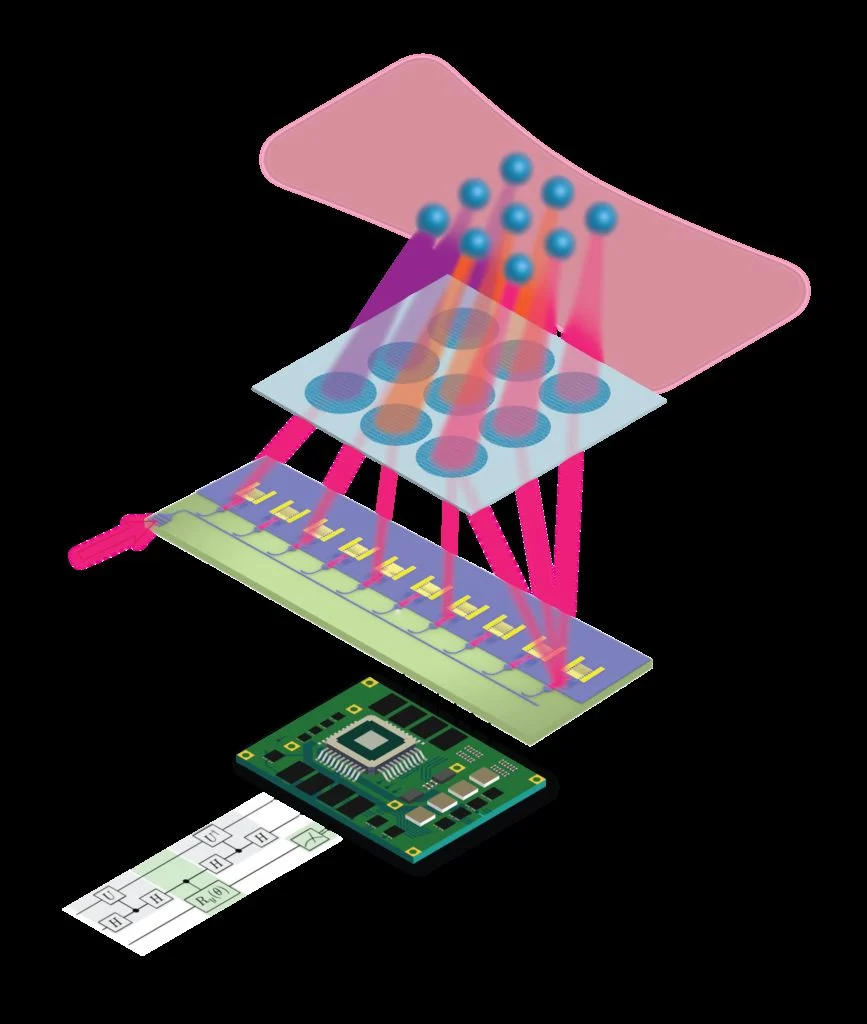
Clavina Architecture Enables Reconfigurable Photonic Quantum Computation This architectural innovation, detailed in Nature Photonics, departs from traditional photonic systems often designed for single, specific tasks and instead offers a reconfigurable platform adaptable to diverse computational challenges. The ability to switch between functional modules without redesigning the underlying hardware represents a significant advancement, allowing a single system to tackle problems previously requiring dedicated setups. The design of Clavina draws direct inspiration from modern computer processors, a strategy intended to address the historical difficulty of achieving robust photon interactions. Unlike earlier systems, Clavina utilizes a central control unit to direct information flow between a programmable optical network and specialized nonlinear modules. This modularity is key; it allows researchers to add new functionalities without fundamentally altering the processor’s core structure, a feature that dramatically increases its versatility and potential lifespan. To demonstrate Clavina’s capabilities, the research team successfully applied the platform to two complex problems in quantum physics. First, they simulated the Bose-Hubbard model, a crucial problem in condensed matter physics used to describe interactions between quantum particles. This simulation highlights Clavina’s ability to handle many-body interactions, a task often restricted by the limitations of superconducting quantum computers. Dr. Jinzhao Sun of Queen Mary University of London explained, “The versatility of our hardware enables us to integrate nonlinear operations and linear operations.” He continued, stating that these operations are used to perform simulations involving many-body interactions which are also restricted on superconducting quantum computers. Beyond simulation, the team also achieved a more reliable method for generating Gottesman-Kitaev-Preskill (GKP) states, essential resources for quantum error correction. Previous photonic approaches to GKP state generation were probabilistic, meaning they could not be consistently produced on demand. Clavina’s architecture, however, delivers these states with significantly improved consistency, removing a major obstacle to building practical, fault-tolerant quantum computers. Fast electro-optic modulators are integral to Clavina’s reconfigurability, rapidly switching encoded time bins into functional modules and enabling fast programming of the processor. This speed is critical for adapting the system to different computational tasks and overcoming the inherent challenges of manipulating photons, which lack the strong interactions found in other quantum computing platforms. Previously, building photonic hardware for a specific task necessitated a complete redesign of the system. Ying Dong, co-author from China Jiliang University, explained, “Previously, researchers would have to build photonic hardware tailored to a specific task. The ability to switch in different functional modules in our architecture enables a single set of hardware to perform multiple functions without overhauling the design.” Clavina, in contrast, can solve graph problems, simulate quantum systems, or generate entangled states and resource states for error correction, all without requiring a hardware overhaul. This adaptability is particularly important as quantum computing systems grow in scale and complexity; as the demands on these systems increase, the ability to adapt to new computational challenges without constant hardware redesign will become increasingly crucial. Clavina provides a framework for developing photonic processors that can evolve alongside the field, offering a sustainable path towards more powerful and versatile quantum computers. The architecture’s modularity and extensibility suggest a future where quantum processors can be customized and upgraded with relative ease, mirroring the evolution of classical computing systems.
The team’s success in generating GKP states with improved reliability is a particularly noteworthy achievement. These states are not merely theoretical constructs; they represent a critical building block for quantum error correction, a necessary step towards building practical quantum computers capable of solving real-world problems. By removing a major barrier to the practicality of GKP states, the researchers have paved the way for more robust and reliable quantum computations. The combination of reconfigurability, efficient simulation capabilities, and improved error correction resources positions Clavina as a promising platform for future advancements in photonic quantum computing. We set out to build a photonic quantum processor that provides a step change in functionality over our previous designs. Dr. Shang Yu, Marie Skłodowska-Curie Fellow at Imperial Source: https://www.imperial.ac.uk/news/articles/natural-sciences/physics/2026/new-shape-shifting-architecture-brings-versatility-to-photonic-quantum-computing/ Stay currentSee today’s quantum computing news on Quantum Zeitgeist for the latest breakthroughs in qubits, hardware, algorithms, and industry deals. Tags:
Tags
Source Information
Discussion
0 professional contributions
Sign in to join this professional discussion.
Be the first to add a constructive contribution.