
IBM Says It Has Reached Verifiable Quantum Advantage. Here Is Why the Claim Matters
If the findings are independently reproduced and remain ahead of improving classical simulation methods, they could mark an important transition for the industry. Quantum computing would begin moving from demonstrations of hardware capability towards scientifically useful and defensible computation.
Understand this faster with AI


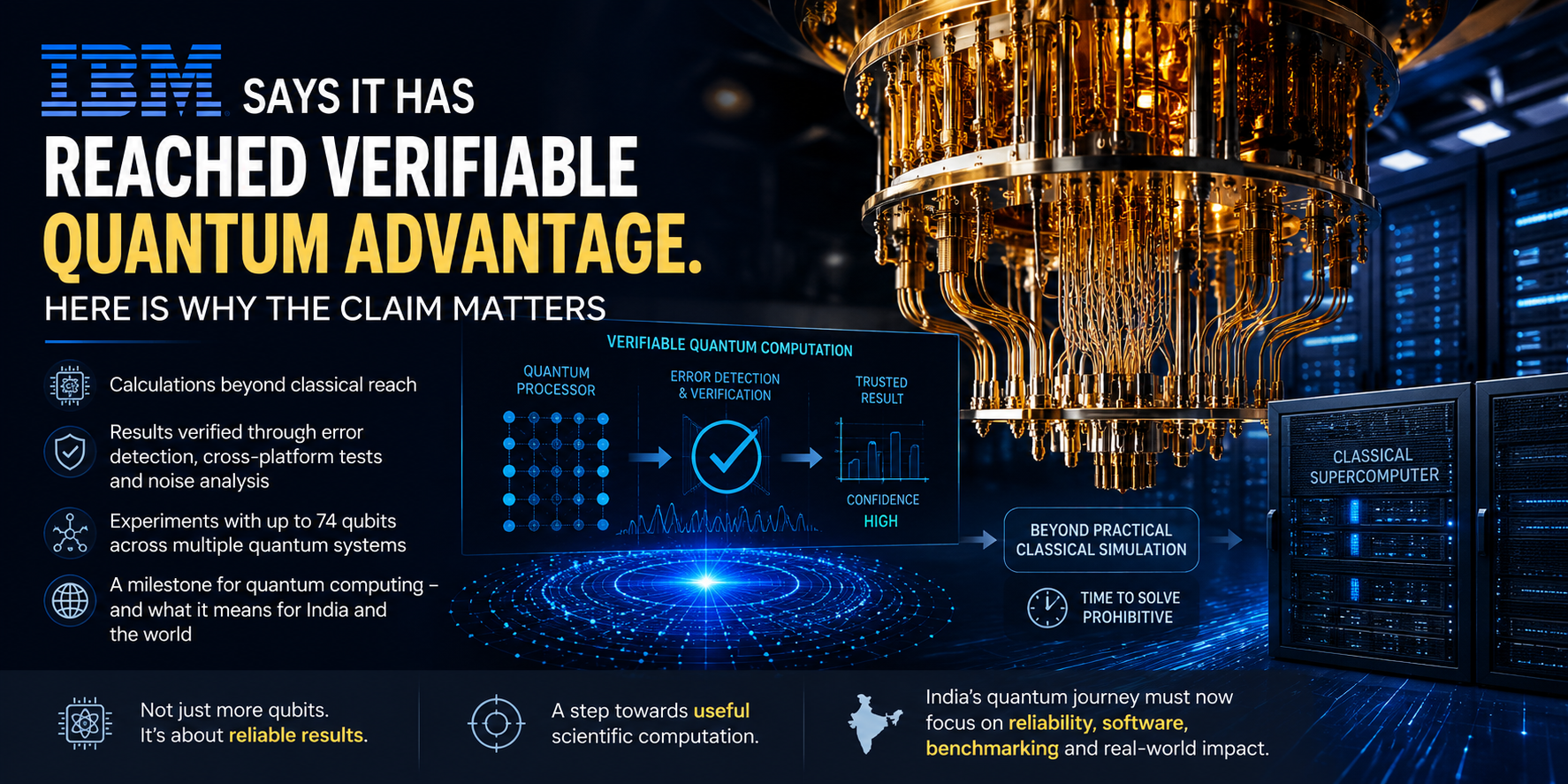
IBM says quantum computers have crossed an important threshold: performing certain calculations beyond the practical reach of leading classical methods while still producing results that can be independently tested and trusted.
The claim, announced on July 30, is based on three separate research efforts involving IBM, the University of Chicago, Algorithmiq, Qedma, RIKEN and BlueQubit. The experiments used IBM’s quantum processors to study complex quantum systems in areas where classical simulations either became prohibitively difficult or produced conflicting results.
IBM is describing the work as quantum advantage through trusted quantum computation. The wording is important. The company is not claiming that quantum computers are now generally faster than conventional computers, or that they are ready to replace supercomputers. It is claiming something narrower but potentially more consequential: that quantum hardware has produced credible results in selected computational regimes where the strongest known classical methods struggle.
If the findings withstand independent scrutiny, they would mark a shift from simply demonstrating that quantum computers can run difficult circuits to showing that their answers can be scientifically useful and trustworthy.
That distinction addresses one of the biggest problems in quantum computing.
The problem with proving quantum advantage
A quantum computer is generally said to achieve quantum advantage when it performs a meaningful task more efficiently, accurately or economically than the best available classical approach.
But proving such an advantage is not straightforward.
When a quantum calculation is small, researchers can simulate it on a classical computer and compare the answers. As the quantum circuit becomes larger and more complex, exact classical simulation can require enormous computing resources.
Eventually, the classical machine may no longer be able to calculate the answer within a practical time.
This creates an uncomfortable question: if a quantum computer has entered a region that classical computers cannot reproduce, how can researchers confirm that its result is correct?
Quantum processors are still error-prone. Qubits are affected by noise, imperfect control operations, calibration drift and environmental interference. A result that appears to be beyond classical reach may simply be wrong.
Earlier claims of quantum advantage were often verified by running smaller versions of the same problem, comparing those with classical simulations and then extrapolating the expected performance of the larger experiment.
IBM argues that this is not sufficient for establishing trust in the full computation. Errors can behave differently as circuits grow deeper and more complicated. A calculation therefore needs stronger internal checks and statistical evidence.
The new work tries to provide that evidence.
What IBM and its partners actually did
The announcement covers three distinct experiments rather than one universal test of quantum advantage.
In the first study, IBM and the University of Chicago used circuits that are structured to detect errors while still becoming difficult for classical computers to simulate.
The researchers worked with so-called doped Clifford circuits and spacetime codes. Clifford circuits are relatively easy to simulate classically. By adding selected non-Clifford operations, the researchers make the circuits much harder while retaining mathematical structures that help detect faults.
IBM reported an experiment involving 70 logical qubits in which post-selection reduced the effective gate-error rate by roughly a factor of ten. The error information generated by the circuit was used to estimate whether the computation had remained above a required fidelity level.
In practical terms, the circuit did not merely generate an output. It also generated evidence about whether the underlying computation had been performed reliably.
The second effort, involving Qedma, RIKEN and BlueQubit, studied the behaviour of interacting quantum systems under repeated external pulses.
The team ran circuits involving up to 74 qubits and examined persistent oscillations in the system. IBM said two leading classical simulation techniques, even with access to major supercomputing resources, failed to agree in the most demanding region of the calculation.
Researchers used separate error-mitigation methods and reproduced part of the behaviour on a Quantinuum processor. Agreement across different machines and mitigation techniques strengthened the case that the observations were physical results rather than artefacts of one device.
The third experiment, carried out with Finnish quantum-algorithm company Algorithmiq, examined how information spreads through a quantum system.
The calculation used 56 qubits on IBM Heron processors. Classical simulation teams produced different predictions in the hardest part of the experiment, while the quantum processors generated a result outside those estimates.
Instead of claiming that the quantum answer could be checked directly against a known classical result, the researchers tested whether it remained stable when the conditions changed.
They ran the calculation across multiple processors, deliberately changed gate calibrations, introduced controlled noise and compared the resulting outputs. They also modelled the hardware noise and used error-mitigation techniques to estimate the remaining uncertainty.
IBM’s argument is that a result which remains consistent across processors and under deliberately altered noise conditions can be trusted even when no classical computer can calculate the exact answer efficiently.
Algorithmiq has released its classical benchmark software, allowing independent researchers to try to reproduce or overturn the result. That is an important part of the process. Quantum advantage is not established permanently through a company announcement. It survives only if improved classical algorithms fail to close the gap.
The road to this point
The development of quantum computing has advanced through a series of theoretical and experimental milestones:
1981 — Feynman proposes quantum simulation → 1985 — Deutsch describes a universal quantum computer → 1994 — Shor develops his factoring algorithm → 1995 — Quantum error correction is established → 2001 — IBM demonstrates a small implementation of Shor’s algorithm → 2016 — IBM opens quantum hardware through the cloud → 2019 — Google claims quantum supremacy → 2023 — IBM demonstrates quantum utility on a 127-qubit processor → 2024–25 — Logical qubits and error correction improve → 2026 — IBM claims trusted, verifiable quantum advantage
Google’s 2019 experiment was a major turning point. Its Sycamore processor completed a specialised sampling task that Google said would take a classical supercomputer thousands of years.
The result showed that programmable quantum hardware could enter a computational regime beyond the practical reach of classical machines. But the task had no immediate commercial use, and classical researchers subsequently reduced the estimated time needed to reproduce it.
That episode demonstrated an enduring feature of quantum advantage claims: they are moving targets.
Quantum hardware improves, but so do classical chips, supercomputers and simulation algorithms. A problem that appears impossible for a conventional computer today may become tractable after a new approximation method or a better GPU implementation is developed.
IBM’s own 2023 “quantum utility” experiment reflected a more cautious approach. The company used a 127-qubit processor to calculate physical properties from circuits that were difficult to simulate through brute force. It presented the work as evidence that noisy quantum machines could contribute useful scientific results, not as a conclusive commercial advantage.
The latest claim attempts to go one step further by combining hard calculations with methods for validating the results.
How significant is the claim?
The claim is significant, but it needs to be understood precisely.
IBM has not demonstrated a universal quantum computer that can solve a wide range of business problems faster than conventional systems. The experiments remain specialised scientific calculations involving quantum dynamics, many-body physics and logical circuits.
There is also no claim that the machines are fully fault-tolerant.
Current processors still rely on error mitigation, error detection, post-selection and repeated execution. Fully fault-tolerant computing would require logical qubits that remain reliable through long and complex calculations, with errors continuously detected and corrected.
IBM is targeting a large-scale fault-tolerant system for 2029. The company said in 2025 that its planned Starling system would use about 200 logical qubits and be capable of running 100 million quantum operations. Its present advantage experiments should be seen as steps towards that goal, not as proof that it has already been reached.
The commercial significance is also not immediate.
The work does not show that a bank can optimise its portfolio more cheaply on a quantum computer, that a pharmaceutical company can discover a medicine faster, or that a logistics company can reduce operating costs using quantum hardware today.
What it does show is that quantum processors may be reaching a stage where they can generate scientific information that is difficult to obtain classically.
That could matter first in areas where the underlying problem is itself quantum mechanical, including molecular chemistry, catalysts, superconductors, magnetic materials and complex physical systems.
These are not consumer applications, but they could influence sectors such as energy, pharmaceuticals, advanced manufacturing and semiconductor research.
The strongest test will come from classical computing
IBM’s claim will now face challenge from the classical-computing community.
This is not a weakness in the announcement. It is how the field progresses.
Google’s 2019 claim prompted researchers to develop much faster classical simulation methods. Similar challenges followed advantage claims from photonic, superconducting and annealing systems.
IBM’s experiments are likely to drive new work in tensor networks, approximation techniques, GPU computing and many-body simulation. If classical researchers reproduce the results efficiently, the claimed advantage may narrow or disappear.
If they cannot, and independent quantum groups obtain similar results, the claim will become much stronger.
A 2026 Financial Times report on Google’s separate quantum-advantage work noted that recent claims are likely to face intense scrutiny before the scientific community reaches a consensus. That caution applies equally to IBM.
The important development is therefore not that one company has declared victory. It is that quantum experiments are becoming strong enough to create serious competition with the best classical methods.
What it means for the world
For the global technology industry, IBM’s announcement moves the focus away from physical-qubit counts.
For several years, quantum companies competed through headline numbers: more qubits, larger processors and ambitious roadmaps. But a large number of unreliable qubits has limited value.
The more meaningful measures are now circuit quality, logical error rates, useful computation depth, verification methods and performance against the strongest classical alternatives.
This will also change where value is created.
Building the quantum processor remains critical, but advantage will depend on the full stack: hardware control, compilers, error mitigation, error correction, noise modelling, high-performance computing and domain-specific algorithms.
The likely future is not a quantum computer replacing the classical data centre. It is a hybrid system in which CPUs and GPUs prepare data, manage workflows and process results, while quantum processors handle selected calculations.
This is also why the geopolitical stakes are increasing. Governments are investing not only in experimental hardware but also in fabrication, research infrastructure, skilled talent and secure supply chains.
The United States has committed substantial public funding to domestic quantum manufacturing, while companies including IBM, Google, Microsoft, IonQ and several startups are pursuing different technical approaches.
What it means for India
For India, IBM’s claim should prompt a practical reassessment of how progress under the National Quantum Mission is measured.
The mission has an approved outlay of ₹6,003.65 crore from 2023–24 to 2030–31. It covers quantum computing, communication, sensing and metrology, and quantum materials and devices. Four thematic hubs have been established to lead work in these areas.
India’s stated hardware ambitions are important, but qubit count alone should not become the main measure of success.
IBM’s announcement shows that the real competition is moving towards reliable computation, logical qubits, verification and comparison with the best classical systems.
India has strengths that are directly relevant to this next stage. These include software engineering, theoretical computer science, mathematics, high-performance computing, statistics and a large scientific talent base.
The country may not need to win only by building the largest processor. It can establish leadership in quantum compilers, error mitigation, verification protocols, benchmarking, hybrid orchestration and independent testing of hardware claims.
India should also connect quantum programmes more closely with national supercomputing infrastructure. Any future advantage claim from an Indian institution or startup must be tested against the strongest available classical implementation, not against a weak baseline.
The most useful national programmes would focus on problems linked to Indian priorities: battery materials, fertilisers, pharmaceutical molecules, catalysts, power systems, climate modelling and advanced manufacturing.
Not all of these will show a quantum advantage. That is precisely why rigorous benchmarking is needed.
India also has an opportunity to create an independent quantum-validation capability. As more companies announce advantage, the industry will need credible institutions that can examine the hardware, classical baseline, error model and reproducibility of each claim.
Such a capability would give India influence over global standards even before it leads every area of quantum-hardware manufacturing.
A milestone, not the finish line
IBM’s announcement does not mean that useful quantum computing has suddenly become widespread. It does not make conventional computers obsolete, and it does not prove that commercial quantum applications are ready for large-scale deployment.
It does, however, address a central issue that the industry can no longer avoid.
Producing an answer beyond classical reach is not enough. The result must also be trusted.
IBM and its partners have presented a framework for building that trust through error-detecting circuits, cross-platform experiments, controlled noise tests and quantified uncertainty.
The next phase will be decided outside IBM’s laboratories. Classical researchers will try to close the computational gap. Independent quantum teams will try to reproduce the experiments. Scientists will debate whether the tasks represent genuine advantage or only temporary separation.
That scrutiny is not a challenge to the progress of quantum computing. It is the evidence that the technology is entering a more serious phase.
For India and the rest of the world, the message is clear: the quantum race is no longer only about who can build the biggest machine. It is about who can produce a result that matters—and prove that it is correct.
Tags
Source Information
Discussion
0 professional contributions
Sign in to join this professional discussion.
Be the first to add a constructive contribution.