
Guest Post: After DeepMind’s RSA Results, The Case For QKD on Critical Links
Understand this faster with AI


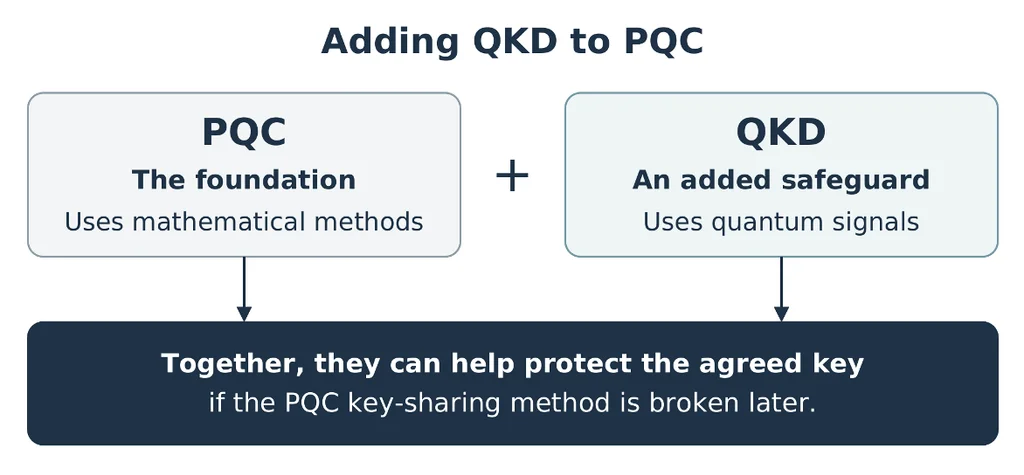
Guest Post by Ofir Joseph, Quantum Communication Researcher, University of Haifa, and Head of the Cybersecurity Program, Academic College of Tel Aviv–YaffoProf. Irit Hadar, Dean, Faculty of Computer and Information Science & Director, Center for Cyber, Law and Policy, University of HaifaMiriam Shtilman, Tal VenturesAI is helping researchers improve attacks on cryptography. Quantum key distribution can work alongside post-quantum cryptography to give selected critical connections extra protection against future attacks on how encryption keys are shared.TQI 2.0 | Quantum IntelligenceThe Quantum Economy is Moving FastTQI 2.0 makes sure you're not left behind.Google DeepMind’s November working papers show how AI can help researchers improve cryptographic attacks. One repeated a computation used in RSA-1024 signature attacks more efficiently, after billions of advance calls to a signing interface accepting chosen numerical inputs. It did not recover the private key. Another proposed theoretical savings when attacking many RSA keys of the same size through shared work; it has not been implemented. Neither demonstrated a practical break of deployed RSA-2048.Peer-reviewed studies have also used AI to analyse simplified versions of encryption methods and exploit information leaking from particular devices. These results do not demonstrate a mathematical break of today’s standardised post-quantum algorithms.In July 2026, Anthropic reported that a researcher working with Claude had developed an improved attack on HAWK, a proposed digital signature scheme. Their preprint describes recovering a key able to produce valid signatures for a small HAWK-256 test instance. For the larger HAWK-512 and HAWK-1024 versions, it reports lower estimated attack costs. HAWK was a candidate in the additional post-quantum signature process run by the US National Institute of Standards and Technology (NIST). Its designers confirmed the attack and withdrew it on 29 July, saying straightforward fixes would make it uncompetitive. It had not become a NIST standard.Digital signatures help verify who signed data and whether it has changed. QKD also requires reliable checks on the participating sites and their messages. A signature failure that allows impersonation during the exchange can undermine QKD. HAWK illustrates how security estimates can change. The case for QKD rests separately on research into protecting shared encryption keys.For critical infrastructure, the question is how to protect information that must stay private for years. The priority remains the move to post-quantum cryptography, or PQC, using mathematical methods selected for resistance to quantum-computer attacks. QKD offers a possible addition for selected connections.Consider two utility sites exchanging planning records that must remain confidential for 25 years. This example concerns sensitive transfers. The systems controlling the grid in real time have separate requirements for keeping services running.Encryption uses a secret key to protect those records. An attacker might record the encrypted traffic and the messages used to agree its key, hoping that future advances will reveal the key. Protection therefore depends partly on how the key is shared, as well as on the encryption itself.Quantum key distribution, or QKD, helps two sites create a shared secret key using carefully prepared light signals. They compare measurements and process their results into a shorter key, with a calculated limit on what an eavesdropper could learn. That limit can be proved without restricting the attacker’s computing power, provided the equipment and the exchange meet the proof’s assumptions. Once those conditions hold, more powerful AI does not by itself defeat a guarantee that already allows unlimited computing power.For the utility sites, QKD can be combined with PQC through a design whose proof covers a later failure of the PQC key-exchange method. If QKD’s contribution remains protected, that failure need not reveal the agreed encryption key. This is extra protection against recovering keys from recorded key exchanges.The sites must check who sent each message, that it has not changed, and that it belongs to the current exchange. Those checks must be secure while the exchange takes place. Some combined designs can keep the agreed key secret from the recorded exchange even against unlimited later computing power. This stronger promise needs a specific security proof.The equipment must also behave as assumed, and keys must remain protected while they are delivered, stored and used. Sending QKD keys to an application through another connection that can be cracked later could undo the benefit. Figure 1 illustrates QKD’s additional contribution alongside PQC.Figure 1. This benefit requires a design whose security has been proved for the stated situation. The sites must verify who is communicating during the exchange and protect their equipment and keys. The data encryption must also remain secure.QKD’s role is to supply keys. If AES, a widely used encryption method, protects the records, their security still depends on AES and the computers using it. Stored copies also need their own protection.In a 2025 field demonstration, researchers reported an average secret-key rate of about 110 bits per second over 254 kilometres of a commercial telecom network during a 7.5-hour run. Their particular design allowed a central measurement station to operate without being trusted with the secret key. Other QKD networks use intermediate stations that must be trusted.That average describes the key yield. Usable keys require sufficient measurements and further processing. With AES, a short key can protect much larger amounts of data, so modest key rates can support regular key changes. The key generation rate is different from the data transmission rate.Each deployment still needs evidence on usable-key supply, reliability, maintenance and cost. Some QKD designs can share fibre with ordinary data traffic, so a dedicated fibre is not always necessary.Official guidance also matters for deployment decisions. The UK’s National Cyber Security Centre does not support QKD for government or military applications and says it should not count as evidence of data-in-transit security under its Cyber Assessment Framework. The US National Security Agency does not recommend it for National Security Systems unless identified limitations are overcome.Securely delivered shared keys can also meet long-term needs. A 2025 peer-reviewed analysis found limited benefits in many documented QKD use cases it examined. It explains that a sufficient, securely stored initial stock of keys, or a suitable way to generate successive keys from a shared secret, can avoid frequent physical deliveries.QKD can replenish shared secrets remotely, with security based on its quantum exchange. Other methods can also refresh keys. The relevant comparison is what each approach guarantees and what it requires to operate. A long confidentiality requirement makes that comparison important; it does not automatically make QKD the best choice.NSA highlights QKD’s exposure to denial-of-service attacks. Aquina and colleagues also identify the risk of attackers forcing automatic fallback to protection without QKD. Operators should therefore define how protected reserves are used, when sensitive transfers wait and whether an authorised, visible fallback to PQC alone is acceptable.For selected critical links, QKD can add protection against recovering agreed keys from recorded exchanges if PQC key exchange is broken later. That contribution depends on a proof covering the failure and an implementation that preserves its assumptions.TopicsShareGet the latest research, company news, and market intelligence every week.MENTIONED IN THE ARTICLETel Aviv University (TAU), a public research university located in Tel Aviv, Israel, was established in 1956 through the merger of three educational institutions. It has since become the largest university in Israel, serving over 30,000 students across a diverse array of disciplines.Tal Ventures is an Israel-based venture capital group with strong connections to the Israeli high-tech ecosystem. The firm invests in start-up companies led by experienced and aspirational founders, supporting technologies with the potential to make a significant impact. Tal Ventures invests across various industries and at multiple stages of company development, aiming to maximize both stability and capital growth. The firm is known for its active involvement in portfolio companies, providing strategic support and leveraging its network to help businesses scale.More in Industry News
Tags
Source Information
Discussion
0 professional contributions
Sign in to join this professional discussion.
Be the first to add a constructive contribution.