
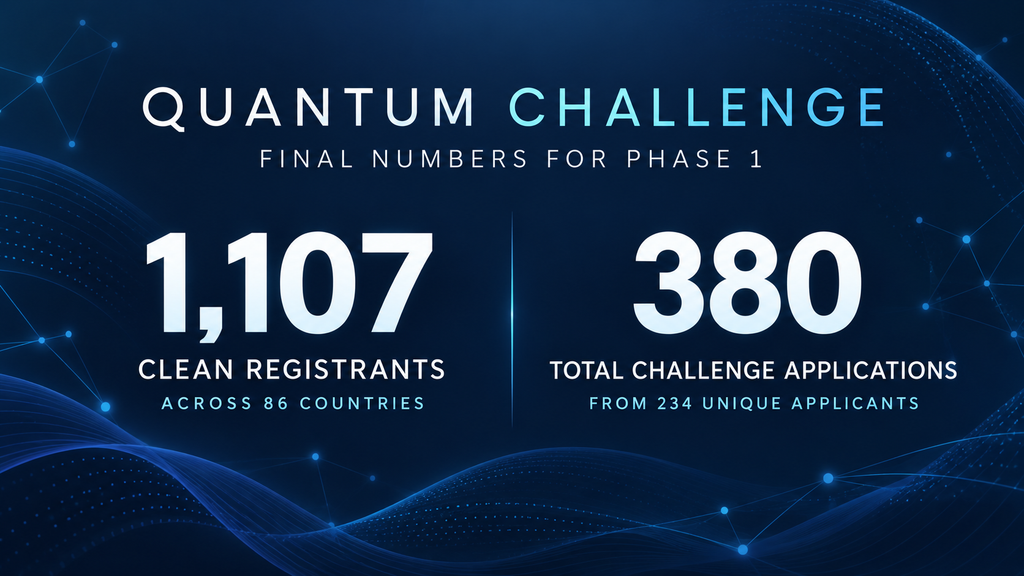
Global Quantum + AI Challenge Advances After Phase 1 Draws More Than 1,000 Entrants From Around The World
Understand this faster with AI


Insider BriefThe Global Quantum + AI Challenge is moving into its second phase after attracting more than 1,000 entrants from around the world to address practical problems submitted by five major enterprises.Following the close of Phase 1 submissions on Sept. 15, the challenge jury and enterprise partners will review proposals and select finalists for a proof-of-concept sprint. The selected teams will receive access to technology and support from Amazon Web Services and Classiq, along with resources from South Carolina Quantum, as they turn their initial ideas into demonstrations that can be tested against real industry needs.The yearlong challenge, led by The Quantum Insider, is designed to help move quantum computing projects from early concepts toward credible validation. It offers a total prize pool of $200,000 across five tracks, with $40,000 allocated to the top-performing team in each challenge.The enterprise tracks focus on predictive aerodynamic modeling for Airbus, simulation of allosteric signaling for Cleveland Clinic, distribution-grid expansion planning for E.ON, credit card fraud detection for HSBC and vision-language-action models for autonomous driving and robotics at Volkswagen Group Innovation. Quantum computing is central to the program, while artificial intelligence and high-performance computing can be used to support practical development and testing.Each track begins with a defined business or scientific problem rather than an open-ended technology exercise. That structure is intended to give teams a clearer standard for evaluating performance, feasibility and potential impact. It also allows the participating enterprises to compare different technical approaches to the same problem while giving researchers, startups and practitioners a route to test their work in an applied setting.During Phase 2, finalists will work toward proof-of-concept-grade results rather than purely theoretical proposals. The program is expected to provide computing resources, software tools and expert guidance that can help teams define workflows, benchmark their approaches and assess whether their proposed methods offer a practical path to enterprise use.Amazon Braket will give participants access to a range of quantum technologies through AWS, while Classiq will support the software development process.
South Carolina Quantum serves as the regional ecosystem partner, connecting the program with research and technical capacity in the state. MITRE is participating as an ecosystem partner.The jury includes scientists, industry leaders and investors with experience spanning quantum computing, algorithms, commercialization and research strategy. Announced members include Seth Lloyd, professor of quantum mechanical engineering at the Massachusetts Institute of Technology; Jonathan Legh-Smith, executive director of UKQuantum; Dr. Helmut Katzgraber, chief science officer and general partner at 55 North; and Professor Ignacio Cirac, director of the Theory Division at the Max Planck Institute of Quantum Optics.Lloyd developed an early technologically realizable model for quantum computation and the first quantum simulation algorithm. Cirac, working with Peter Zoller, proposed an influential trapped-ion quantum computing architecture. Legh-Smith brings experience in industry research strategy and the U.K. quantum sector, while Katzgraber contributes expertise in computational physics, optimization and quantum investment analysis.The review period will run through the fall, with Phase 2 scheduled from November 2026 through February 2027. The challenge is expected to conclude in March or April 2027, when final results and prize recipients will be determined. Full program information and updates are available at quantumai.thequantuminsider.com.About The Quantum InsiderThe Quantum Insider provides news, market intelligence and analysis covering the global quantum technology sector. Through its reporting, research and ecosystem programs, it supports organizations tracking the development and commercialization of quantum technologies.TopicsShare Get the latest research, company news, and market intelligence every week. MENTIONED IN THE ARTICLEAmazon Braket – A fully managed service that allows scientists, researchers, and developers to begin experimenting with computers from multiple quantum hardware providers in a single place. Bra-ket notation is commonly used to denote quantum mechanical states, and inspired the name of the service.Classiq Technologies specializes in quantum computing software, focusing on enabling the design, optimization, analysis, and deployment of quantum algorithms. It develops a high-level quantum algorithm design platform (IDE, compiler, “OS”) that transforms functional models into optimized, hardware-aware quantum circuits to address the challenge of gate-level complexity. It emphasizes abstraction, circuit synthesis, and resource optimization, working with enterprises, researchers, and hardware/cloud providers to deliver scalable quantum software.The South Carolina Quantum Association is a state-funded initiative aimed at advancing quantum talent and technology in South Carolina. It received $15 million from the state budget to make Columbia a hub for quantum supercomputing. The association plans to partner with Benedict College to increase diversity in the field and create a research, education, and workforce development program around the new technology. The initiative aims to build a Quantum smart workforce by engaging academic, government, and industry resources. It also seeks to attract high-tech companies to leverage the expertise of graduates in quantum technology.NSEC delivers research, engineering, and analytical solutions to the Department of Defense and the Intelligence Community. Since 1958, NSEC has contributed transformational innovations to essential systems such as the Semi-Automated Ground Environment (SAGE), the nation’s first air-defense system. These include Joint STARS, the Air Force/Army airborne ground surveillance, battle management, command and control aircraft, and Intelink, the first secure intranet used by the Intelligence Community. A team of physicists led by MITRE’s Gerry Gilbert, a theoretical physicist and quantum expert, are working on a quantum moonshot: a mission to build a scalable universal quantum computer.Cleveland Clinic functions as a not-for-profit academic medical institution, seamlessly merging clinical and hospital care with research and educational endeavors. The institution is dedicated to enhancing medical treatment for the unwell, delving into the intricacies of their ailments, and advancing the knowledge of those in the medical profession. In a significant milestone, Cleveland Clinic achieved the distinction of being the inaugural healthcare provider in the United States to join the United Nations Global Compact as a signatory in 2008, following the second worldwide.The E.ON Group is one of Europe's largest operators of energy networks and energy infrastructure and a provider of innovative customer solutions for 50 million customers.HSBC stands as a global bank, possessing assets amounting to USD 3 trillion and serving a customer base of 40 million individuals across the world. Its operational footprint extends across 64 countries, supported by approximately 220,000 full-time employees. The bank maintains significant presence in regions such as Asia, Europe, the Middle East and North Africa, and North America. Notably, the United Kingdom and Hong Kong stand as the bank's largest markets. HSBC's services encompass a wide range, including retail, commercial, and institutional banking, global banking and markets, as well as wealth management and private banking.Volkswagen is a German multinational automotive manufacturing corporation headquartered in Wolfsburg, Lower Saxony, GermanyThe Massachusetts Institute of Technology, located in Cambridge, Massachusetts, functions as a privately funded research university. It was founded in 1861 and has played a crucial part in advancing various fields of modern technology and science.UKQuantum is the voice of the UK quantum industry with the latest developments from research laboratories, research centers, and academic groups.55 North is a venture capital firm exclusively focused on investing in companies across the entire quantum technology stack, including quantum computing, sensing, and communication. The firm provides patient, long-term capital to help global quantum startups scale from laboratory to market, with a particular emphasis on European-based companies.The MPQ is one of the world's leading institutes on Quantum Optics. As part of the Max Planck Society, they offer scientists a unique infrastructure, ranging from state-of-the-art laboratories and equipment, and custom-made pieces from their own precision mechanical workshop.More in Research
Source Information
Discussion
0 professional contributions
Sign in to join this professional discussion.
Be the first to add a constructive contribution.