
Freezing Swampland: How Krylov Complexity Reframes the Weak Gravity Conjecture
The result bridges the Swampland program with quantum information theory and holographic complexity. It suggests that consistency conditions in quantum gravity may leave measurable imprints on how quantum states spread under time evolution, potentially opening new ways to test or reformulate swampland conjectures using complexity diagnostics.
Understand this faster with AI


Freezing Swampland: A Krylov Complexity Criterion for the Weak Gravity Conjecture
In the ongoing quest to understand the boundaries of consistent quantum gravity, the Swampland program has emerged as a powerful framework. It seeks to distinguish effective field theories that can be UV-completed with gravity (the “landscape”) from those that cannot (the “swampland”). One of its cornerstone proposals is the Weak Gravity Conjecture (WGC), which roughly states that gravity should be the weakest force: in any consistent theory of quantum gravity, there must exist charged particles for which the charge-to-mass ratio exceeds that of extremal black holes, ensuring that sufficiently charged black holes can decay rather than remain eternally stable.
A recent paper by Amin Faraji Astaneh and Reza Ghomi Shurkaie (arXiv:2607.23747) offers a striking new perspective on the WGC, reframing it through the lens of quantum information theory—specifically, Krylov spread complexity.arXiv
Setting the Stage: Charged Thermofield Double and RN-AdS Black Holes
The authors work in the holographic setting of AdS/CFT. They consider a charged thermofield double (TFD) state in the grand canonical ensemble. This state is dual to a two-sided Reissner–Nordström–AdS (RN-AdS) black hole. The TFD purifies the grand-canonical density matrix involving both energy and charge, and its time evolution is governed by a modular (grand-canonical) Hamiltonian.
Krylov complexity (or K-complexity) quantifies how a quantum state spreads in a specially constructed “Krylov basis” generated by the Lanczos algorithm. It provides a parameter-free measure of operator or state growth that has proven useful for diagnosing chaos, scrambling, and information dynamics without relying on specific holographic complexity conjectures such as Complexity=Volume or Complexity=Action.
Extremality and the Freezing of Krylov Spreading
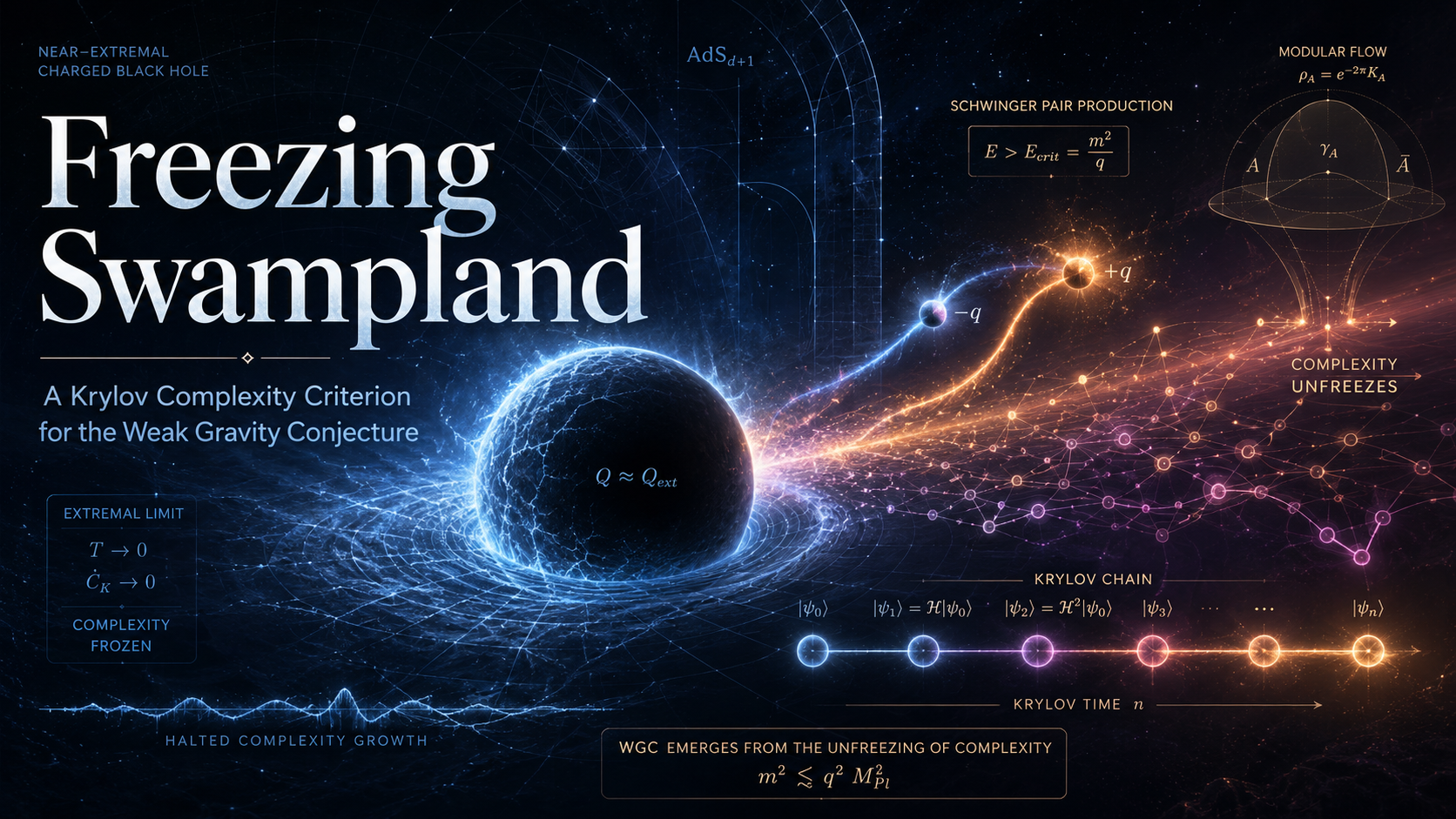
The central observation is that, as the RN-AdS black hole approaches the extremal limit (where temperature goes to zero and the inner and outer horizons coincide), the Krylov spreading of the dual charged TFD state effectively freezes.
In this regime:
- The return amplitude becomes essentially a pure phase.
- Higher cumulants of the modular Hamiltonian are suppressed.
- The variance that drives the leading term in Krylov complexity vanishes in a controlled way.
- The dual quantum state ceases to spread nontrivially through Krylov space.
In other words, extremality is accompanied by an obstruction to sustained complexity growth. The authors interpret this “freezing” as a complexity-theoretic signature of the absolute stability that extremal black holes would enjoy in the absence of a discharge mechanism.
Unfreezing via Schwinger Pair Production
To connect this directly to the WGC, the authors introduce charged matter and examine Schwinger pair production in the near-horizon AdS₂ throat of the near-extremal black hole. This process opens a discharge channel: virtual charged pairs can be produced, allowing the black hole to lose charge.
Once this channel is available:
- The frozen behavior is lifted.
- Krylov dynamics become nontrivial again.
- Complexity growth resumes.
Within the semiclassical near-extremal approximation, the presence of a viable discharge pathway—precisely what the WGC demands—prevents exact freezing of Krylov complexity.
A Complexity Criterion for the Weak Gravity Conjecture
The resulting picture is elegant: the Weak Gravity Conjecture can be rephrased, at least in this holographic setting, as the statement that exact freezing of Krylov spread complexity should not occur when a discharge channel is open. Absolute stability of extremal charged black holes (which would correspond to permanent freezing) is incompatible with consistent quantum gravity.
The authors are careful to note that their analysis is semiclassical and limited to the near-extremal throat; it does not capture the full nonlinear, backreacting evolution of a discharging black hole. Nevertheless, it isolates a clean diagnostic that links a classic swampland criterion to a dynamical property of quantum complexity.
Broader Implications
This work opens a promising bridge between three major areas of modern theoretical physics:
- The Swampland program and its conjectures about quantum gravity consistency.
- Black-hole thermodynamics and near-extremal dynamics.
- Quantum information theory, particularly complexity measures that probe spreading and chaos.
By showing that a swampland constraint can leave a detectable imprint on Krylov complexity, the paper suggests a broader research program: using dynamical complexity diagnostics as probes of other swampland criteria. Future work could explore whether similar freezing/unfreezing phenomena appear for other conjectures, or whether fully quantum treatments of discharging black holes reinforce the same picture.
In short, “Freezing Swampland” offers a fresh, information-theoretic reading of the Weak Gravity Conjecture. Extremality freezes complexity growth; the requirement that charged black holes must be able to decay unfreezes it. Consistency with quantum gravity, it seems, demands that complexity never freezes completely when a discharge channel is available.
Freezing Swampland: A Krylov Complexity Criterion for the Weak Gravity Conjecture
In the landscape of modern theoretical physics, few programs have generated as much excitement—and controversy—as the Swampland program. Initiated by Cumrun Vafa and developed by a large community of string theorists and quantum gravity researchers, it aims to map the boundary between effective field theories that can be consistently coupled to quantum gravity (the “landscape”) and those that cannot (the “swampland”). Among its most influential proposals stands the Weak Gravity Conjecture (WGC), first formulated by Arkani-Hamed, Motl, Nicolis, and Vafa. In its simplest form, the WGC asserts that gravity is the weakest force: in any consistent theory of quantum gravity, there must exist charged particles whose charge-to-mass ratio is at least as large as that of an extremal black hole. This ensures that sufficiently charged black holes are unstable and can discharge, rather than remaining eternally stable.
A recent paper by Amin Faraji Astaneh and Reza Ghomi Shurkaie, titled “Freezing Swampland: A Krylov Complexity Criterion for the Weak Gravity Conjecture” (arXiv:2607.23747), offers a striking reformulation of this classic swampland criterion. Working at the intersection of holography, black-hole physics, and quantum information theory, the authors propose that the WGC can be understood through the dynamical behavior of Krylov spread complexity. Their central claim is that the approach to extremality is accompanied by an effective “freezing” of Krylov spreading in the dual quantum state, while the opening of a discharge channel—precisely what the WGC requires—unfreezes this dynamics.
The Swampland Program and the Weak Gravity Conjecture
The Swampland program begins from a simple observation: not every low-energy effective field theory that appears consistent (anomaly-free, unitary, etc.) can be completed into a ultraviolet theory that includes quantum gravity. String theory provides a vast but finite landscape of consistent vacua; everything outside that landscape belongs to the swampland. Over the past decade, a web of conjectures has been developed to characterize this boundary. These include the absence of exact global symmetries, the distance conjecture (which predicts infinite towers of light states at large distances in moduli space), the de Sitter conjecture, and, most relevant here, the Weak Gravity Conjecture.
The WGC has several formulations. The electric version requires the existence of a particle with mass m and charge q satisfying m≤2gqMPl (in four dimensions). The magnetic version bounds the ultraviolet cutoff of the effective theory by the gauge coupling. In the black-hole context, the conjecture implies that extremal charged black holes cannot be absolutely stable: there must exist lighter, more strongly charged states that allow the black hole to decay via emission or pair production. Without such states, an extremal black hole would constitute a stable remnant, raising theoretical difficulties related to the information paradox, the no-global-symmetry principle, and the completeness of the charge spectrum.
Krylov Complexity: A Quantum-Information Probe
To rephrase the WGC in information-theoretic language, the authors turn to Krylov complexity (also called K-complexity or spread complexity). Introduced in the context of operator growth and quantum chaos, Krylov complexity quantifies how a quantum state or operator spreads under time evolution in a specially constructed orthonormal basis—the Krylov basis—generated by the Lanczos algorithm.
Starting from an initial state ∣ψ0⟩, one iteratively applies the Hamiltonian (or a modular Hamiltonian) and orthogonalizes the resulting vectors. This produces a chain of states {∣Kn⟩} in which the dynamics reduce to a one-dimensional tight-binding problem with Lanczos coefficients an and bn. The Krylov complexity is then defined as the expectation value of the position operator on this chain:
CK(t)=n∑n∣ϕn(t)∣2,where ϕn(t) are the amplitudes in the Krylov basis. For early times, CK(t) is dominated by the variance of the Hamiltonian; higher cumulants control later behavior. Unlike circuit complexity or holographic proposals such as Complexity=Volume and Complexity=Action, Krylov complexity requires no arbitrary reference state or gate set; it is intrinsic to the dynamics.
In recent years, Krylov complexity has been linked to holographic duals (particularly in the double-scaled SYK model and JT gravity, where it maps to wormhole length) and has proven sensitive to chaos, integrability, and late-time saturation. Its parameter-free character makes it an attractive diagnostic for quantum-gravity consistency conditions.
Holographic Setup: Charged Thermofield Double and RN-AdS Black Holes
The authors work in the AdS/CFT correspondence. They consider a charged thermofield double (TFD) state in the grand canonical ensemble. The grand-canonical Hamiltonian is
K=H−μQ,where H is the ordinary Hamiltonian, Q the conserved charge, and μ the chemical potential. The corresponding partition function is
Z(β,μ)=Tre−βK.The TFD state purifies the grand-canonical density matrix and is holographically dual to a two-sided Reissner–Nordström–AdS black hole. The left and right boundaries of the eternal RN-AdS geometry host the two entangled copies of the boundary theory. Global time evolution in the bulk corresponds to evolving one boundary forward and the other backward; to obtain a nontrivial return amplitude, one therefore evolves only a single copy with the modular Hamiltonian K.
The return amplitude
A(t)=Z(β,μ)Z(β−it,μ)is the central object. Its logarithm generates the cumulants of K:
logA(t)=n=1∑∞n!(it)nκn.The first few cumulants are the mean, variance, skewness, and kurtosis of the modular Hamiltonian. Through the standard moment–cumulant relations, these determine the early-time Lanczos coefficients and hence the early-time growth of Krylov complexity. In particular, the leading term is controlled by the variance κ2.
Extremality and the Freezing of Krylov Spreading
The geometry of interest is the charged AdS black hole in Einstein–Maxwell theory with negative cosmological constant. In the near-extremal limit, the Hawking temperature approaches zero, the inner and outer horizons coincide, and a long AdS₂ throat develops near the horizon. Thermodynamically, the charge and mass approach the extremality bound.
The authors compute the cumulants of the modular Hamiltonian in this regime. As extremality is approached, the variance κ2 and higher cumulants are strongly suppressed. Consequently, the return amplitude becomes dominated by a pure phase factor. In Krylov space, this implies that the state ceases to spread: the amplitudes ϕn(t) remain concentrated near the initial Krylov vector, and the complexity CK(t) freezes at a low value.
This “freezing” is not claimed to be a complete dynamical description of an extremal black hole. Rather, it is presented as a diagnostic: absolute stability of the extremal black hole is reflected, on the dual side, by an obstruction to sustained complexity growth. In the language of the paper, extremality is accompanied by an effective freezing of Krylov spreading.
Unfreezing Through Schwinger Pair Production
To restore nontrivial dynamics, charged matter must be included. In the near-horizon AdS₂ throat of a near-extremal RN-AdS black hole, a strong electric field is present. This field can produce charged particle–antiparticle pairs via the Schwinger mechanism. The authors derive the relevant heat kernel for a charged scalar in the throat and compute the pair-production rate.
Once a discharge channel opens, the black hole can lose charge. Within the semiclassical near-extremal approximation, this process lifts the freezing: the cumulants of the modular Hamiltonian acquire non-vanishing contributions, the return amplitude develops a non-trivial modulus, and Krylov complexity resumes its growth. The dynamics become nontrivial again precisely because a pathway for the black hole to discharge has been provided.
This is the key conceptual step.
The Weak Gravity Conjecture demands the existence of such a discharge channel (through the presence of sufficiently light, sufficiently charged particles). In the complexity language developed here, that demand is equivalent to the requirement that exact freezing of Krylov spread complexity should not occur when a discharge channel is available.
Interpretation and Caveats
The authors emphasize that their analysis is semiclassical and restricted to the near-extremal throat. It does not capture the full nonlinear, backreacting evolution of a discharging black hole, nor does it provide a first-principles derivation of the WGC from quantum information. Instead, it offers a diagnostic: one of the characteristic physical consequences of the WGC—the instability of near-extremal charged black holes—leaves a clear imprint on Krylov dynamics.
The result also suggests a broader research program. If a classic swampland criterion can be rephrased in terms of the presence or absence of complexity freezing, other conjectures might admit similar reformulations. One can imagine searching for complexity-theoretic signatures of the distance conjecture, the no-global-symmetry principle, or the de Sitter conjecture. Conversely, the behavior of Krylov complexity in holographic models may serve as a consistency check on proposed swampland constraints.
Broader Context and Outlook
The paper sits at a fertile intersection. On one side lies the Swampland program, which seeks universal constraints on quantum gravity. On another lies the growing body of work relating quantum complexity to gravitational observables—wormhole lengths, volumes of Einstein–Rosen bridges, and action functionals. Krylov complexity has already found a precise bulk dual in JT gravity; the present work extends its reach into the charged, near-extremal regime and links it to a foundational swampland conjecture.
Several open questions remain. Can the freezing–unfreezing transition be made fully quantum, including backreaction and finite-temperature effects beyond the near-extremal limit? Does a similar diagnostic exist for higher-form charges or for the magnetic Weak Gravity Conjecture? Can one formulate a quantitative complexity bound that sharpens the WGC? And, more ambitiously, might complexity-based criteria eventually help distinguish absolute swampland constraints (true in any quantum gravity theory) from relative ones (specific to string theory or asymptotic safety)?
For now, the message is clear and elegant. In the dual description of a charged black hole, extremality freezes Krylov spreading. The requirement that the black hole must be able to discharge—central to the Weak Gravity Conjecture—unfreezes it. Consistency with quantum gravity, viewed through the lens of complexity, demands that complexity never freezes completely when a discharge channel is open. In this sense, the Swampland itself can freeze—and the Weak Gravity Conjecture is the principle that prevents it from remaining frozen forever.
Tags
Source Information
Discussion
0 professional contributions
Sign in to join this professional discussion.
Be the first to add a constructive contribution.