
Fermilab physicist wins DOE Early Career Award to study dark matter with entangled qubits
Understand this faster with AI


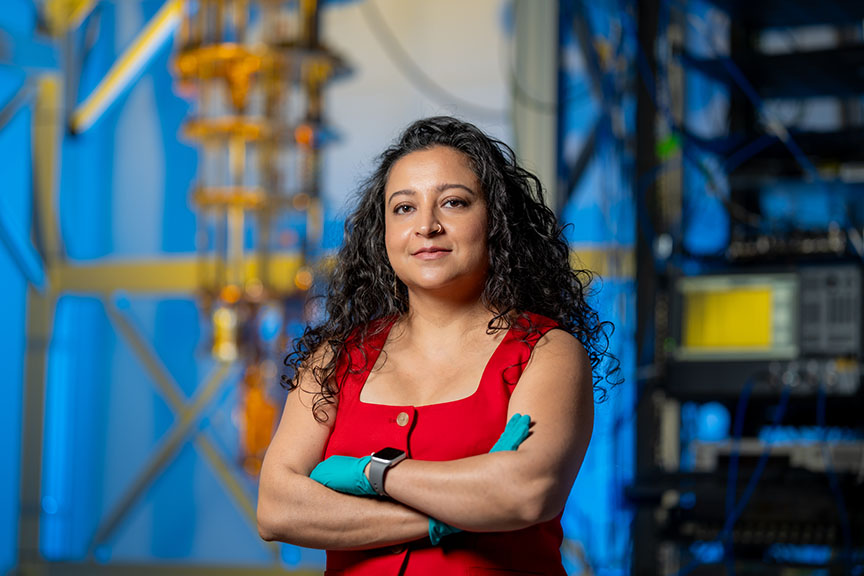
Rakshya Khatiwada, a physicist with Fermi National Accelerator Laboratory and Illinois Institute of Technology, has received the U.S. Department of Energy Early Career Award to pursue an innovative approach for discovering dark matter. Her project will test the potential of entangled superconducting qubits, the building blocks of quantum computers, to detect signals far too faint for conventional instruments to catch. Dark matter makes up roughly five times more of the universe’s matter than the ordinary matter we see in stars, planets and people, yet it has never been directly observed. “We already see some signatures of dark matter from astrophysical observations like gravitational lensing and cosmic microwave background radiation,” Khatiwada explained. “Searching for dark matter in the laboratory requires a different approach. Scientists need highly specialized instruments to detect the faint signals that dark matter might produce through interactions with ordinary matter and electromagnetic fields.” Rakshya Khatiwada is a physicist at Fermilab and a professor at Illinois Institute of Technology. Credit: Ryan Postel, Fermilab Khatiwada’s research will use a four-qubit entangled system to test whether quantum entanglement offers a genuine sensing advantage over independent, non-entangled qubits when exposed to a simulated dark matter signal. Entanglement links the quantum states of two or more qubits, which can work together as a sensitive detector. “These entangled qubits share a single quantum state,” Khatiwada said. “So, if they all encounter the same dark matter signal, their response is enhanced.” Before coming to Fermilab, Khatiwada conducted postdoctoral research at the University of Washington with the Axion Dark Matter eXperiment, working with quantum amplifiers as a quantum detector lead. Resonant-cavity experiments like ADMX are sensitive to narrow bands of dark matter mass and require careful tuning to sweep across a broad range of masses over time. That experience convinced her that quantum sensing is essential for detecting dark matter, and she has been exploring the use of qubits for this purpose ever since. Khatiwada explained that entangled qubits could not only help researchers detect fainter signals but also search more efficiently across a range of possible dark matter masses. “These entangled qubits share a single quantum state,” Khatiwada said. “So, if they all encounter the same dark matter signal, their response is enhanced.” Rakshya Khatiwada Khatiwada credits Fermilab’s highly specialized capabilities and resources, including the Superconducting Quantum Materials and Systems Center, and her work as a professor with excellent graduate students at Illinois Institute of Technology with creating the ideal setting for her project. Her work recently demonstrated very low-noise performance of superconducting qubits in the QUIET and LOUD facilities at Fermilab, where she is also using super intelligence and machine learning to study noise that is extremely hard to detect using traditional methods. These ongoing efforts will lay the groundwork for her entanglement project. “I am really excited about applying these ideas that I have been working on to entanglement-based sensing for dark matter,” Khatiwada said. “Fermilab has excellent infrastructure, resources and technical expertise, as well as talented postdoctoral researchers. This is a great place to do research.” Fermi National Accelerator Laboratory is America’s national laboratory for particle physics and accelerator research.
Fermi Forward Discovery Group manages Fermilab for the U.S. Department of Energy Office of Science. Visit Fermilab’s website at www.fnal.gov and follow us on social media.
The Superconducting Quantum Materials and Systems Center at Fermilab is supported by the DOE Office of Science.The Superconducting Quantum Materials and Systems Center is one of the five U.S. Department of Energy National Quantum Information Science Research Centers. Led by Fermi National Accelerator Laboratory, SQMS is a collaboration of more than 30 partner institutions — national labs, academia and industry — working together to bring transformational advances in the field of quantum information science. The center leverages Fermilab’s expertise in building complex particle accelerators to engineer multiqubit quantum processor platforms based on state-of-the-art qubits and superconducting technologies. Working hand in hand with embedded industry partners, SQMS will build a quantum computer and new quantum sensors at Fermilab, which will open unprecedented computational opportunities. For more information, please visit sqmscenter.fnal.gov. Recommended reading View all news New DOE Early Career project uses magnetic vortices to uncover hidden sources of loss in superconducting quantum devices October 8, 2026 Early Career Awardmaterials sciencequantumSQMSFermilab feature Daniel Bafia will develop a new measurement approach that uses magnetic vortices to investigate defects and interfaces that can limit the performance of superconducting quantum devices. The project could provide researchers with a new way to understand and ultimately reduce sources of energy loss in quantum materials. Christina Wang of Fermilab receives prestigious award for advances in dark matter detection June 16, 2026 awarddark matterFermilab feature Christina Wang, a postdoctoral researcher and Lederman Fellow at Fermi National Accelerator Laboratory, has been awarded the American Physical Society’s 2026 Mitsuyoshi Tanaka Award in Experimental Particle Physics for her pioneering work in particle detection. Her innovative techniques, which open new pathways for identifying elusive dark matter candidates, are advancing the search for physics beyond the Standard Model. Yao Lu receives Early Career Award to harness quantum entanglement for dark matter search April 23, 2026 dark matterquantumSQMSFermilab feature Supported by a DOE Early Career Award, a Fermilab scientist is building a scalable superconducting cavity array to detect faint signals from mysterious dark photons with unprecedented speed and sensitivity.
Tags
Source Information
Discussion
0 professional contributions
Sign in to join this professional discussion.
Be the first to add a constructive contribution.