
Electron spin force moves a macroscopic object
Understand this faster with AI


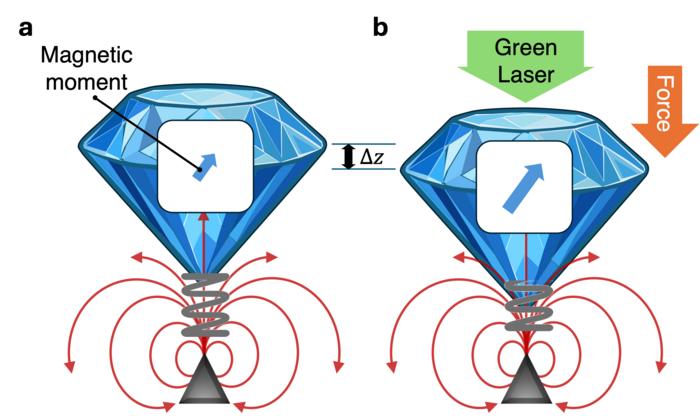
Shine on, NV diamond: Real-colour photo of the lower half of the experimental setup. The diamond with nitrogen-vacancy centres is suspended via a graphite rod above a magnet. When the diamond is illuminated with a green laser, the spin state within the diamond shifts, pushing it towards the magnet. The diamond glows red due to electrons in the nitrogen-vacancy centres being excited to a higher energy state by the laser. (Courtesy: Cassondra George, OIST) Physicists have moved a macroscopic sample of diamond using only the force from the sample’s own electron spins. This achievement, which shows that a small quantum effect can produce a large classical response, could herald a new class of sensors that are precise enough to probe the nature of gravity and test the boundaries of quantum mechanics. “There is a lot of interest in this spin force because the force it exerts can be a quantum force,” explains physicist Jason Twamley, who led the research at Japan’s Okinawa Institute of Science and Technology (OIST). “I think it’s amazing that tiny spins can exert so much force and displace a macroscopic object that weighs so much.” One of the fundamental principles of quantum mechanics is that objects can be in a superposition of two or more states. These superpositions are very delicate, however, and interactions between an object and its environment tend to destroy them. The bigger the object is, the harder it is to prevent such interactions, which is why Schrödinger’s famous cat – a macroscopic object – cannot be simultaneously dead and alive. For scientists wishing to probe the quantum nature of gravity, this presents a problem. Objects that interact strongly via the gravitational force are, by definition, massive, but massive objects will not remain in a quantum superposition unless thermal vibrations and other sources of noise are tightly controlled. Levitating the object in a vacuum is one possible strategy, but doing this with conventional techniques such as optical traps has proved difficult. Nitrogen-vacancy defects in diamond In the new work, Twamley and colleagues tried a different approach. Their trapping system comprises a diamagnetically levitated graphite plate that is fitted with a mirror and connected to their massive object – a centimetre-scale, 128-milligram sample of diamond – via a carbon rod that passes through magnetic shielding. A graphical representation of the observed movements. a) When the laser is off, the diamond slab has a small magnetic moment (blue arrow) induced by the latent spin-state inside the nitrogen-vacancy centres of the diamond. b) When the green laser is on, the spin-state is polarized, causing the magnetic moment to fluctuate weakly, pushing the diamond towards the magnetic field (red arrows). The amount of movement is labeled as displacement (Δz). (Courtesy: Nayak et al., 2026) The OIST team engineered the diamond sample to contain billions of defects that occur when two neighbouring carbon atoms are replaced by a nitrogen atom and an empty lattice site. These nitrogen-vacancy (NV) centres, as they are known, act as a “trap” for unpaired electrons, and their electronic spins are extremely well isolated from the surrounding lattice. This means that if they are placed in a certain spin state, they will remain in that state for a relatively long time, even at room temperature. Driving force: By shining a green, 50-milliwatt laser on a diamond with nitrogen-vacancy centres in pulses and measuring its movements with an interferometer, the researchers detected up-and-downward movements (blue line) driven by changes in spin force alone. These movements were much larger than those observed when the laser was off (orange line). (Courtesy: Nayak et al., 2026) When Twamley and colleagues illuminate their sample with green laser light, the NV centres polarize into a predefined spin state. This polarization generates tiny magnetic fluctuations that exert a force on the diamond, pushing it upwards. The researchers tracked this motion using an interferometer that reflects laser light off the mirror on the graphite plate. They found that they could controllably move the diamond sample by as much as ∼100 nanometres in air and up to ∼1.5 μm in vacuum. “This means that under the right conditions, one can put the spin in a superposition of states and so create a superposition of forces that can displace the diamond into a superposition of positions,” Twamley explains, though he adds that achieving those conditions will be extremely tough. Towards a spatial Schrödinger’s cat According to Twamley, most previous work in this area focused on levitated nanodiamonds containing a single NV spin. “We therefore decided to go to the opposite end of the scale and study a macroscopic diamond sample,” he says. Spatial superpositions of objects larger than tens of nanometres have not yet been achieved, Twamley adds, so “demonstrating this would allow us to explore the fragile border between the quantum and classical world.” Spin-motional coupling like the OIST team created could be used for many purposes. One example, Twamley suggests, would be to create a “spatial Schrödinger’s cat” – that is, an object with a centre of mass in a superposition of two locations. “Our experiment shows that tiny spins can lead to a large displacement, which is one step along the road towards taming this cat,” he says. Schrödinger cat state sets new size record Read more He and his colleagues hope that their research will encourage other groups to study macroscopic diamond NV ensembles and ways of actuating them in a magnetic field gradient. “One of the lessons from our experiments is that our low frequency levitated system is very sensitive to vibrational noise,” says Twamley. “We are now discovering the many joys of vibration isolation and hopefully will be able to put these oscillators in a nice quiet box where they can be super-protected from the world.” They report their work in Science Advances. Want to read more? Registration is free, quick and easy Note: The verification e-mail to complete your account registration should arrive immediately. However, in some cases it takes longer. Don't forget to check your spam folder. If you haven't received the e-mail in 24 hours, please contact customerservices@ioppublishing.org. E-mail Address Register
Tags
Source Information
Discussion
0 professional contributions
Sign in to join this professional discussion.
Be the first to add a constructive contribution.