
26 days to break Bitcoin? IonQ publishes a detailed quantum plan
Understand this faster with AI


IonQ reports a 20,000-physical-qubit quantum computer could break secp256k1, the cryptographic standard securing Bitcoin, in under 26 days. This estimate, detailed in a newly published paper, significantly accelerates timelines for potential cryptographic vulnerability previously projected for the 2030s. IonQ’s research team optimized the algorithm, compiler, hardware, and error-correction layer to achieve this result, focusing on secp256k1 because it is “one of the most scrutinized cryptography standards in production today.” According to Niccolo de Masi, Chairman & CEO of IonQ, “As our paper demonstrates in full detail, IonQ’s full-stack approach provides powerful capabilities.” IonQ’s 20,000-Qubit System Projected to Break secp256k1 in 26 Days IonQ estimates a 20,000-physical-qubit quantum computer would require just under 26 days to break secp256k1, the elliptic curve cryptographic standard vital to blockchain technologies like Bitcoin, a timeframe significantly faster than previous projections placing the threat in the 2030s. This calculation is not theoretical; the company’s research team compiled every operation to the level of actual error-correction primitives for its architecture, establishing a provable lower bound on computational success, IonQ says. The resulting blueprint details 1,457 logical qubits and 39 million Toffoli gates operating at the logical level, a scale aligning with IonQ’s publicly stated hardware roadmap for approximately 2028. The detailed resource estimate marks a shift from abstract risk assessment to concrete engineering planning, according to John Gamble, VP Architecture at IonQ. He stated, “This level of completeness is what turns a resource estimate into an engineering blueprint. The hardware resource count for this computation is at the same scale as the systems we are already building toward.” This work isn’t simply a demonstration of cryptographic vulnerability, but a validation of IonQ’s full-stack approach, integrating algorithm optimization, compiler design, hardware architecture, and error-correction layers.
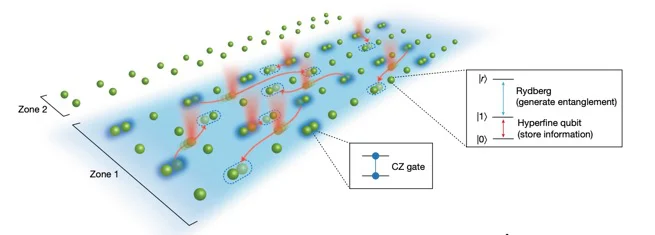
The team’s work, published in a peer-reviewed paper, builds upon the company’s Walking Cat architecture, first unveiled in April 2026, and utilizes trapped ions alongside quantum LDPC codes. Major enterprises and the U.S. government now concur, and the White House issued its executive order on quantum security earlier this summer. IonQ emphasizes that the findings are best understood as a capability milestone, demonstrating a re-architected solution to a decades-old problem, rather than solely a security breach, according to the company. Martin Roetteler, VP Quantum Applications R&D, added that this full-stack methodology is being applied across IonQ’s broader roadmap, encompassing applications in chemistry, finance, materials science, and defense. IonQ followed responsible disclosure practices, sharing advance copies of the research with government and industry partners before publication, and the company notes that the vulnerability affects authentication and integrity, not data confidentiality. While the research highlights a potential risk, mitigation strategies like Stateless Hash-Based Digital Signature Algorithm and ML-DSA are already available, and the company advocates for ongoing cryptographic agility and defense-in-depth strategies to address evolving quantum threats. As our historic paper today demonstrates in full detail, IonQ’s superior full-stack approach provides powerful capabilities. We are on track to produce our fully fault tolerant 10,000 physical qubit system in 2027, with significant further advances in our labs, manufacturing and deployments in 2028. Niccolo de Masi, Chairman & CEO, IonQ Source: http://www.businesswire.com/news/home/20260908846673/en/IonQ-Publishes-World%E2%80%99s-First-Fully-Compiled-End-to-End-Blueprint-for-Breaking-256-Bit-Elliptic-Curve-Signatures/ More like thisQuantum Computing NewsQuantum Zeitgeist Weekly DigestQuantum Computing Business NewsSK Telecom & IonQ: Quantum Computing for AI StabilityQuantum Computing Business NewsIonQ Buys Qubitekk: Quantum Networking BoostQuantum CryptographyIonQ says orders set 2030 deadline for post-quantum crypto migrationStay currentSee today’s quantum computing news on Quantum Zeitgeist for the latest breakthroughs in qubits, hardware, algorithms, and industry deals. Tags: Rusty Flint Rusty is a quantum science nerd. He's been into academic science all his life, but spent his formative years doing less academic things. Now he turns his attention to write about his passion, the quantum realm. He loves all things Quantum Physics especially. Rusty likes the more esoteric side of Quantum Computing and the Quantum world. Everything from Quantum Entanglement to Quantum Physics. Rusty thinks that we are in the 1950s quantum equivalent of the classical computing world. While other quantum journalists focus on IBM's latest chip or which startup just raised $50 million, Rusty's over here writing 3,000-word deep dives on whether quantum entanglement might explain why you sometimes think about someone right before they text you.
Tags
Source Information
Discussion
0 professional contributions
Sign in to join this professional discussion.
Be the first to add a constructive contribution.