
Cornell Researchers Demonstrate Standing-Wave EIT Cooling for Trapped Ions
Understand this faster with AI


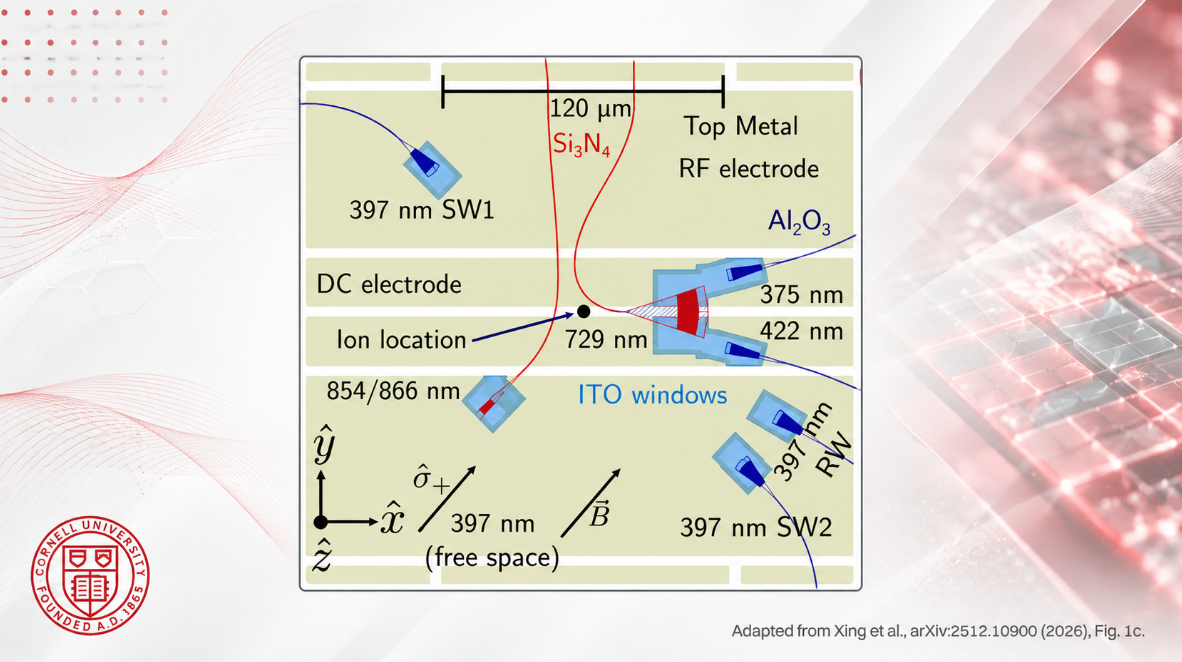
Insider BriefPRESS RELEASE — Nullspace, a leading provider of advanced electromagnetic simulation software, today announced that researchers at Cornell University, led by Professor Karan Mehta, used Nullspace ES to support the first experimental demonstration of standing-wave electromagnetically-induced-transparency (EIT) cooling for trapped ions, building on theoretical predictions dating back to 1992.Using Nullspace ES to simulate the electrostatic fields of a complex chip-scale ion trap, researchers in Cornell University’s Mehta Group calculated the baseline voltage sets used to control ions throughout the experiment. The resulting experiment demonstrated a new approach to trapped-ion cooling that achieved higher cooling rates, addressed a broader range of modes, and reached lower final phonon occupation numbers than the conventional running-wave approach.Trapped-ion quantum computing depends on the ability to manipulate individual ions with extreme precision. As more optical and electrical functionality is added to traps, the simulations supporting these experiments must account for increasingly complex geometries while keeping up with the pace of research.Nullspace ES simulated the electrostatic fields generated by the Mehta Group’s chip surface electrodes, providing the baseline voltage calculations the researchers used for axial confinement, radial mode rotation, and sub-micron ion positioning.“As quantum hardware grows more complex, researchers are under pressure to iterate at a faster pace,” said Masha Petrova, CEO of Nullspace. “Cornell’s work demonstrates why simulation must advance alongside hardware, if not ahead of it. When ions need to be controlled at this level of precision within increasingly sophisticated systems, the simulation tools researchers rely on cannot become the bottleneck.”Prior to using Nullspace ES, the Mehta Group used COMSOL and a different Python-based toolkit for electrostatic simulation. COMSOL’s comprehensive physics modeling required more computation time, while the toolkit produced an analytical solution that did not capture all the physical features required for the experiment’s level of precision.Nullspace ES enabled the group to combine high-fidelity simulation with the faster iteration required for this kind of research.
The Mehta Group integrated Nullspace ES into its broader design workflow to create an automated pipeline from chip design to experimentally usable voltage sets.“Nullspace ES has proven highly valuable in allowing us to carry out accurate trap simulations efficiently, which is essential to effective design and simulation of devices at the precision important for these kinds of experiments,” said Cornell Professor Karan Mehta, principal investigator of the study.The Cornell experiment demonstrated an approach that cooled faster across a broader range of motional modes while reaching lower final phonon numbers than the conventional running-wave approach. For trapped-ion quantum computing, the results represent a step toward faster and more scalable quantum systems, while demonstrating how advanced electrostatic simulation can support increasingly complex chip-scale architectures. Read more about how the Mehta Group used Nullspace ES in the full case study here.TopicsShare Get the latest research, company news, and market intelligence every week. MENTIONED IN THE ARTICLECornell University, a private Ivy League research university, is situated in Ithaca, New York. It was established in 1865 by Ezra Cornell and Andrew Dickson White.More in Research The Quantum Insider (TQI) is the leading source for the latest quantum technology news, market intelligence, industry analysis, and data covering the global quantum ecosystem. NEWSROOMPLATFORMSERVICESCOMPANY© 2026 The Quantum Insider. All rights reserved. Part of the Resonance networkOne of our team will be in touch to learn more about your requirements, and provide pricing and access options.Subscribe to our industry leading leading newsletter for the latest in quantum news and insights. We use cookies to analyse traffic and improve your experience. Privacy Policy
Tags
Source Information
Discussion
0 professional contributions
Sign in to join this professional discussion.
Be the first to add a constructive contribution.