
Chulalongkorn University and AIST Sign MoU on Quantum Technology
Understand this faster with AI


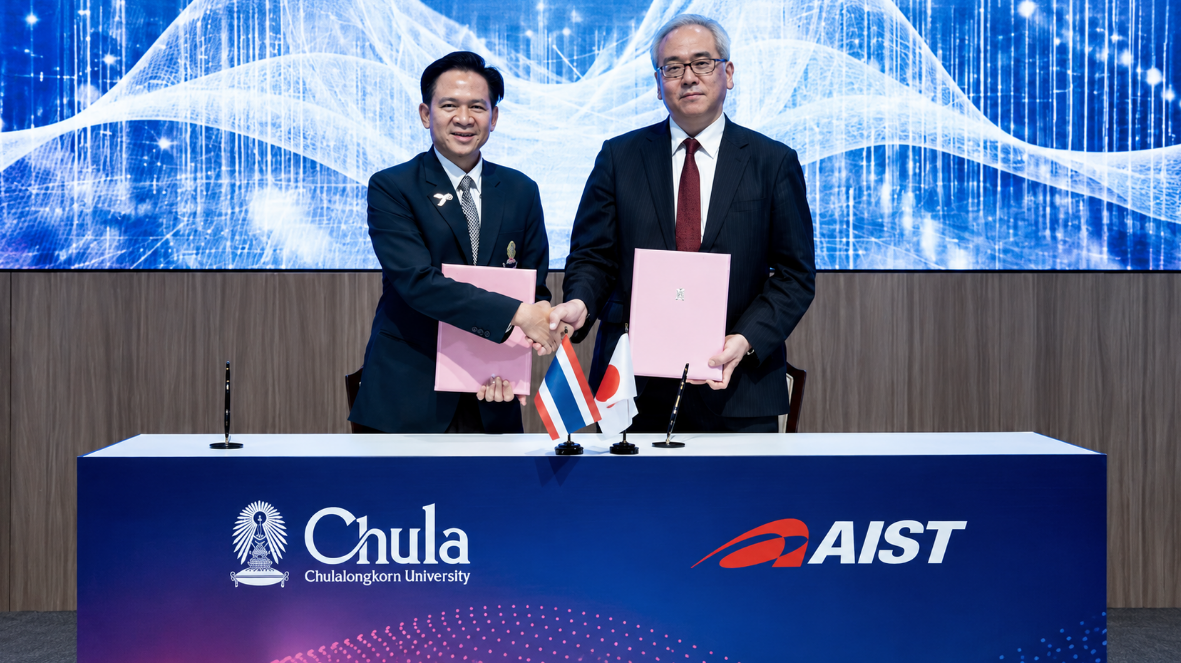
Insider BriefPRESS RELEASE — Chulalongkorn University and the National Institute of Advanced Industrial Science and Technology (AIST) in Japan, through the Global Research and Development Center for Business by Quantum-AI Technology (G-QuAT), signed a memorandum of understanding to drive collaboration in quantum technology and the development of quantum ecosystems between Thailand and Japan. Prof. Dr. Pranut Potiyaraj, Dean of the Faculty of Science, Chulalongkorn University, and Dr. Masahiro Horibe, Deputy Director of G-QuAT acting on behalf of G-QuAT Director, Dr. Kazuya Masu, signed the MoU. The signing, which took place on July 24, 2026, at Room 105, Maha Chulalongkorn Building, was attended by representatives from the government sector, the industry sector, and academic institutions from both countries. This MOU marks an important step towards establishing long-term cooperation in quantum technology with the aim of promoting research, human resource development, and the application of quantum computing technology for the benefit of industry and society, as well as strengthening the international quantum ecosystem between Thailand and Japan. Under this collaboration, the two institutions will jointly organize activities including seminars and academic conferences, exchanges of scientists and researchers, and joint research projects on areas of mutual interest. Chulalongkorn University will coordinate the collaboration through Siam Quantum Square (SQ²), while AIST will carry out its activities through the Corporate Planning and Management Headquarters. The MOU will remain in effect for a period of five years. According to Prof. Dr. Pranut Potiyaraj, Dean of the Faculty of Science, Chulalongkorn University, “The collaboration between Chulalongkorn University and G-QuAT, AIST, is an important milestone in the development of quantum science and technology in Thailand, an area that is currently advancing rapidly around the world. Although Thailand entered the scene later than many other countries, building collaborative networks with a world-class partner like Japan will enable Thailand to learn and develop more rapidly in terms of knowledge, technology, and the quantum ecosystem that Japan has firmly established. Japan’s experience and development approaches will serve as an important model that Thailand can adapt to enhance the country’s capabilities in the future.” “This collaboration is aligned with the vision of the Faculty of Science and Chulalongkorn University to promote quantum technology as one of the country’s key technologies. One of the most urgent priorities for Thailand is the development of a skilled workforce, as the current number of qualified personnel remains insufficient to meet the demands of the research and industrial sectors. The Faculty of Science is therefore in the process of developing quantum-related curricula and will take advantage of its collaboration with AIST as a key mechanism to accelerate the development of skilled professionals, thereby supporting the tangible growth of quantum technology in Thailand,” Prof. Dr. Pranut added. Dr. Masahiro Horibe, Deputy Director of G-QuAT, AIST, made the observation that “Cross-border collaboration plays a vital role in accelerating the application of quantum technology in industry and society. We are confident that the collaboration between AIST and Chulalongkorn University will help generate tangible outcomes and expand opportunities for innovation in both countries.” “Thailand has long been an important partner to Japan in terms of the economy, investment, and industry, with numerous Japanese companies operating businesses and manufacturing bases in Thailand. At the same time, the role of quantum technology will be more important in the development of industries and businesses in the future. AIST therefore places great importance on building partnerships with leading Thai universities such as Chulalongkorn University to jointly advance research, promote human resource development, and provide Thai researchers with opportunities to access Japan’s quantum computing infrastructure and advanced technologies. This will contribute to strengthening Thailand’s quantum capabilities in the long run,” Dr. Horibe added. Dr. Horibe concluded, “The next five years will be a crucial period for building the global quantum technology market and industrial ecosystem. Thailand has the potential to become a hub for quantum technology in Southeast Asia, with the strength of its industrial sector and supply chains. AIST therefore expects this collaboration to contribute to the development of a quantum ecosystem, the growth of new industries and markets, and the establishment of collaborative networks connecting the academic, research, and business sectors of both countries. These efforts will help drive the practical adoption of quantum technology and generate economic impact in the future.” The signing ceremony was followed by a panel discussion on the topic “Opportunities for Thailand–Japan Collaboration in Quantum Computing and Quantum Technologies” with the purpose of exchanging perspectives on quantum technology collaboration, the development of manpower, and industrial applications of the technology. The panelists included: The section was moderated by Dr. Kamonluk Suksen. The event received excellent support from key organizations within Thailand’s science, research, and innovation ecosystem, including the National Higher Education, Science, Research, and Innovation Policy Council (NXPO), the Thailand Science Research and Innovation (TSRI), the National Science and Technology Development Agency (NSTDA), and the National Institute of Metrology (Thailand), reflecting the significance of the collaboration in advancing Thailand’s efforts to become part of the global quantum technology ecosystem.TopicsShare Get the latest research, company news, and market intelligence every week. MENTIONED IN THE ARTICLEMore in Research
Tags
Source Information
Discussion
0 professional contributions
Sign in to join this professional discussion.
Be the first to add a constructive contribution.