
Argonne and JPMorganChase Develop New Method to Study QAOA at Scale
This advance bridges classical and quantum optimization, offering a scalable way to benchmark QAOA’s performance on large problems, which is critical for validating quantum advantage claims and guiding algorithmic improvements.
Understand this faster with AI


Insider BriefPRESS RELEASE — Quantum computers have arisen as a possible solution for highly complex mathematical problems, offering “quantum advantage” over classical computers in certain cases.
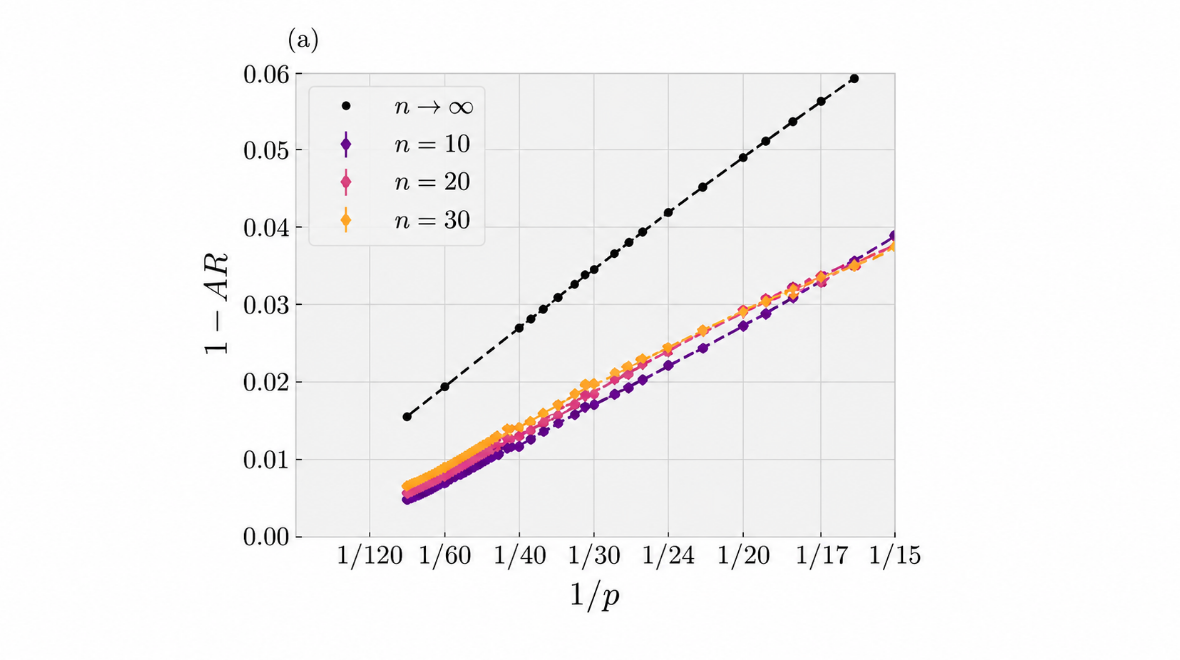
The Quantum Approximate Optimization Algorithm (QAOA) is a leading candidate for realizing this advantage, and some success has been achieved for small problems. But demonstrations on large problems have remained too computationally costly to run on classical computers and current quantum hardware.Researchers from JPMorganChase and the U.S. Department of Energy’s (DOE) Argonne National Laboratory have now found a way to make such calculations possible. Their results were published in Physical Review Letters.The team focused on the Sherrington–Kirkpatrick (SK) model, a disordered system with random interactions between every pair of variables.“As problem size grows, the SK model’s optimal value is known in the large-system limit. This value provides a baseline to measure how well QAOA is performing,” said Jeffrey Larson, a computational mathematician in Argonne’s Mathematics and Computer Science division and a coauthor of the paper.The researchers discovered that in the infinite-size limit, a high-depth QAOA state for the SK model converges mathematically to a single quantum spin coupled to bosonic modes. By translating the problem into this “spin-boson” system, the team replaced the costly calculations with much simpler simulations using matrix product state simulations.For this problem setting, Larson developed a novel optimization method for identifying high-quality QAOA parameters. The simulations and parameter optimization were performed on the supercomputers at the Argonne Leadership Computing Facility (ALCF) and DOE’s National Energy Research Scientific Computing Center. The researchers were able to use these facilities through a grant from the DOE’s Innovative and Novel Computational Impact on Theory and Experiment (INCITE) program. The ALCF is a DOE Office of Science user facility.“This multi-institutional collaboration is a great way to work because the questions are both practical and fundamental,” Larson said. “We are asking how far quantum optimization algorithms can go, and we need advanced classical simulation, strong optimization tools and high-performance computing to understand what is really possible.”The new technique lets researchers evaluate the expected solution quality of QAOA without running it end to end.“Progress in quantum computing is not just about building larger devices,” Larson said. “It also depends on better algorithms, better optimization methods and better classical tools for testing and understanding those algorithms.”The researchers believe their results lay a foundation for understanding the potential and limitations of quantum optimization algorithms as quantum hardware matures.For more details, see the full paper by Sami Boulebnane, Abid Khan, Minzhao Liu, Jeffrey Larson, Dylan Herman, Ruslan Shaydulin, and Marco Pistoia, “Spin-Boson Mapping of the Quantum Approximate Optimization Algorithm,” Physical Review Letters 136, 240601 https://doi.org/10.1103/2w94-rymn. A preprint is available at https://arxiv.org/abs/2505.07929.TopicsShare Get the latest research, company news, and market intelligence every week. MENTIONED IN THE ARTICLEJPMorgan Chase & Co. is an American multinational investment bank and financial services holding companyArgonne National Laboratory, one of the U.S. Department of Energy's national laboratories for science and engineering research, employs 3,400 employees, including 1,400 scientists and engineers, three-quarters of whom hold doctoral degrees. Argonne's annual operating budget of around $1 billion supports upwards of 200 research projects. Since 1990, Argonne has worked with more than 600 companies and numerous federal agencies and other organizations. The Lab has successfully launched its own Quantum Foundry to accelerate quantum information research.The United States Department of Energy is a cabinet-level department of the United States Government concerned with the United States' policies regarding energy and safety in handling nuclear material.More in Research The Quantum Insider (TQI) is the leading source for the latest quantum technology news, market intelligence, industry analysis, and data covering the global quantum ecosystem. NEWSROOMPLATFORMSERVICESCOMPANY© 2026 The Quantum Insider. All rights reserved. Part of the Resonance networkOne of our team will be in touch to learn more about your requirements, and provide pricing and access options.Subscribe to our industry leading leading newsletter for the latest in quantum news and insights. Necessary cookies are always on to ensure the website works. Optional cookies help us understand how the site is used. Privacy Policy
Tags
Source Information
Discussion
0 professional contributions
Sign in to join this professional discussion.
Be the first to add a constructive contribution.