
What Is the Role of Loss Detection and Erasure Conversion in the Neutral Atom Computing Stack?
Part 104 of the Neutral Atom Quantum Computation series, covering 2.2.3 Gates and High-Fidelity Control and the roadmap's guidance on loss detection and erasure conversion.
⚡ Quantum Brief
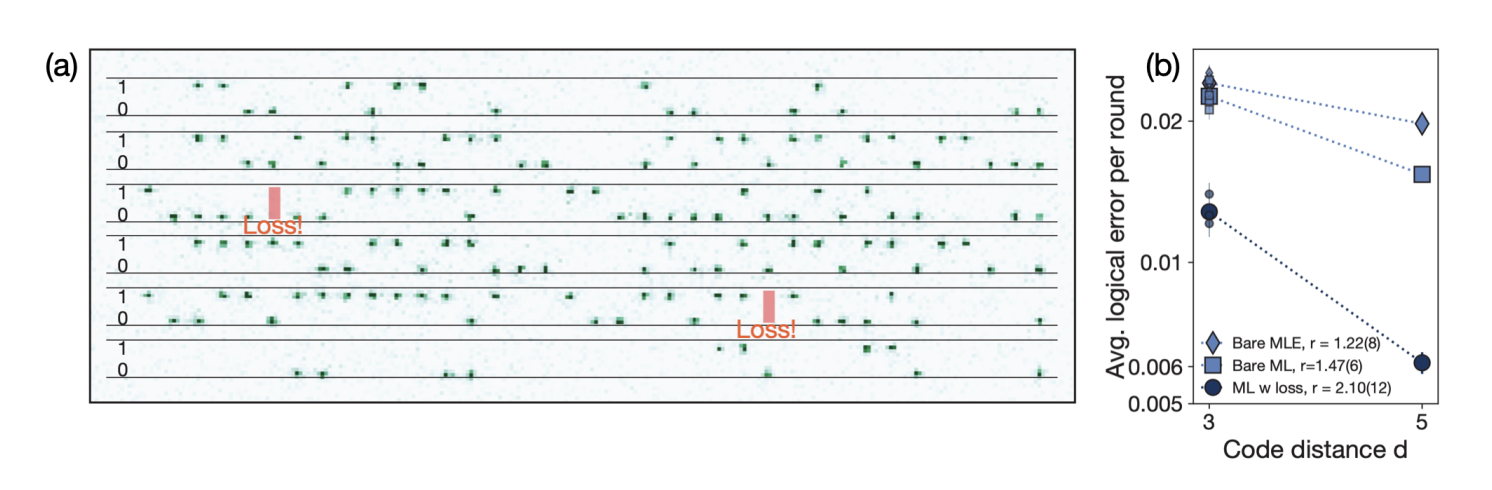
Neutral atom platforms can sometimes identify the location of atom loss or leakage, converting an unknown error into an erasure that a decoder can handle more efficiently. It interacts with processor hardware, optical and electronic control, compilation, error correction, and—where relevant—networking.
Key takeaways
- Neutral atom platforms can sometimes identify the location of atom loss or leakage, converting an unknown error into an erasure that a decoder can handle more efficiently.
- Known error locations can raise effective thresholds and reduce the physical resources required for a target logical error rate.
- Detection must be fast, accurate, and non-destructive; false positives, missed loss, and measurement-induced disturbance can erase the benefit.
- Develop state-selective transport, leakage detection, repeatable imaging, erasure-aware codes, and decoders that use reliability information.
- Measure detection fidelity, false-alarm rate, survival, latency, conversion coverage, and logical error with and without erasure information. A decisive milestone is lower logical error in repeated circuits because real-time erasure information is used successfully by the decoder.
On this page
Short answerWhy it mattersChallenges and constraintsResearch directionsMetrics and milestonesFrequently asked questionsShort answer
Neutral atom platforms can sometimes identify the location of atom loss or leakage, converting an unknown error into an erasure that a decoder can handle more efficiently.
Why it matters
Known error locations can raise effective thresholds and reduce the physical resources required for a target logical error rate.
Challenges and constraints
Detection must be fast, accurate, and non-destructive; false positives, missed loss, and measurement-induced disturbance can erase the benefit.
Research directions
Develop state-selective transport, leakage detection, repeatable imaging, erasure-aware codes, and decoders that use reliability information.
- 1
Integrate the stack
Evaluate the proposal with the control, compilation, and fault-tolerance assumptions needed by a complete processor.
- 2
Measure representative workloads
Prefer repeated circuit and logical-operation evidence over isolated best-case component measurements.
- 3
Make assumptions explicit
Report scale, error model, calibration, classical support, and resource-accounting boundaries.
Metrics and milestones
Measure detection fidelity, false-alarm rate, survival, latency, conversion coverage, and logical error with and without erasure information.
A decisive milestone is lower logical error in repeated circuits because real-time erasure information is used successfully by the decoder.
| Dimension | What to report | Why it matters |
|---|---|---|
| Component performance | Measure detection fidelity, false-alarm rate, survival, latency, conversion coverage, and logical error with and without erasure information. | Shows whether the underlying mechanism is improving. |
| System performance | Behavior in a representative circuit or repeated operating cycle. | Reveals integration overhead and correlated failures. |
| Strategic milestone | A decisive milestone is lower logical error in repeated circuits because real-time erasure information is used successfully by the decoder. | Connects laboratory progress to useful neutral atom computation. |
Frequently asked questions
What is the central goal of loss detection and erasure conversion?
Neutral atom platforms can sometimes identify the location of atom loss or leakage, converting an unknown error into an erasure that a decoder can handle more efficiently.
Why is loss detection and erasure conversion strategically important?
Known error locations can raise effective thresholds and reduce the physical resources required for a target logical error rate.
What is the main obstacle for loss detection and erasure conversion?
Detection must be fast, accurate, and non-destructive; false positives, missed loss, and measurement-induced disturbance can erase the benefit.
What research does the strategic plan recommend for loss detection and erasure conversion?
Develop state-selective transport, leakage detection, repeatable imaging, erasure-aware codes, and decoders that use reliability information.
What would count as convincing progress in loss detection and erasure conversion?
Measure detection fidelity, false-alarm rate, survival, latency, conversion coverage, and logical error with and without erasure information. A decisive milestone is lower logical error in repeated circuits because real-time erasure information is used successfully by the decoder.
Related answers
Methodology
This editorial draft is a structured transformation of Strategic Plan for Neutral Atom Quantum Computation (arXiv:2607.21554), especially 2.2.3 Gates and High-Fidelity Control, pages 31-34. Claims are summarized rather than copied at length. The article remains a draft until a technical reviewer checks the interpretation, figure context, and any developments published after 23 July 2026.
Update history
24 July 2026 — Initial source-grounded draft generated for the Neutral Atom Quantum Computation Answers series.
Corrections
Found an error or newer technical evidence? Contact the QuantumNews editorial team.
References
Discussion
0 professional contributions
Sign in to join this professional discussion.
Be the first to add a constructive contribution.