
Which Research Directions Are Proposed for Advantage-Oriented Algorithms?
Part 36 of the Neutral Atom Quantum Computation series, covering 1.2.3 Algorithms and the roadmap's guidance on algorithms for practical quantum advantage.
⚡ Quantum Brief
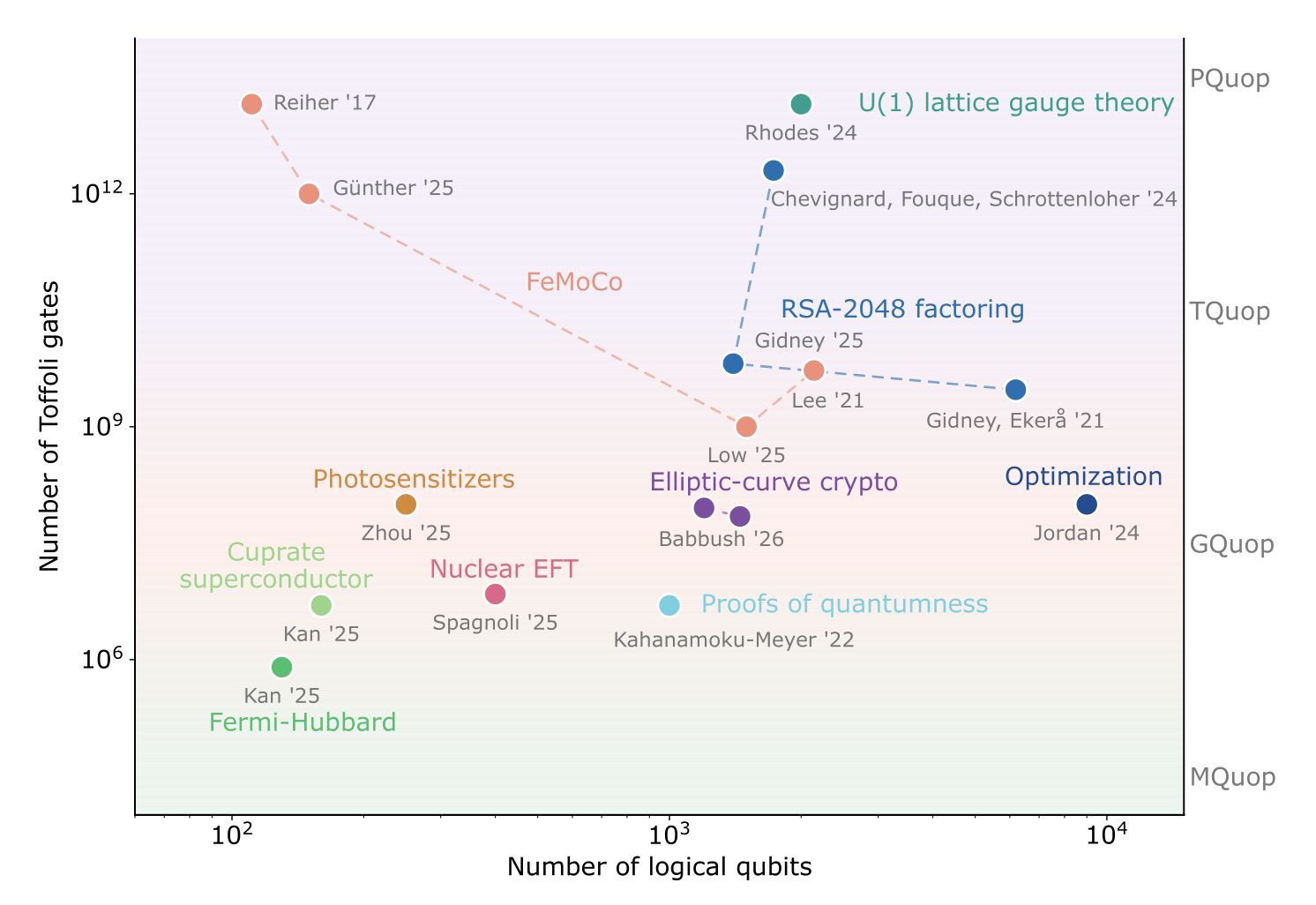
Prioritize end-to-end resource estimates, neutral-atom-native primitives, early fault-tolerant algorithms, and workloads with clear external value. These directions are intended to close the gap between isolated demonstrations and reliable integrated computation.
Key takeaways
- Advantage-oriented algorithm design begins with a valuable problem and then co-designs the algorithm, data path, error budget, and hardware implementation.
- An asymptotic speedup is not enough if data loading, fault-tolerant overhead, sampling, or verification removes the practical benefit.
- Many candidate algorithms require deep circuits, costly non-Clifford operations, unrealistic input models, or accuracy beyond near-term hardware.
- Prioritize end-to-end resource estimates, neutral-atom-native primitives, early fault-tolerant algorithms, and workloads with clear external value.
- Track logical qubits, non-Clifford count, circuit depth, data movement, repetitions, target precision, decoder load, and the classical comparison cost. A meaningful milestone is an algorithm-hardware design with a credible resource budget that fits a projected machine and preserves an end-to-end advantage.
On this page
Short answerWhy it mattersChallenges and constraintsResearch directionsMetrics and milestonesFrequently asked questionsShort answer
Advantage-oriented algorithm design begins with a valuable problem and then co-designs the algorithm, data path, error budget, and hardware implementation.
Why it matters
An asymptotic speedup is not enough if data loading, fault-tolerant overhead, sampling, or verification removes the practical benefit.
Challenges and constraints
Many candidate algorithms require deep circuits, costly non-Clifford operations, unrealistic input models, or accuracy beyond near-term hardware.
Research directions
Prioritize end-to-end resource estimates, neutral-atom-native primitives, early fault-tolerant algorithms, and workloads with clear external value.
- 1
Integrate the stack
Evaluate the proposal with the control, compilation, and fault-tolerance assumptions needed by a complete processor.
- 2
Measure representative workloads
Prefer repeated circuit and logical-operation evidence over isolated best-case component measurements.
- 3
Make assumptions explicit
Report scale, error model, calibration, classical support, and resource-accounting boundaries.
Metrics and milestones
Track logical qubits, non-Clifford count, circuit depth, data movement, repetitions, target precision, decoder load, and the classical comparison cost.
A meaningful milestone is an algorithm-hardware design with a credible resource budget that fits a projected machine and preserves an end-to-end advantage.
| Dimension | What to report | Why it matters |
|---|---|---|
| Component performance | Track logical qubits, non-Clifford count, circuit depth, data movement, repetitions, target precision, decoder load, and the classical comparison cost. | Shows whether the underlying mechanism is improving. |
| System performance | Behavior in a representative circuit or repeated operating cycle. | Reveals integration overhead and correlated failures. |
| Strategic milestone | A meaningful milestone is an algorithm-hardware design with a credible resource budget that fits a projected machine and preserves an end-to-end advantage. | Connects laboratory progress to useful neutral atom computation. |
Frequently asked questions
What is the central goal of algorithms for practical quantum advantage?
Advantage-oriented algorithm design begins with a valuable problem and then co-designs the algorithm, data path, error budget, and hardware implementation.
Why is algorithms for practical quantum advantage strategically important?
An asymptotic speedup is not enough if data loading, fault-tolerant overhead, sampling, or verification removes the practical benefit.
What is the main obstacle for algorithms for practical quantum advantage?
Many candidate algorithms require deep circuits, costly non-Clifford operations, unrealistic input models, or accuracy beyond near-term hardware.
What research does the strategic plan recommend for algorithms for practical quantum advantage?
Prioritize end-to-end resource estimates, neutral-atom-native primitives, early fault-tolerant algorithms, and workloads with clear external value.
What would count as convincing progress in algorithms for practical quantum advantage?
Track logical qubits, non-Clifford count, circuit depth, data movement, repetitions, target precision, decoder load, and the classical comparison cost. A meaningful milestone is an algorithm-hardware design with a credible resource budget that fits a projected machine and preserves an end-to-end advantage.
Related answers
Methodology
This editorial draft is a structured transformation of Strategic Plan for Neutral Atom Quantum Computation (arXiv:2607.21554), especially 1.2.3 Algorithms, pages 17-19. Claims are summarized rather than copied at length. The article remains a draft until a technical reviewer checks the interpretation, figure context, and any developments published after 23 July 2026.
Update history
24 July 2026 — Initial source-grounded draft generated for the Neutral Atom Quantum Computation Answers series.
Corrections
Found an error or newer technical evidence? Contact the QuantumNews editorial team.
References
Discussion
0 professional contributions
Sign in to join this professional discussion.
Be the first to add a constructive contribution.