
The Wild Becomes a “Death Trap” for Rescued Slow Lorises
Understand this faster with AI


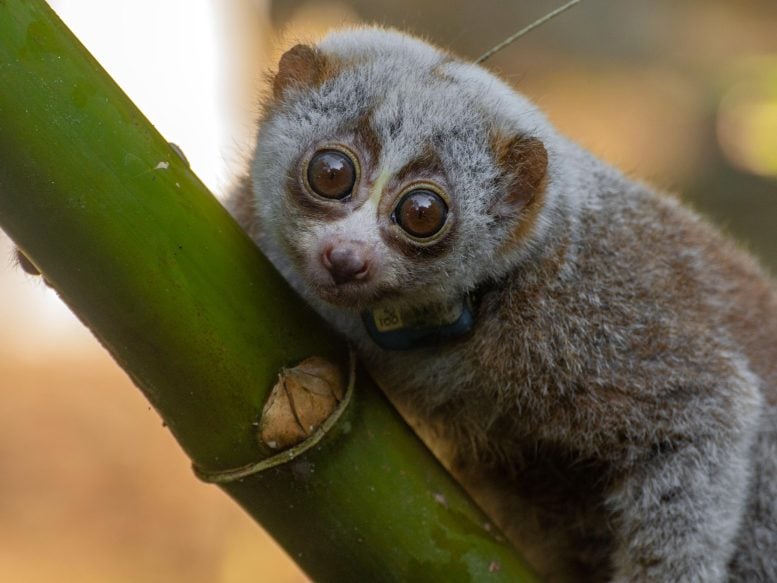
Nishat, one of the two Bengal slow lorises (Nycticebus bengalensis) to survive being released. Credit: Marcel Stawinoga Releasing rescued slow lorises back into the wild may sound heroic, but most don’t survive. In one study, seven out of nine were killed—largely by other lorises defending their territory. A new study suggests that returning rescued animals to their natural habitats does not always end well. In some cases, the wild can become what researchers describe as a “death trap” for animals that have spent time in captivity. The findings were published today (February 25) in the journal Global Ecology and Conservation. The research team included Professor Anna Nekaris OBE, a primatologist at Anglia Ruskin University, along with partners from Plumploris e.V. and the University of Western Australia. They focused on Bengal slow lorises (Nycticebus bengalensis) that had been released in Bangladesh. Slow Lorises and the Illegal Pet Trade Slow lorises are easily recognized by their large eyes and gentle appearance. That look has made them a major target in the illegal pet trade, ranking them among the most trafficked primates in the world. Every species of slow loris is listed by the International Union for Conservation of Nature as Critically Endangered, Endangered, or Vulnerable. Because of their threatened status, they are frequently involved in rescue and release efforts intended to boost wild populations.
Tracking Survival After Release Despite good intentions, the new research shows that release programs can have tragic outcomes for these small, nocturnal primates. Scientists fitted nine Bengal slow lorises with radio collars and monitored them after their release into a national park in northeastern Bangladesh, an area previously used for similar efforts. Only two of the nine animals survived. Three died within 10 days, and four more died within six months. Of the seven that perished, four bodies were recovered. Each showed evidence of fatal attacks by other slow lorises. Territorial Behavior and Venomous Bites Slow lorises are intensely territorial. They are also the only venomous primates in the world, using specialized teeth to deliver a toxic bite. The recovered animals had clear bite wounds on the head, face, and digits, pointing to deadly territorial disputes as the cause of death. Researchers also discovered that lorises kept in captivity for longer periods survived for fewer days once released. After returning to the forest, the animals moved more and appeared more alert than wild Bengal slow lorises, which may reflect stress or difficulty adjusting. The two survivors traveled across larger areas than those that died. This suggests that putting distance between themselves and established residents helped them avoid violent encounters.
Rethinking Wildlife Release Practices High-profile species such as big cats often receive extensive post-release monitoring. In contrast, many smaller or less celebrated animals are released with little long-term follow-up, meaning their outcomes may never be fully documented. The researchers emphasize that successful reintroductions require careful evaluation of both the habitat and the individual animal. Detailed site assessments, long-term monitoring, and rehabilitation plans tailored to each species are critical. Senior author Anna Nekaris OBE, Professor of Ecology, Conservation and Environment at Anglia Ruskin University in Cambridge, England, and head of the Little Fireface Project, said: “It’s assumed that returning confiscated or rescued animals to the wild is always a positive conservation story. Our research shows that for highly territorial species like slow lorises, releasing them into areas that are already densely populated can be a death trap. “Many rescued endangered species are often released because the public expects it, but for animals such as the Bengal slow loris, this is not always the best course of action. Without fully understanding the animal’s behaviour, its time spent in captivity and the density of resident populations at the release site, reintroductions may do more harm than good.” Lead author Hassan Al-Razi, the team leader of Plumploris e.V. Bangladesh, said: “Rescue and release have become an increasingly common practice in Bangladesh. Many wild animals, including slow lorises, are rescued and subsequently released back into the wild. “However, in many cases, these releases are conducted inappropriately. For forest-dwelling species, release sites are often selected based on logistical convenience rather than ecological suitability. As a result, certain forests have effectively become dumping grounds for rescued animals and are no longer appropriate release sites. “Although our research has focused on the Bengal slow loris and demonstrated the consequences of such practices, we believe similar patterns likely affect many other species.” Reference: “A new home is a death trap: Reinforcement at a translocation release site leads to fatalities in an endangered primate species” 25 February 2026, Global Ecology and Conservation. DOI: 10.1016/j.gecco.2026.
Tags
Source Information
Discussion
0 professional contributions
Sign in to join this professional discussion.
Be the first to add a constructive contribution.