
Does the moon look the same from everywhere on Earth?
Understand this faster with AI


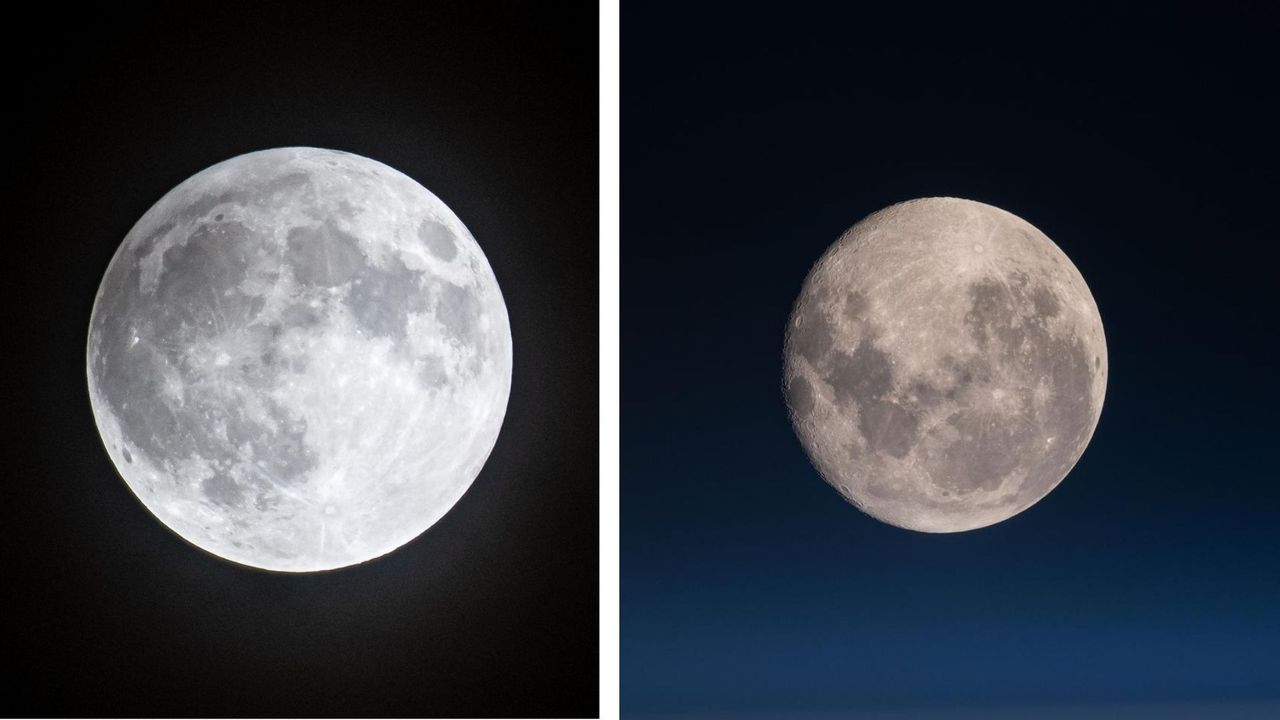
The moon's orientation changes quite dramatically across time and between places, largely due to differences in perspective. When you purchase through links on our site, we may earn an affiliate commission. Here’s how it works. Get the world’s most fascinating discoveries delivered straight to your inbox.Become a Member in Seconds Unlock instant access to exclusive member features.You are now subscribedYour newsletter sign-up was successfulWant to add more newsletters?Delivered DailyDaily NewsletterSign up for the latest discoveries, groundbreaking research and fascinating breakthroughs that impact you and the wider world direct to your inbox.Once a weekLife's Little MysteriesFeed your curiosity with an exclusive mystery every week, solved with science and delivered direct to your inbox before it's seen anywhere else.Once a weekHow It WorksSign up to our free science & technology newsletter for your weekly fix of fascinating articles, quick quizzes, amazing images, and moreDelivered dailySpace.com NewsletterBreaking space news, the latest updates on rocket launches, skywatching events and more!Once a monthWatch This SpaceSign up to our monthly entertainment newsletter to keep up with all our coverage of the latest sci-fi and space movies, tv shows, games and books.Once a weekNight Sky This WeekDiscover this week's must-see night sky events, moon phases, and stunning astrophotos. Sign up for our skywatching newsletter and explore the universe with us!Join the clubGet full access to premium articles, exclusive features and a growing list of member rewards.Whether you're watching a spectacular lunar eclipse or studying lunar features through a telescope, there are plenty of reasons to gaze at the moon.But does the moon look the same from everywhere on Earth?The short answer is no, astronomers told Live Science. Not only does the moon's appearance change from place to place, but it even seems to swivel in some locations from moonrise to moonset."How we see the Moon and Stars is all a matter of perspective," Pamela Gay, a senior scientist at the Planetary Science Institute, a U.S.-based nonprofit that investigates solar system exploration, told Live Science in an email. Sign up for our weekly Life's Little Mysteries newsletter to get the latest mysteries before they appear online.If you were to look at a full moon from Earth's North Pole, you'd see the iconic Tycho crater, with its splayed ejecta rays at the bottom of the moon's face. However, from the Amundsen-Scott South Pole Station, situated exactly at our planet's South Pole, Tycho crater would appear at the moon's top.Less-dramatic changes in the moon's orientation appear from temperate regions. A diagram collated by the Lunar and Planetary Institute shows that the moon's orientation in Wellington, New Zealand, is 97.1 degrees counterclockwise to that visible in Los Angeles. This angle depends on the difference in latitude between the locations.In other words, while someone in Illinois might see an upright "man on the moon," for an observer in Sydney, the "moon is now a bunny jumping downward," Gay said.This happens because your orientation with respect to space-based objects changes as you travel between latitudes. Observers on opposite ends of Earth look at the moon from opposite vantage points.Still, all places on Earth see more or less the same face of the moon. That's because the moon completes one rotation on its axis in exactly the same time it takes to orbit Earth once — a phenomenon called synchronous rotation (though librations, or wobbles, cause the view to slightly vary). The moon's phases during each lunar cycle — the 29.5-day cycle from full moon to new moon and back — also differ between the Northern and Southern hemispheres."This is a result of how the local horizon plane … is oriented relative to the positions of the Earth, moon and sun," Catherine Miller, observatory specialist at Mittelman Observatory at Middlebury College in Vermont, told Live Science by email. Far from the equator, she said, the boundary between the moon's unlit and lit regions is aligned nearly vertically, so the moon's phases progress horizontally. But while Northern Hemisphere observers watch the moon grow and shrink from right to left, the opposite occurs for the Southern Hemisphere, as per the Lunar Planetary Institute. This difference, Miller said, again stems from the different perspectives from the hemispheres. That's why unicode calendar symbols (the kind you see in your phone's emoji list) for the first- and third-quarter moons — which have been designed from a Northern Hemisphere viewpoint — appear inaccurate for Southern Hemisphere observers, according to a 2017 Unicode Technical Committee document.Things get even more interesting at the equator. The moon, seen at the time it rises, expands vertically rather than sideways as it heads toward the full-moon phase. This means the crescent moon often looks like a boat. However, across most of Earth's surface, the moon's phases change from being more vertical to more horizontal (and vice versa) over different seasons, according to the book "Astronomy for All Ages" (Globe Pequot Publishing, 2000). In many places, the orientation of the moon's face appears to rotate about its center as it travels across the sky on a given night, Miller said. For example, at the equator, it looks like the "Moon's face can rotate by roughly 180 degrees in an evening," she said.This is because the moon's orbit is nearly aligned with the orbital plane that Earth takes around the sun. Consequently, it frequently passes nearly over the zenith (the point in the sky directly above an observer) at the equator, according to a 2025 article in the Journal of the British Astronomical Association.When the moon rises from the east at the equator, it will set to the west after having crossed the zenith. At moonrise, you will be facing due east, but to see the moon at moonset, you will have to rotate your body by 180 degrees. So, it's not the moon that has twisted, but people watching the moon who are turning their bodies to follow the moon's path. "It's all about how [the moon] follows that arc," Gay said. This phenomenon is not true at higher latitudes, where the moon does not pass over the zenith, so you do not have to turn by a full 180 degrees to see it.This apparent "rolling" of the moon decreases as you move away from the equator, toward the poles. The farther the moon is away from the zenith, the less it appears to twist between moonrise and moonset.So, the next time you travel, take a peek at the moon. You might just be stunned.What do you know about the moon? Test your knowledge with our moon quiz! Deepa Jain is a freelance science writer from Bengaluru, India. Her educational background consists of a master's degree in biology from the Indian Institute of Science, Bengaluru, and an almost-completed bachelor's degree in archaeology from the University of Leicester, UK. She enjoys writing about astronomy, the natural world and archaeology. You must confirm your public display name before commentingPlease logout and then login again, you will then be prompted to enter your display name.
Tags
Source Information
Discussion
0 professional contributions
Sign in to join this professional discussion.
Be the first to add a constructive contribution.