
This Quantum Detector Boosts Terahertz Sensitivity by 20 Times
Understand this faster with AI


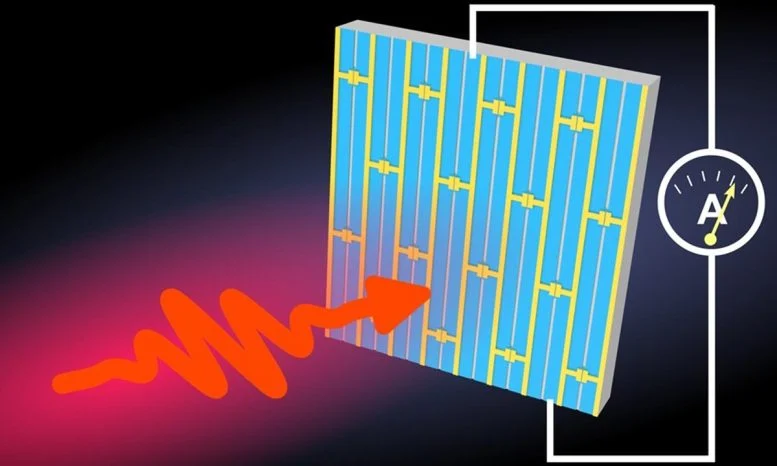
Detecting terahertz radiation using a quantum metasurface-based photoelectric tunable-step terahertz detector – a path to high-sensitivity imaging and sensing in the far-infrared region of the electromagnetic spectrum. Credit: W. Michailow and R. XiaA quantum metasurface breakthrough boosts terahertz detection by 20 times, bringing practical THz technology a step closer.Detecting light and radiation is essential across the electromagnetic spectrum, but some regions remain difficult to work with. One of the biggest challenges involves terahertz (THz) radiation, which sits between microwaves and infrared light. Existing detectors for these frequencies are often slow, lack sensitivity, or depend on large, costly systems that may require extreme cooling, limiting their practical use.Researchers have now developed a compact new detector that combines quantum physics with a specially engineered metasurface, significantly improving the ability to capture and measure terahertz radiation. The work, reported in Advanced Photonics, could help advance technologies ranging from wireless communications to medical imaging and astronomy.Quantum Physics Meets Metasurface DesignThe device relies on a phenomenon known as the in-plane photoelectric effect. In this quantum process, incoming terahertz photons transfer energy to electrons confined within a two-dimensional electron gas. Those energized electrons cross a carefully designed potential step, generating an electrical current that can be measured.Unlike conventional photoelectric detectors, this mechanism does not require photons to exceed a minimum energy threshold. Because the process occurs entirely within the plane of the material, it also avoids several efficiency limitations that affect traditional detector designs.Earlier detectors using this concept showed promising performance but suffered from one major drawback. They captured only a small portion of the incoming radiation because they relied on single-antenna structures.To overcome that limitation, the research team built the new detector around a metasurface. This patterned structure concentrates electromagnetic energy into regions much smaller than the wavelength of the incoming radiation. In the new design, a repeating “brickwork” pattern gathers terahertz waves and channels them into narrow gaps where detection takes place.Capturing More Terahertz RadiationEach of these tiny gaps functions as an individual detector. By distributing many of them across the metasurface and connecting them electronically, the researchers were able to combine their outputs into a stronger overall signal.This approach eliminates the need for complex detector arrays or external optical components while ensuring that incoming radiation is focused precisely where it can contribute to detection.The design process began with the metasurface itself. Individual photoelectric tunable-step (PETS) detector elements were then integrated into the capacitive gaps, which experience the strongest electromagnetic fields.“This ensures optimal coupling of the metasurface to the detection elements,” notes corresponding author Wladislaw Michailow, who led the research at the University of Cambridge and later at Swansea University in the UK. “Compared to the conventional approach of connecting multiple devices in parallel, this approach allowed us to significantly boost the detection sensitivity,” adds Michailow.Rather than treating light collection and signal generation as separate challenges, the team designed both functions as a single integrated system.Optimizing the Quantum DetectorThe researchers used computer simulations to fine-tune critical features of the device, including the spacing between repeating structures and the size of the detection gaps.These dimensions determine how tightly the electric field is confined and, in turn, how much photocurrent is produced. The final design balances field enhancement with the width of the electron transport channel to maximize signal strength.Fabrication relied on a semiconductor structure containing a high-mobility electron gas. The manufacturing process closely resembles techniques already used to produce field effect transistors, making future integration with electronic circuits more practical.Because the metasurface itself concentrates the incoming radiation, the detector does not require external focusing components such as silicon lenses. This simplifies assembly and could make large-scale manufacturing easier.Strong Performance With Simpler HardwareDuring testing, the detector was cooled to 10 K and exposed to radiation near 1.9 THz. It generated a clear electrical signal that matched the on and off pattern of the incoming radiation.Measurements showed a responsivity of 2.7 amperes per watt. The proof-of-concept device also achieved an external quantum efficiency of 2.1 percent at 1.9 THz.According to the researchers, this represents roughly a 20-fold improvement over previously demonstrated PETS detectors. Much of that gain comes from the metasurface’s ability to capture more incoming radiation and direct it into the active detection regions.The detector also operates without a source drain bias. This reduces unwanted noise because no dark current is produced.“The devices are direct detectors operating at zero bias, and therefore, they operate without dark currents,” observes first author Ruqiao Xia, who fabricated and measured the devices as part of her doctoral research in the Semiconductor Physics Group at the Cavendish Laboratory of the University of Cambridge.Because the geometry can be scaled, the same basic concept could potentially be adapted for other parts of the electromagnetic spectrum, including microwave and mid-infrared frequencies.Potential Applications Across Multiple IndustriesBeyond its sensitivity, the detector offers several practical advantages. Its flat, planar structure is compatible with established semiconductor manufacturing methods and can be integrated directly with on-chip electronics.The metasurface approach also eliminates the need for carefully aligned external optical components, simplifying packaging and deployment compared with many existing terahertz systems.The researchers believe the technology could eventually operate at temperatures higher than those required by many competing detector designs. Similar PETS devices have already demonstrated performance at temperatures reachable using compact cryocoolers rather than liquid helium.That capability could help fill the gap between highly sensitive cryogenic detectors and lower-sensitivity room-temperature technologies, potentially expanding the range of real-world applications.The study marks the first demonstration of a quantum metasurface photodetector based on a two-dimensional electron system. By combining efficient light collection with a highly sensitive quantum detection mechanism, the work represents a significant step toward overcoming long-standing challenges in terahertz technology.“The results are particularly intriguing due to the applications that terahertz technology can enable, in areas such as wireless network, healthcare, astronomy, biomedicine, quality assurance in manufacturing, and many others,” remarks coauthor David Ritchie, head of the Semiconductor Physics Group.By integrating metasurface optics directly into the detector itself, the researchers demonstrate how advances in materials engineering and quantum physics can work together to improve terahertz technologies and expand their practical uses.Reference: “Quantum metasurface-based photoelectric tunable-step terahertz detector” by Ruqiao Xia, Matthew Tan, Harvey E. Beere, Jonathan P. Griffiths, David A. Ritchie and Wladislaw Michailow, 17 March 2026, Advanced Photonics. DOI: 10.1117/1.AP.8.2.026011Never miss a breakthrough: Join the SciTechDaily newsletter.Follow us on Google and Google News.
Tags
Source Information
Discussion
0 professional contributions
Sign in to join this professional discussion.
Be the first to add a constructive contribution.