
Scientists Say New Chip Architecture Could Tackle a Barrier to Scaling Quantum Computers Towards 1 Million Qubits
Understand this faster with AI


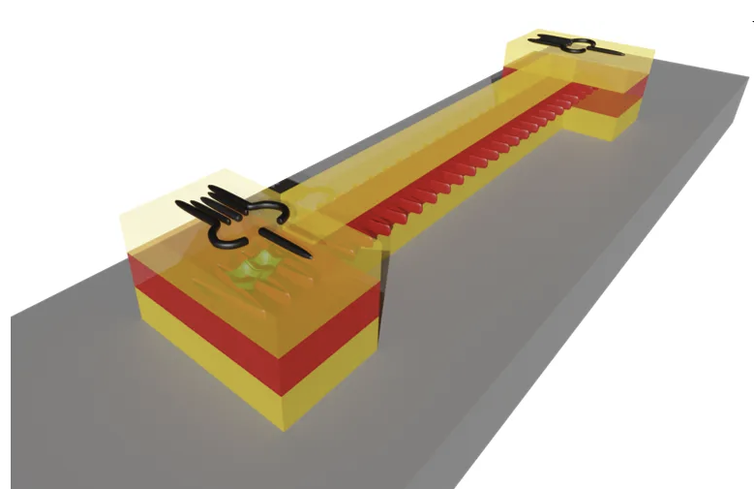
Insider BriefPRESS RELEASE — A new concept from Warwick researchers could help solve one of the biggest challenges to building large-scale quantum computers: enabling communication between vast numbers of quantum bits (qubits) over long distances across a single chip.Published in APL Quantum, the team of researchers from The University of Warwick and NRC Canada introduce the concept of Quantum Phononic Links (QPLs): a new approach to communication between qubits. It uses sound-like vibrations travelling through a specially engineered material to carry quantum information between qubits that are physically far apart.Today’s leading quantum chips typically only allow neighbouring qubits to talk to each other directly. To build useful quantum computers, engineers expect to need to coordinate millions of qubits spread across an entire semiconductor chip, not just clusters of adjacent ones.
The team’s proposed approach is to use sound vibrations, known as phonons, as an inherent communication system, allowing qubits to exchange quantum information over much greater distances than is currently possible.“One of the key challenges in quantum computing is long-range qubit connectivity,” said Dr Maksym Myronov, Department of Physics, University of Warwick. “Our work introduces a new concept in which phonons act as a quantum bus, enabling distant qubits to exchange quantum information while remaining fully compatible with semiconductor technology.”The concept relies on a specialised material, compressively strained germanium on silicon (cs-GoS), pioneered at Warwick using advanced epitaxial growth techniques. In this material, the qubits are especially sensitive to tiny vibrations passing through the thin germanium crystal layer. By carefully engineering and controlling those vibrations, the researchers show that, in principle, quantum information could be transferred between qubits whether they sit side by side or are separated across an entire semiconductor chip up to 300 mm in diameter.Other approaches to long-range qubit connections have relied on microwaves or externally generated surface acoustic waves, typically requiring complex designs and extra hardware attached to the chip. By contrast, QPLs are built directly into the semiconductor material that hosts the qubits. Because the approach is compatible with established semiconductor manufacturing techniques, it could provide a more compact, cheap and scalable route to future commercial quantum processors.TopicsShare Get the latest research, company news, and market intelligence every week. MENTIONED IN THE ARTICLEThe University of Warwickis a public research university on the outskirts of Coventry between the West Midlands and Warwickshire, England.The university was founded in 1965 as part of a government initiative to expand higher education.
The Warwick Business School was established in 1967, the Warwick Law School in 1968, Warwick Manufacturing Group (WMG) in 1980, and Warwick Medical School in 2000. Warwick incorporated Coventry College of Education in 1979 and Horticulture Research International in 2004.National Research Council Canada is the primary national agency of the Government of Canada dedicated to science and technology research and development. It is the largest federal R&D organization in Canada, supporting innovation through research centres, collaboration programs, and funding initiatives. NRC's work spans aerospace, construction, digital technologies, health, metrology, quantum and nanotechnologies, and more, aiming to accelerate scientific breakthroughs and address national priorities. It partners with industry, academia, and government to deliver impactful solutions and foster Canadian competitiveness.More in Research The Quantum Insider (TQI) is the leading source for the latest quantum technology news, market intelligence, industry analysis, and data covering the global quantum ecosystem.NEWSROOMPLATFORMSERVICESCOMPANY© 2026 Resonance Alliance Inc. All rights reserved.A RESONANCE NETWORK PROPERTYOne of our team will be in touch to learn more about your requirements, and provide pricing and access options.Subscribe to our industry leading leading newsletter for the latest in quantum news and insights. Necessary cookies are always on to ensure the website works. Optional cookies help us understand how the site is used. Privacy Policy
Tags
Source Information
Discussion
0 professional contributions
Sign in to join this professional discussion.
Be the first to add a constructive contribution.