
Science news this week: Comets light up the skies and race toward the sun, our galaxy's mysterious glow is explained, and scientists tell us why time moves faster as we age
Understand this faster with AI


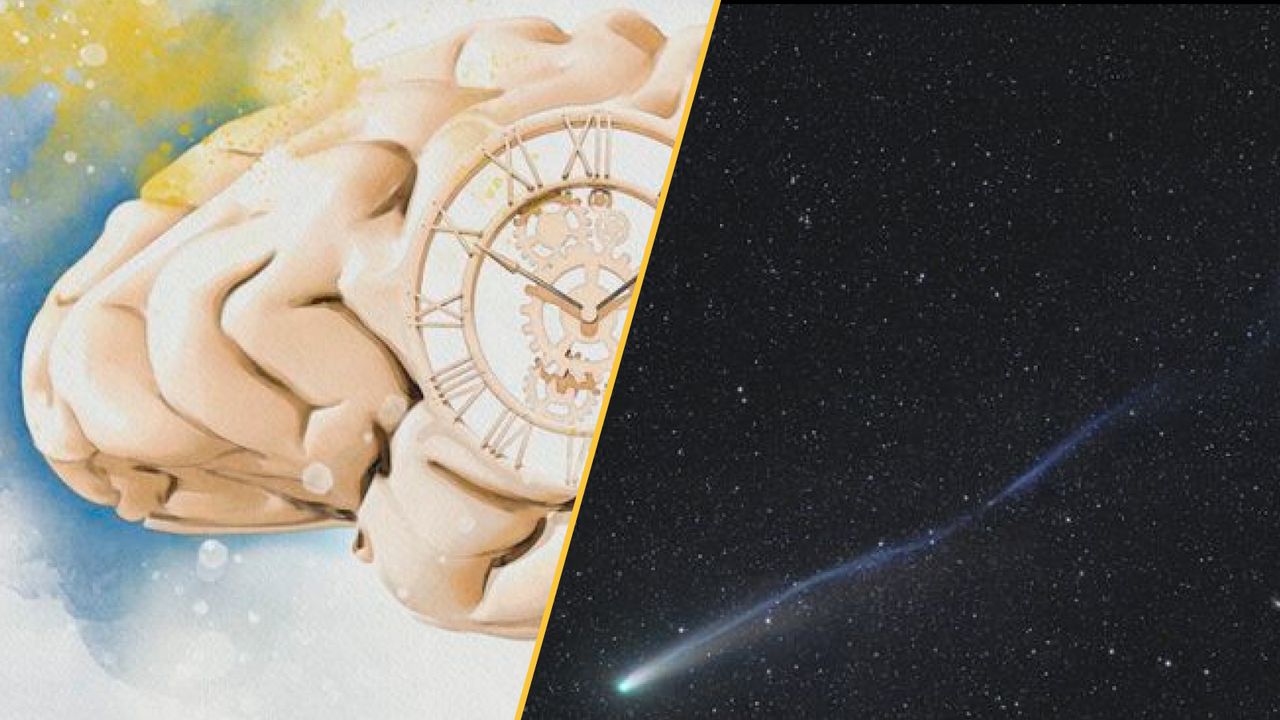
Oct. 25, 2025: Our weekly roundup of the latest science in the news, as well as a few fascinating articles to keep you entertained over the weekend. When you purchase through links on our site, we may earn an affiliate commission. Here’s how it works. This week's science news has been comet-ing thick and fast, with a flurry of reports on three dusty space snowballs that are hurtling through our cosmic backyard.First are the comets Lemmon and SWAN, which reached their peaks in brightness in Earth's skies this week, enabling skywatchers to easily glimpse them. This led to some stunning observations, with Lemmon captured flying through a sky drenched in auroral technicolor over Scotland and getting its tail temporarily shredded by solar wind above Czechia (also known as the Czech Republic).Meanwhile, Comet 3I/ATLAS has been snapped with its jet shooting toward the sun as it approaches perihelion, its closest point to our star. Growing almost as rapidly as the comet's tail are tall tales online about the comet's nature, so just to be clear: No, it's almost certainly not an alien spaceship.If asteroids are more your thing, we've got some big stories on them too, with news this week that a skyscraper-size asteroid has been discovered hiding behind the sun's glare, while NASA's plans to visit the asteroid Apophis, the "god of Chaos," have been saved from budget cuts in a last-minute decision. There's a mysterious and diffuse glow at the center of our Milky Way galaxy, a flattened disk of unusually energetic gamma rays that has puzzled astronomers for more than a decade. Now, a new study has given weight to a possible explanation: colliding pockets of dark matter.The results, made using high-resolution supercomputer simulations, suggest that our galaxy's dark matter could have been squished into an oval-like shape through collisions and gravitational mergers.The findings could lead to our first ever detection of the mysterious component thought to make up 85% of the universe's matter, solving a major cosmic mystery.Get the world’s most fascinating discoveries delivered straight to your inbox.Discover more space news—Astronomers spot giant hidden 'bridge' and record-breaking tail between 2 dwarf galaxies—James Webb telescope finds that galaxies in the early universe were much more chaotic than we thought—Astronomers detect first 'heartbeat' of a newborn star hidden within a powerful cosmic explosion Mosquitos are a near-ubiquitous animal and humanity's deadliest predator — up to 110 trillion mozzies on the planet inflict illnesses upon 700 million people a year, resulting in nearly a million deaths over the same period.So is there anywhere on the planet where the buzzing pests don't exist? We thought we knew the answer, but a surprising update changed everything this week.—If you enjoyed this, sign up for our Life's Little Mysteries newsletter It's a commonly observed adage: As we get slower, time goes by faster. There have been plenty of psychological explanations for this experience, but now scientists have finally found hints of its neurological origins.The process is called neural dedifferentiation, whereby the activity of different brain regions becomes less specific as we age, leading our brains to shift through fewer distinct states that it may use to mark the passage of time. And if older brains are logging fewer "events" in a given time frame, maybe that's why time seems to fly by.Discover more health news—You don't need to be very happy to avoid an early death from chronic disease, study finds—Diagnostic dilemma: A toddler accidently ate gonorrhea bacteria from a lab dish—New eye implants combined with augmented-reality glasses help blind people read again in small trial—Google's breakthrough 'Quantum Echoes' algorithm pushes us closer to useful quantum computing — running 13,000 times faster than on a supercomputer—1,300-year-old poop reveals pathogens plagued prehistoric people in Mexico's 'Cave of the Dead Children'—'Illegal' metal detectorist found a huge hoard of Roman treasure in Germany — and kept it hidden for 8 years Since the Neanderthal genome was first sequenced in 2010, some scientists have tentatively proposed the resurrection of one of modern humans' closest extinct relatives (the other being Denisovans). But just how would it be done? Is it even possible? And even if we can, should we? Live Science sought out the answers.If you're looking for something a little longer to read over the weekend, here are some of the best interviews, crosswords and dives into science history published this week.'It's really an extraordinary story,' historian Steven Tuck says of the Romans he tracked who survived the AD 79 eruption of Mount Vesuvius [Interview]Live Science crossword puzzle #15: Explosive death of a star — 11 down [Crossword]Science history: Scientists use 'click chemistry' to watch molecules in living organisms — Oct. 23, 2007 [Science history] This week, Live Science published a fascinating writeup on this aerial photo taken by an astronaut that shows the islands of Dek and Daga in Ethiopia's Lake Tana.The country's northwestern, algae-infested lake hosts a number of islands (some of which only appear during the rainy season) and these islands are home in turn to a plethora of monasteries and churches. The religious buildings were built on these islands partly to protect the country's most valuable holy relics and the mummified remains of at least five emperors during times of war and upheaval.Want more science news? Follow our Live Science WhatsApp Channel for the latest discoveries as they happen. It's the best way to get our expert reporting on the go, but if you don't use WhatsApp we're also on Facebook, X (formerly Twitter), Flipboard, Instagram, TikTok, Bluesky and LinkedIn.Ben Turner is a U.K. based writer and editor at Live Science. He covers physics and astronomy, tech and climate change. He graduated from University College London with a degree in particle physics before training as a journalist. When he's not writing, Ben enjoys reading literature, playing the guitar and embarrassing himself with chess.You must confirm your public display name before commentingPlease logout and then login again, you will then be prompted to enter your display name.
Tags
Source Information
Discussion
0 professional contributions
Sign in to join this professional discussion.
Be the first to add a constructive contribution.