
Realizing the fermionic Laughlin state on a trapped-ion quantum processor
Understand this faster with AI


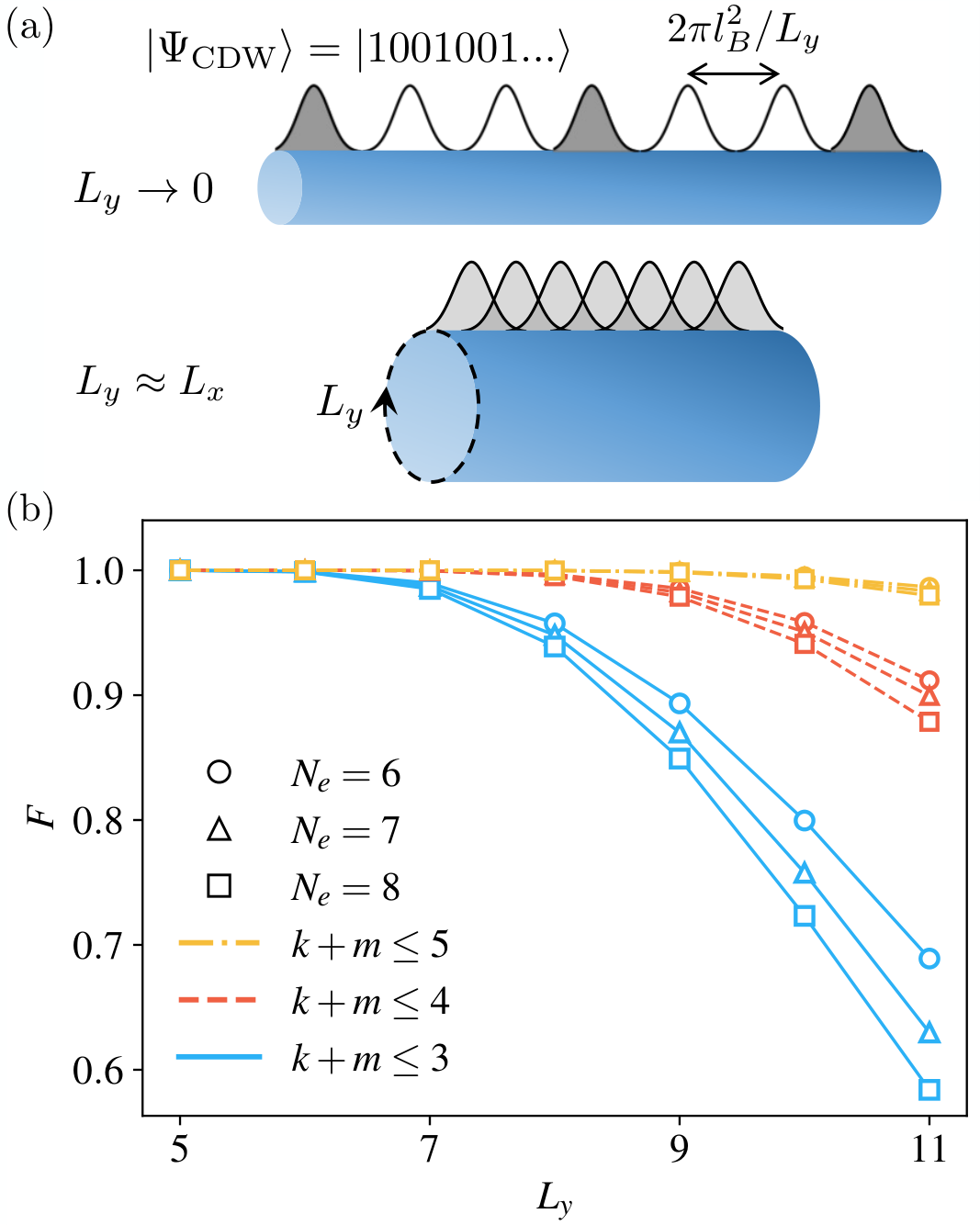
This post was contributed by Lingnan Shen, Mao Lin, Cedric Yen-Yu Lin, Di Xiao, and Ting CaoQuantum computing is beginning to simulate forms of matter that are difficult to study in the lab or compute classically. In this work, researchers from University of Washington and Amazon Braket demonstrate one such milestone. They realized a fundamentally new quantum state—the fermionic Laughlin state—on a programmable quantum processor.Topological phases of matter underpin some of the most exotic phenomena in condensed matter physics. They offer deep insights into the fundamental laws of nature such as the emergence of fractionally charged excitations and enable next-generation computing paradigms through robust, fault-tolerant quantum computation. Yet probing these phases in real materials remains extraordinarily difficult due to the stringent conditions required for topological order to emerge. This has motivated the use of programmable quantum processors to simulate and manipulate exotic topological states in a controlled setting.Among topological states, the Laughlin state embodies fractionalization, anyonic excitations, and incompressibility—hallmarks of the fractional quantum Hall (FQH) effect. These properties make the Laughlin state a cornerstone for understanding exotic quantum matter, while also informing the broader scientific roadmap toward topological approaches to quantum computing. While the bosonic analogs of Laughlin states have been realized on photonic and cold-atom platforms, a genuine fermionic Laughlin state had not previously been demonstrated on a digital quantum processor.In this post, researchers describe how they realized the ν = 1/3 fermionic Laughlin state on IonQ’s trapped-ion quantum computers, accessed through Amazon Braket. The approach uses an efficient and scalable Hamiltonian Variational Ansatz (HVA) [1]. We demonstrate an end-to-end workflow—from Hamiltonian design and ansatz construction to error mitigation and observable extraction—that captures the defining diagnostics of the Laughlin state: density structures of the edge modes, the correlation hole of an incompressible quantum liquid, and the topological entanglement entropy. All measurements show strong agreement with exact diagonalization benchmarks. This work highlights how Amazon Braket serves as a bridge between academic discovery and real-world quantum applications—allowing researchers to prototype, test, and scale advanced quantum algorithms on the commercial cloud.Synthetic topological orders such as the toric code can be prepared with shallow circuits thanks to their exactly solvable structure. The Laughlin state is fundamentally different: it arises from strong electron-electron interactions that lack simple mappings to short-depth quantum circuits. On a cylinder geometry, the FQH Hamiltonian reduces to an effective one-dimensional fermion chain with two-body interactions whose range and strength depend on the cylinder circumference. In the isotropic geometry regime—where the Laughlin state’s defining long-range entanglement and incompressibility emerge—the full Hamiltonian contains O(N³) terms for N orbitals, making a basic variational ansatz impractical.We address this by developing a systematic protocol to construct an effective Hamiltonian that retains only the dominant interaction terms. The selection criteria are twofold. First, quantitative fidelity: the ground state of the truncated Hamiltonian must have high wavefunction overlap with the exact Laughlin state. Second, qualitative preservation of topology and entanglement: the truncated model must remain in the same topological class, as verified by entanglement entropy scaling and symmetry classification. We find that including interactions up to the range k + m ≤ 4 satisfies both criteria, where k and m label the orbital separation of the two-body interaction terms. This truncation achieves fidelity above 0.95 between the exact Laughlin state and the ground state of the truncated Hamiltonian, computed via exact diagonalization (see Fig. 1). It also preserves the area-law entanglement scaling characteristic of a topological quantum liquid. In contrast, truncating at k + m ≤ 3 (the Tao-Thouless limit) confines the system to a Krylov subspace that is too small to capture the full Laughlin state’s correlations. This leads to low fidelity and entanglement entropy that saturates rather than scaling linearly with the cylinder circumference.Figure 1 – Cylinder geometry and interaction truncation. (a) Schematic of the cylinder in the Tao-Thouless (thin-cylinder) and isotropic geometry limits, showing the Gaussian-localized orbitals of the lowest Landau level. (b) Fidelity between the exact Laughlin state and the ground state of the truncated Hamiltonian for various interaction ranges and number of electrons Ne. Including interactions up to k + m ≤ 4 (red dashed) achieves fidelity above 0.95 in the isotropic regime, while k + m ≤ 3 (blue solid) drops significantly.With the effective Hamiltonian identified, we construct a HVA whose circuit layers correspond to unitary evolutions generated by each interaction term. Two physical principles keep the circuit compact. First, we generalize the variational parameters across the lattice: all gates within the same unitary layer share a single parameter, yielding a constrained HVA with just five parameters per repetition, independent of system size. Second, the squeezing rule of FQH physics dictates the ordering of circuit layers, starting from the charge-density-wave initial state |100100…1001⟩.We interpret the HVA (see Fig. 2 for an illustration) as a digitized adiabatic protocol. Lieb-Robinson bounds on the spread of correlations under local dynamics imply that the number of HVA repetitions must grow at least linearly with system size to reproduce the long-range entanglement of the topological phase faithfully. The total parameter count therefore scales as O(p), where p is the number of repetitions. For a single repetition at six electrons (16 qubits), the circuit requires 369 two-qubit (Controlled-NOT, or CNOT) gates, growing to 883 gates for 12 electrons (34 qubits). We further reduce the gate count by a factor of roughly 3× through optimized Pauli-term reordering after the Jordan-Wigner transformation.Crucially, parameters optimized on a small 6-electron system transfer directly to larger systems as warm starts without reoptimization. Intensive observables such as local density and two-point correlations show constant deviation from exact values as the system grows. This confirms that reproducing local physics with high accuracy does not require large prefactors in the linear depth scaling.Figure 2 – Schematic quantum circuit for preparing the ν = 1/3 Laughlin state. The initial charge-density-wave state |Ψ₀⟩ is evolved through five unitary layers (Û₂₁, Û₃₀, Û₃₁, Û₂₀, Û₁₀), each corresponding to an interaction term in the effective Hamiltonian. The circuit uses five variational parameters per repetition and scales linearly with system size.We executed the quantum circuits on two IonQ trapped-ion quantum computers accessed through Amazon Braket. Local density and spatial correlation measurements were performed on IonQ’s 25-qubit Aria-1, which reported a mean two-qubit gate fidelity of 98.5% on the day of execution. Topological entanglement entropy measurements were performed on IonQ’s 36-qubit Forte-1, which reported a mean two-qubit gate fidelity of 99.7%.With approximately 300 two-qubit gates in each qubit’s light cone, a naive estimate places the raw circuit fidelity around 1% on Aria-1 — too low to extract meaningful physics without error mitigation. We employed a combined strategy: IonQ’s native debiasing scheme, which is available out-of-the-box on Braket, together with a custom symmetry-verification postselection protocol. Our HVA naturally preserves both particle number and center-of-mass coordinate conservation. The protocol discards any measured bitstring violating either symmetry as unphysical. This postselection retained about 10% of the 5,000 shots and dramatically improved the quality of the extracted observables.We validated the prepared Laughlin state by extracting three independent diagnostics from the quantum hardware. We deem the preparation successful only when all three are simultaneously satisfied, providing mutually reinforcing evidence for the target topological phase.In Fig. 3, we show the local electron density measured on Aria-1, which clearly reveals an overdensity near the system boundaries with subsequent oscillatory deviations from the bulk filling fraction ν = 1/3. These edge mode density oscillations, governed by U(1) conformal field theory, are a direct manifestation of the bulk’s nontrivial topological order via the bulk-boundary correspondence. Away from the edges, the bulk density forms a uniform plateau, signaling the incompressibility of the FQH liquid. This spatial structure—a compressible, gapless edge surrounding an incompressible bulk—is an emblematic signature of FQH liquids.Figure 3 – Edge and bulk density structure. Local electron density ⟨nj⟩ measured on IonQ Aria-1 (red triangles) with debiasing and symmetry-verification postselection, compared with noiseless simulation (orange squares) and exact diagonalization (blue circles). The overdensity at the boundaries and oscillatory deviations from ν = 1/3 reveal edge mode density, while the bulk plateau signals incompressibility.In Fig. 4, we show the two-point density-density correlation function, revealing a strong correlation hole at short distances (separation d < 4 sites), reflecting the repulsive nature of the Laughlin state. Medium-range oscillations indicate short-range solid-like order characteristic of a strongly coupled plasma, while correlations decay rapidly to zero beyond d ≥ 7, consistent with a featureless homogeneous liquid at long range. Both the positions of the correlation maxima and minima and the spatial extent of the correlation hole show strong quantitative agreement with exact diagonalization benchmarks.Figure 4 – Site-averaged correlation function C(d) as a function of separation distance d, measured on IonQ Aria-1 (red triangles) with debiasing and postselection. The strong negative correlation at short distances (d < 4) is the correlation hole, a hallmark of the repulsive Laughlin state. Medium-range oscillations reflect the solid-like order of a strongly coupled plasma, while long-range correlations decay to zero, consistent with a homogeneous quantum liquid.To go beyond pairwise correlations and directly probe the topological order of the prepared state, we measured the topological entanglement entropy (TEE) γ on IonQ’s Forte-1 quantum computer. The TEE is a universal quantity that reflects the quantum dimension of anyonic excitations and serves as a robust diagnostic of topological order—it cannot be mimicked by states that merely reproduce the correct local density profile. The result is shown in Fig. 5.To extract the TEE, we varied the cylinder circumference Ly and measured the second-order Rényi entropy of a six-qubit bulk subsystem. We used a randomized measurement protocol with an ensemble of 200 random unitaries and 300 shots per unitary. The Rényi entropy follows the expected area-law scaling: S = αLy − γ, where α is a non-universal constant and γ is the topological contribution. For the ideal ν = 1/3 Laughlin state with two entanglement boundaries, the theoretical prediction is −γ = −2 ln√3 ≈ −1.10.From the experimental data, we extracted −γexp = −0.92 ± 0.17 (68% confidence interval), in good agreement with the theoretical value and the noiseless simulation result of −γHVA = −1.09. The systematic drift to slightly higher entropy is attributed to hardware noise. This measurement provides compelling evidence that the prepared state possesses genuine topological order, not merely the correct local observables.Figure 5 – Topological entanglement entropy. Second-order Rényi entropy of a six-qubit bulk subsystem as a function of cylinder circumference Ly. Red triangles: experimental data from IonQ Forte-1 using randomized measurements. Orange squares: noiseless simulation. Dashed lines: linear fits to the area-law form S = αLy − γ. The experimental fit yields −γexp = −0.92 ± 0.17, consistent with the theoretical prediction of −2 ln√3 ≈ −1.10. Inset: schematic of the orbital partition into bulk subsystem A and environment B.This work demonstrates that today’s quantum computers, accessed through services like Amazon Braket, are beginning to tackle problems at the frontier of physics—bringing us closer to practical, large-scale quantum advantage. Our end-to-end workflow—from Hamiltonian design and ansatz construction to error mitigation and observable-centric validation—successfully extracted three independent diagnostics of the FQH phase: density structures of the edge modes, the correlation hole, and the topological entanglement entropy. This suite of FQH-specific criteria provides a problem-tailored benchmark for future simulations in regimes without classical ground truth.The method extends naturally to quasiparticle excitations and more complex non-Abelian topological phases such as the Moore-Read and Read-Rezayi states. Future directions include adiabatic quasiparticle transport for probing braiding statistics, edge and bulk excitation dynamics, and emergent graviton modes in FQH systems. Our protocol is also well positioned as a state-initialization routine for broader quantum algorithms where high-quality initial states substantially improve convergence and practical performance. As quantum hardware continues to improve, methods like this could enable simulations of complex materials for energy, electronics, and pharmaceuticals—domains where classical computation struggles. This positions quantum computing on the cloud as a long-term driver of industrial innovation.Amazon Braket enables researchers to test their algorithms and make the most out of various quantum devices more easily. Ready to run your own experiments? Explore our Amazon Braket example notebooks to get started. Researchers at accredited institutions can apply for AWS research credits by submitting a proposal.[1] L. Shen, M. Lin, C. Y.-Y. Lin, D. Xiao, and T. Cao. Realization of fermionic Laughlin state on a quantum processor. Nat Commun (2026). https://doi.org/10.1038/s41467-026-72769-y[2] R. B. Laughlin.
Anomalous Quantum Hall Effect: An Incompressible Quantum Fluid with Fractionally Charged Excitations.
Physical Review Letters 50, 1395 (1983).[3] A. Kitaev and J. Preskill. Topological entanglement entropy.
Physical Review Letters 96, 110404 (2006).[4] M. Levin and X.-G. Wen.
Detecting Topological Order in a Ground State Wave Function.
Physical Review Letters 96, 110405 (2006).[5] T. Brydges et al. Probing Rényi entanglement entropy via randomized measurements. Science 364, 260 (2019).[6] M. Iqbal et al. Non-Abelian topological order and anyons on a trapped-ion processor. Nature 626, 505 (2024).[7] J. Léonard et al. Realization of a fractional quantum Hall state with ultracold atoms. Nature 619, 495 (2023).Lingnan Shen is a PhD student in the Department of Physics at the University of Washington. His research focuses on quantum simulation of topological phases of matter using digital quantum processors.Di Xiao is a Professor in the Department of Material Science and Engineering and the Department of Physics at the University of Washington, and a staff scientist at Pacific Northwest National Laboratory. Xiao’s research interest is in theoretical condensed matter physics and quantum materials.Cedric Yen-Yu Lin is a Sr. Applied Scientist at Amazon Braket. He previously worked at Google as a software engineer, where he primarily designed and built data pipelines and algorithms for optimization. Cedric has a PhD in Physics from the Massachusetts Institute of Technology; he spent several years developing quantum algorithms, and understanding their limits through the tools of quantum complexity.Mao Lin is a Scientist at Amazon Braket. His past research focused on theoretical condensed matter physics, particularly topological phases of matter. He studied at University of Illinois where he received his PhD in physics.Ting Cao is a Professor in the Department of Material Science and Engineering and Associate Vice Provost for Research Cyberinfrastructure at the University of Washington. Cao’s research uses quantum physics, machine learning, and emerging computing technology to understand condensed matter and predict material properties.
Tags
Source Information
Discussion
0 professional contributions
Sign in to join this professional discussion.
Be the first to add a constructive contribution.