
Quantum Source and Israel’s DDR&D Demonstrate Robust Single-Atom Source for Real-World Quantum Communication
Understand this faster with AI


Insider BriefPress release – Researchers at Quantum Source Labs, an Israeli quantum computing company, in collaboration with the Israel Directorate of Defense Research & Development (DDR&D), today announced the on-demand generation of high-quality polarization-entangled photon pairs in the robust quantum singlet state.
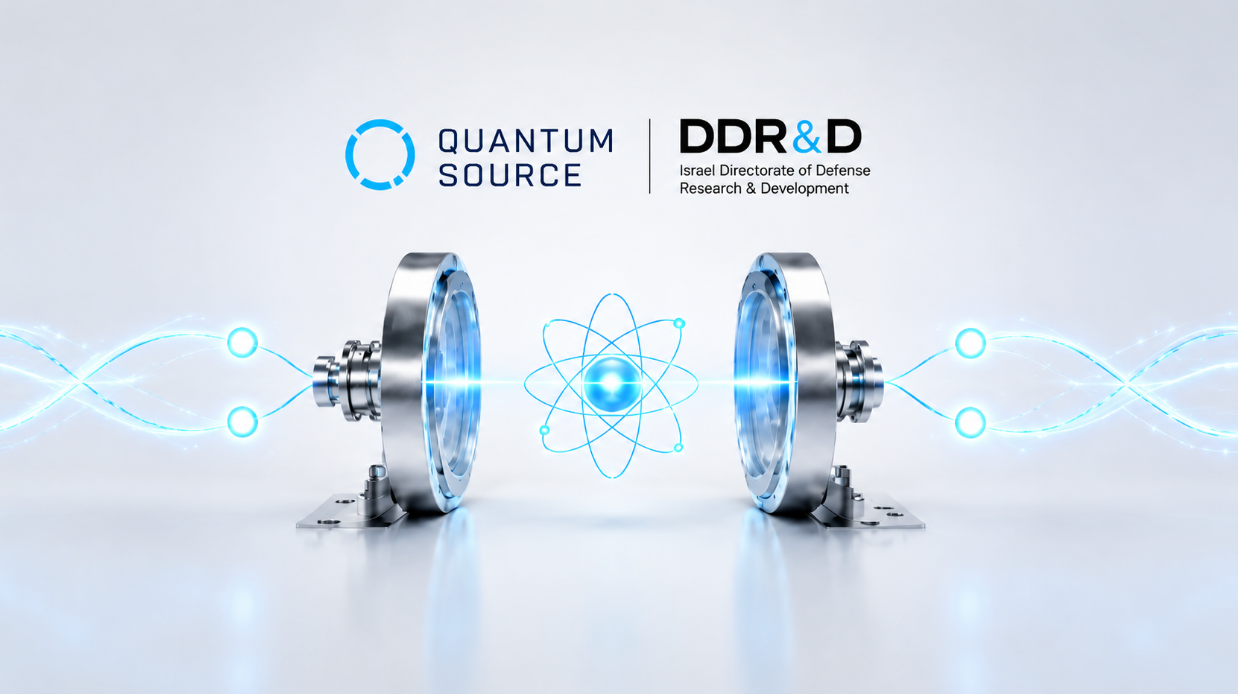
The team further demonstrated the exceptional resilience of this state by transmitting the photon pairs through more than one kilometer of standard optical fiber under arbitrary and continuously changing conditions, observing no measurable degradation in entanglement fidelity – without any active polarization stabilization, feedback, or channel calibration.The achievement represents a significant step toward practical quantum communication networks, where reliable distribution of entanglement over existing fiber infrastructure is essential. By eliminating the need for continuous compensation of environmental fluctuations, the technology simplifies deployment while improving robustness and scalability for real-world applications.Entangled photon pairs are a fundamental resource for quantum communication, quantum networking, distributed quantum computing, and future quantum internet architectures. Today, they are most commonly generated through probabilistic processes such as spontaneous parametric down-conversion (SPDC), where photon pairs are produced randomly and only a small fraction of generation attempts succeed. As the probability of generating pairs is increased, unwanted multiple-pair events also become more likely, reducing the fidelity of the entangled state and limiting system performance.In contrast, the Quantum Source platform generates entangled photon pairs deterministically. A single rubidium atom is strongly coupled to a microscopic optical cavity that dramatically enhances the interaction between the atom and individual photons. Upon receiving a trigger, the atom emits two photons in rapid succession — within only tens of nanoseconds – that are entangled from the moment they are created. Because each emission is initiated on demand, the system provides a reliable source of high-fidelity entangled photons suitable for scalable quantum technologies.“In probabilistic sources such as parametric down-conversion, there is a fundamental trade-off between brightness and fidelity,” said Prof. Barak Dayan, Chief Scientist at Quantum Source. “As the probability of generating a photon pair increases, so does the probability of accidental multiple-pair generation, which introduces errors. Once an application requires entangled pairs with both high probability and high fidelity — whether in a photonic quantum computer or across the nodes of a quantum network — a deterministic source becomes essential.”The photon pairs are generated in the singlet Bell state, one of the four maximally entangled Bell states and the only one that is invariant under identical polarization rotations experienced by both photons. Unlike the three triplet states, whose correlations depend on the measurement basis, the singlet state’s correlations remain unchanged regardless of the polarization basis used for measurement.This unique symmetry makes the singlet state naturally immune to the random polarization rotations introduced by optical fibers due to temperature variations, mechanical stress, bending, or environmental disturbances. As a result, entanglement can be distributed over long distances without the active stabilization systems that are typically required in quantum communication links.To validate this capability, the research team transmitted the entangled photon pairs through more than one kilometer of unstabilized optical fiber, corresponding to a photon propagation time exceeding five microseconds. Measurements performed after transmission showed no measurable degradation in entanglement fidelity compared with measurements taken directly at the source.“We deliberately introduced no compensation for the arbitrary and dynamic conditions in the fiber — no polarization stabilization, no dispersion correction, and no active feedback of any kind,” said Dayan. “The entanglement emerged from the other end of the fiber with essentially the same quality as when it entered. This remarkable robustness is a direct consequence of the symmetry of the singlet state and makes it exceptionally attractive for practical quantum communication systems operating outside the laboratory.”The combination of deterministic photon generation and intrinsic robustness to fiber-induced polarization fluctuations addresses two of the most significant engineering challenges facing quantum communication.The technology has the potential to simplify the deployment of metropolitan quantum networks, quantum key distribution (QKD) infrastructure, quantum repeater systems, distributed quantum computing architectures, and future quantum internet technologies. By removing the need for continuous polarization tracking and calibration, network complexity, operational costs, and maintenance requirements can be significantly reduced while improving long-term reliability.Beyond communications, deterministic entangled-photon sources are expected to play a central role in scalable photonic quantum computing, where millions of high-fidelity entangled photons must be generated with precise timing and synchronization.The demonstration highlights the growing maturity of Israel’s quantum ecosystem and showcases the successful collaboration between academia, industry, and government research organizations. The work represents an important milestone toward translating world-leading quantum science into deployable technologies with applications in secure communications, advanced computing, and national infrastructure.As quantum networks evolve from laboratory demonstrations to operational systems, deterministic and robust entangled-photon sources such as those developed by Quantum Source are expected to become foundational building blocks of future quantum information technologies.TopicsShare Get the latest research, company news, and market intelligence every week. MENTIONED IN THE ARTICLEMore in Research
Tags
Source Information
Discussion
0 professional contributions
Sign in to join this professional discussion.
Be the first to add a constructive contribution.