
Quantum Sensor Advance Could Transform Army Battlefield Signal Detection
Understand this faster with AI


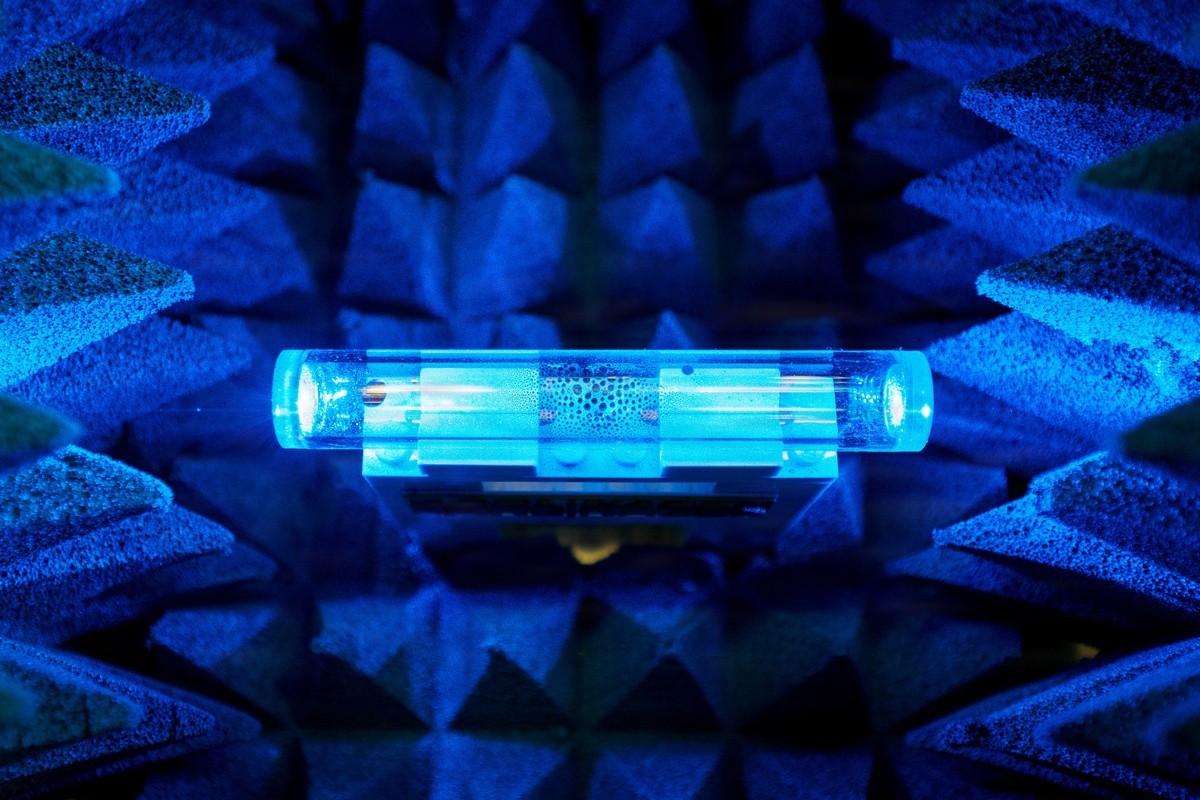
Insider Brief Scientists at the U.S. Army DEVCOM Army Research Laboratory demonstrated the first quantum sensor capable of measuring the full three-dimensional direction, polarization and propagation of radio-frequency electromagnetic fields. The Rydberg atom-based sensor operates across an exceptionally broad frequency range while remaining only a few centimeters in size, overcoming limitations of conventional antennas that are constrained by signal wavelength and bandwidth. Researchers reported that the sensor can identify the direction of incoming signals with an accuracy of about two degrees, a capability that could improve spectrum awareness, communications and decision-making in complex battlefield environments. Image: The rubidium vapor cell at the core of ARL’s Rydberg quantum sensor enables precise detection of radio-frequency signals that could give Soldiers improved situational awareness, more secure communications and faster decision-making on the battlefield. (U.S. Army) PRESS RELEASE — Army scientists achieved a major milestone in quantum sensing technology that could transform how electromagnetic signals are detected on the battlefield. For the first time, scientists at the U.S.
Army Combat Capabilities Development Command, known as DEVCOM, Army Research Laboratory demonstrated a quantum sensor that can measure the full 3D direction of radio-frequency electromagnetic fields. This breakthrough could provide the Army with tools to improve situational awareness, enhance secure communications and enable faster, more informed decision-making on the battlefield. “Our work in quantum science is about giving our Soldiers new ways to sense and understand the world around them,” said David Meyer, ARL research physicist. “This research opens the door to detecting and pinpointing signals over a broad frequency range in a single sensing package, even in the most challenging environments.” In the paper, published in Physical Review Applied, the researchers describe how their new sensor, based on Rydberg atoms, can determine not just the electromagnetic field strength but also the 3D polarization orientation and propagation direction, known as the k-vector. This is the first time such a measurement has been achieved using a quantum sensor. Traditional sensors can only measure the strength of an electromagnetic field in one direction at a time. The new ARL-developed sensor, however, can “see” the direction and motion of the electromagnetic field, providing a complete 3D picture. Unlike conventional antennas, which typically must be as large as the signals they detect and are often limited to narrow frequency ranges, ARL’s quantum sensor is independent of signal size, just a few centimeters across and can operate across the entire radio frequency spectrum. This property stems from the broadband capability of Rydberg atoms, which can operate from direct current to terahertz frequencies, and has been explored extensively by ARL scientists. Despite its small size, the sensor can pinpoint the direction of incoming signals with remarkable accuracy, down to about two degrees, creating an extremely flexible platform for signal detection. “The modern battlefield is an extremely complicated radio frequency environment,” Meyer said. “With the proliferation of autonomous systems, there can be hundreds of distinct signal sources. Having a single sensor platform that covers the entire radio-frequency spectrum and can measure the 3D direction of those fields represents a potentially transformative capability, especially in spectrum awareness. It is a great example of leveraging a quantum system’s unique properties to open new possibilities that aren’t possible with existing technology.” The sensor uses a tiny glass cell filled with a vapor of rubidium atoms. By shining lasers through the cell, researchers put the atoms into special Rydberg states, a highly excited state that makes them extremely sensitive to electric fields. When a radio wave passes through, the atoms react in a way that reveals not just the strength, but the full 3D direction and movement of the field. This means the sensor can not only detect the presence of a radio signal but also determine exactly where the signal is coming from and how it’s moving, in three dimensions. This latest advance builds on ARL’s previous work developing the Rydberg electrometer. In 2024, the team published results in Physical Review Applied demonstrating the sensor’s ability to measure the polarization of radio-frequency fields and even decode information encoded in the polarization. That research also showed how systematic effects, such as reflections within the vapor cell, could be corrected, paving the way for even more precise measurements. This achievement reflects ARL’s decades-long leadership in quantum research. Since the early 1990s, ARL and the DEVCOM Army Research Office have invested in quantum science, laying the groundwork for today’s breakthroughs in sensing, timing, and computing, and in 2023, the lab was designated as one of four Army Quantum Information Science Research Centers.
Matt Swayne LinkedIn With a several-decades long background in journalism and communications, Matt Swayne has worked as a science communicator for an R1 university for more than 12 years, specializing in translating high tech and deep tech for the general audience. He has served as a writer, editor and analyst at The Quantum Insider since its inception. In addition to his service as a science communicator, Matt also develops courses to improve the media and communications skills of scientists and has taught courses. matt@thequantuminsider.com Share this article:
Tags
Source Information
Discussion
0 professional contributions
Sign in to join this professional discussion.
Be the first to add a constructive contribution.