
Quantum Gravity May Be Far Less Quantum Than Physicists Expected
Understand this faster with AI


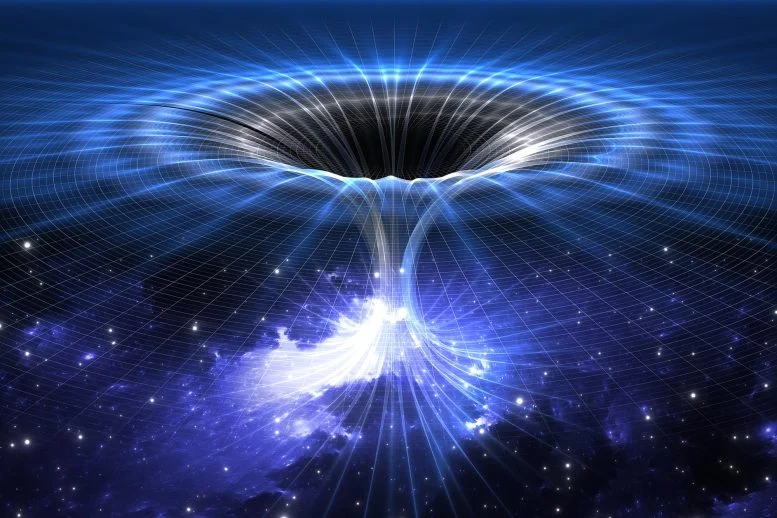
Physicists have long assumed that uniting quantum mechanics with gravity would require spacetime itself to behave quantum mechanically. A new theoretical framework suggests that some apparent signs of “quantum gravity” may instead be explained by quantum particles moving through ordinary spacetime, raising new questions about what future experiments must actually detect. Credit: ShutterstockA new study reveals that some proposed signatures of quantum gravity may have an unexpected classical explanation.Imagine placing an object in two locations at once. Quantum mechanics allows such a possibility, at least for sufficiently small systems. But if the object occupies multiple positions, what happens to the gravity surrounding it?That question lies at the center of one of physics’ most persistent problems. Quantum mechanics describes atoms, particles, and other microscopic systems with remarkable accuracy, while Einstein’s theory of gravity explains planets, stars, black holes, and the expansion of the Universe. Physicists still lack a single theory of “quantum gravity” that can describe both realms together.Quantum mechanics allows an object to become delocalized, meaning its possible location is spread across more than one place. Experiments have demonstrated this behavior with atoms and even small pieces of metal. Einstein’s theory, meanwhile, treats gravity as the shape of space and time itself. Spacetime can curve, remain flat, or carry waves, as gravitational wave detectors have confirmed.If an object can occupy several quantum states at once, many physicists expect the surrounding spacetime to do the same. The difficulty is determining what evidence would distinguish that possibility from ordinary gravity acting on a quantum object.But what would such a situation actually look like?Quantum gravity may have a lookalikeResearchers from Kyushu University, the University of Waterloo, and Stockholm University addressed this problem by examining how proposed quantum gravity experiments can be interpreted. Their work, published in npj Quantum Information, shows that some apparently quantum forms of gravity may have an alternative description.They developed a theoretical framework showing that many situations labeled a “quantum superposition of gravity” can also be understood as quantum particles occupying superpositions while moving through ordinary gravity and spacetime. Under that second description, the particles behave quantum mechanically, but gravity itself does not need to display an observable quantum signature.A quantum superposition of gravitational fields or spacetimes (top) and a “test” particle in a quantum superposition of locations in an ordinary gravitational field (bottom). The gravitational field could be that produced by a star, black hole, or even another quantum “source” particle. Credit: Joshua Foo/Kyushu UniversityThis equivalence creates a challenge for experiments. A result that appears to show gravity occupying several states might also emerge from familiar spacetime combined with the quantum behavior of matter.“Many researchers have proposed experiments that could potentially reveal the quantum nature of gravity,” explains Associate Professor Joshua Foo of Kyushu University’s Institute for Advanced Study and lead author of the study. “What we found is that some of these scenarios can be viewed from two equally valid perspectives. One interpretation describes gravity as being in a quantum superposition, while the other describes quantum particles moving in an ordinary gravitational field.”Two descriptions can fit one resultThe researchers call the concept the “Relativity of Spacetime Superpositions.” The central idea is that the same physical situation can sometimes be represented in two different ways, much as different map projections can depict the same landscape.From one perspective, gravity and spacetime appear to occupy a quantum superposition. From another, gravity remains classical while each particle’s movement is assigned the appropriate quantum state. Although the mathematical descriptions differ, they can lead to the same observable result.That does not establish that gravity is classical, and it does not argue against quantum gravity. Instead, it exposes a problem of interpretation. An experiment may produce a result consistent with quantum gravity without showing that a quantum description of gravity is the only possible explanation.“Our work does not tell us that such experiments rule out quantum gravity,” says Magdalena Zych of Stockholm University and a co-author on the paper. “Rather, it helps us identify which experimental signatures would genuinely require a quantum description of gravity and which ones could arise from more familiar physics. That distinction is crucial for designing future experiments.”Future tests must rule out classical gravityThe framework gives physicists a clearer standard for evaluating proposed tests. Rather than asking only whether a result can be described using quantum gravity, researchers must determine whether ordinary gravity combined with quantum matter could produce the same observation.That distinction can help narrow the experimental search. Measurements that remain explainable through classical spacetime cannot provide unambiguous evidence that gravity itself follows quantum rules. More decisive tests will need to isolate signatures that no classical description can reproduce.The immediate goal is theoretical, but research into fundamental physics has often produced practical consequences that were not apparent at the outset. GPS navigation depends on Einstein’s theory of gravity, while lasers and modern electronics grew from advances in quantum physics.For now, the framework serves as a guide for designing and interpreting experiments aimed at one of modern physics’ most difficult questions. By identifying where classical and quantum explanations overlap, it helps researchers focus on observations that could genuinely separate them.“Understanding how gravity and quantum mechanics fit together is one of the greatest challenges in physics,” concludes Foo. “Before we can test gravity’s quantum nature, we first need to know what evidence would prove that we’ve found it. Our work helps clarify that question.”Reference: “Relativity and decoherence of spacetime superpositions” by Joshua Foo, Cendikiawan Suryaatmadja, Robert B. Mann and Magdalena Zych, 13 May 2026, npj Quantum Information. DOI: 10.1038/s41534-026-01234-xNever miss a breakthrough: Join the SciTechDaily newsletter.Follow us on Google and Google News.
Tags
Source Information
Discussion
0 professional contributions
Sign in to join this professional discussion.
Be the first to add a constructive contribution.